Senate Judiciary opens hearing on HB 93 to tighten residency for hunting, fishing and trapping
February 16, 2026 | 2026 Legislature Alaska, Alaska
This article was created by AI summarizing key points discussed. AI makes mistakes, so for full details and context, please refer to the video of the full meeting. Please report any errors so we can fix them. Report an error »
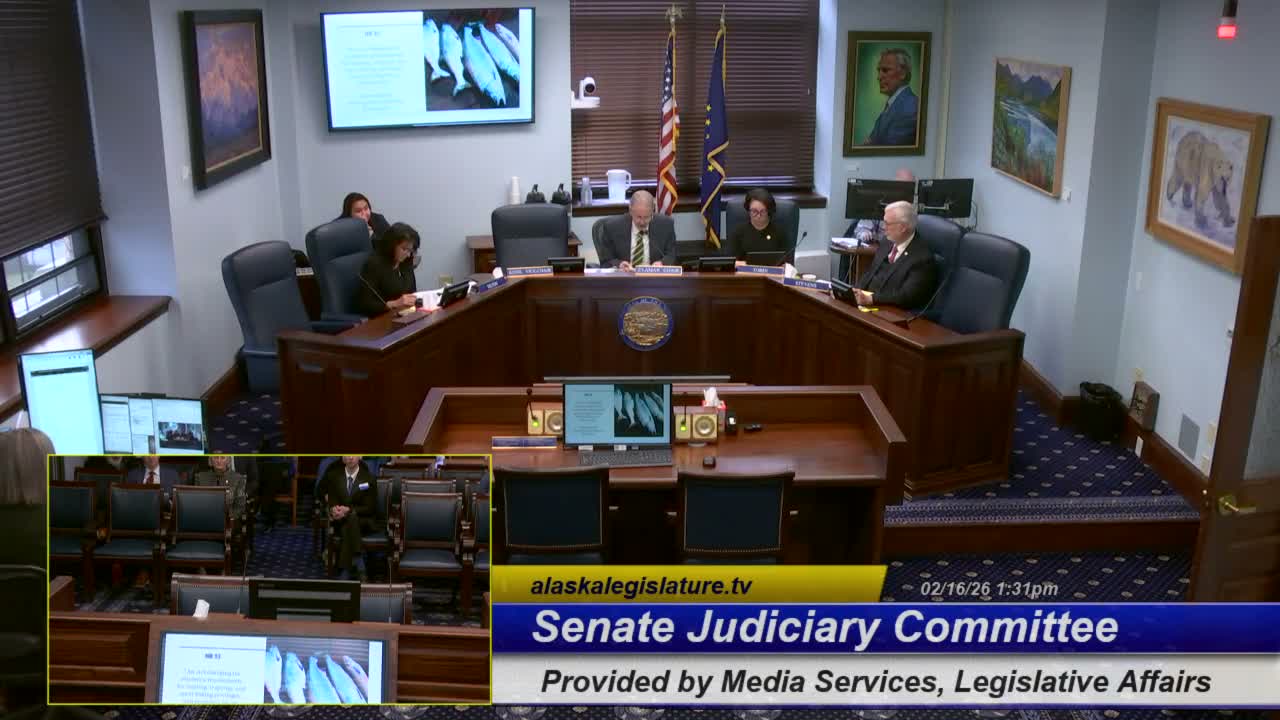
Juneau — The Alaska Senate Judiciary Committee on Monday took testimony on House Bill 93, a proposal to tighten who qualifies for resident hunting, fishing and trapping licenses by aligning the residency test more closely with the Permanent Fund Dividend (PFD) rules.
Representative Rebecca Himshut, sponsor of HB 93, told the committee the bill keeps the current core tests — physical presence, intent to remain indefinitely, a 12‑month domicile and no claim of residency elsewhere — but would add a requirement that applicants be physically present in Alaska during the 12 consecutive months immediately preceding the application unless an absence fits the PFD allowable‑absence list. "You have to be physically present in the state, and you have to intend to remain indefinitely and to make a home here," Himshut said during her presentation.
Himshut and staff argued the change is aimed at enforceability. They told senators that residency disputes tied to licenses can take as long to investigate as serious criminal matters and that using the PFD framework — where the Permanent Fund Division already adjudicates residency — would create a consistent, administrable standard.
Law enforcement testimony described the penalties for false claims. Major Aaron Frenzel, deputy director of the Alaska Wildlife Troopers (participating online), said consequences vary with the violation. "Those are strict liability offenses... That's a $300 violation, I believe," Frenzel said of some false‑statement charges; he added that cases that enable overlimits or violations of guide requirements can lead to class A misdemeanor charges.
Invited and public testimony showed a sharp divide. Tribal and rural witnesses urged support for HB 93 as a conservation and subsistence protection measure. Quentin Cook, a tribal leader representing Southeast Alaska communities, said aligning hunting and fishing residency with PFD standards would protect subsistence access and local food security for communities that depend on resident harvest privileges.
Local guides, commercial fishermen and advisory‑committee members also voiced support, saying seasonal or part‑time residents and some nonresidents were using in‑state addresses to obtain resident licenses and larger bag limits. "The laws need to change," said Laith Wilson, a game advisory committee chair who described commercial transport and medevac operations in Southeast Alaska.
Opponents warned the bill could sweep up legitimate residents who spend extended time out of state for work, medical care or other reasons. United Airlines pilot Walter Reicher said the measure "would force Alaskans to choose between their profession and their heritage" and urged an explicit exemption for aircrew. Other speakers, including seniors and seasonal workers who take long contracts outside Alaska, said tying license eligibility to PFD rules could unintentionally deny hunting and fishing privileges to long‑term residents who maintain Arizona or other out‑of‑state work for part of the year.
Committee members asked about specific implementation details: whether the bill affects voting rights (the sponsor said it does not), how the license application would change (sponsor said applicants would still use the same online application but would attest they meet the updated residency requirements), and whether draft registration or other PFD requirements would be mirrored (the sponsor said some PFD elements, such as selective‑service registration, would not be adopted for licenses).
Several witnesses urged amendments or parallel legislation to protect certain occupations. Representative Himshut said she is a cosponsor of a separate House bill intended to add exemptions for pilots and others who work out of state for their jobs.
The committee did not vote on HB 93. Chair Klayman said the committee would "hold House Bill 93 for further review," scheduled its next meeting and adjourned without taking final action.
What’s next: The committee left HB 93 under consideration; sponsors and supporters may pursue amendments addressing exemptions raised by pilots, long‑term residents and some advisory groups. Public written comments submitted to the committee will be added to the record.
Representative Rebecca Himshut, sponsor of HB 93, told the committee the bill keeps the current core tests — physical presence, intent to remain indefinitely, a 12‑month domicile and no claim of residency elsewhere — but would add a requirement that applicants be physically present in Alaska during the 12 consecutive months immediately preceding the application unless an absence fits the PFD allowable‑absence list. "You have to be physically present in the state, and you have to intend to remain indefinitely and to make a home here," Himshut said during her presentation.
Himshut and staff argued the change is aimed at enforceability. They told senators that residency disputes tied to licenses can take as long to investigate as serious criminal matters and that using the PFD framework — where the Permanent Fund Division already adjudicates residency — would create a consistent, administrable standard.
Law enforcement testimony described the penalties for false claims. Major Aaron Frenzel, deputy director of the Alaska Wildlife Troopers (participating online), said consequences vary with the violation. "Those are strict liability offenses... That's a $300 violation, I believe," Frenzel said of some false‑statement charges; he added that cases that enable overlimits or violations of guide requirements can lead to class A misdemeanor charges.
Invited and public testimony showed a sharp divide. Tribal and rural witnesses urged support for HB 93 as a conservation and subsistence protection measure. Quentin Cook, a tribal leader representing Southeast Alaska communities, said aligning hunting and fishing residency with PFD standards would protect subsistence access and local food security for communities that depend on resident harvest privileges.
Local guides, commercial fishermen and advisory‑committee members also voiced support, saying seasonal or part‑time residents and some nonresidents were using in‑state addresses to obtain resident licenses and larger bag limits. "The laws need to change," said Laith Wilson, a game advisory committee chair who described commercial transport and medevac operations in Southeast Alaska.
Opponents warned the bill could sweep up legitimate residents who spend extended time out of state for work, medical care or other reasons. United Airlines pilot Walter Reicher said the measure "would force Alaskans to choose between their profession and their heritage" and urged an explicit exemption for aircrew. Other speakers, including seniors and seasonal workers who take long contracts outside Alaska, said tying license eligibility to PFD rules could unintentionally deny hunting and fishing privileges to long‑term residents who maintain Arizona or other out‑of‑state work for part of the year.
Committee members asked about specific implementation details: whether the bill affects voting rights (the sponsor said it does not), how the license application would change (sponsor said applicants would still use the same online application but would attest they meet the updated residency requirements), and whether draft registration or other PFD requirements would be mirrored (the sponsor said some PFD elements, such as selective‑service registration, would not be adopted for licenses).
Several witnesses urged amendments or parallel legislation to protect certain occupations. Representative Himshut said she is a cosponsor of a separate House bill intended to add exemptions for pilots and others who work out of state for their jobs.
The committee did not vote on HB 93. Chair Klayman said the committee would "hold House Bill 93 for further review," scheduled its next meeting and adjourned without taking final action.
What’s next: The committee left HB 93 under consideration; sponsors and supporters may pursue amendments addressing exemptions raised by pilots, long‑term residents and some advisory groups. Public written comments submitted to the committee will be added to the record.
Don't Miss a Word: See the Full Meeting!
Go beyond summaries. Unlock every video, transcript, and key insight with a Founder Membership.
✓
Get instant access to full meeting videos
✓
Search and clip any phrase from complete transcripts
✓
Receive AI-powered summaries & custom alerts
✓
Enjoy lifetime, unrestricted access to government data
30-day money-back guarantee
