Alaska ARM board shortens amortization to 15 years, lowers payroll growth assumptions to align funding projections
February 16, 2026 | 2026 Legislature Alaska, Alaska
This article was created by AI summarizing key points discussed. AI makes mistakes, so for full details and context, please refer to the video of the full meeting. Please report any errors so we can fix them. Report an error »
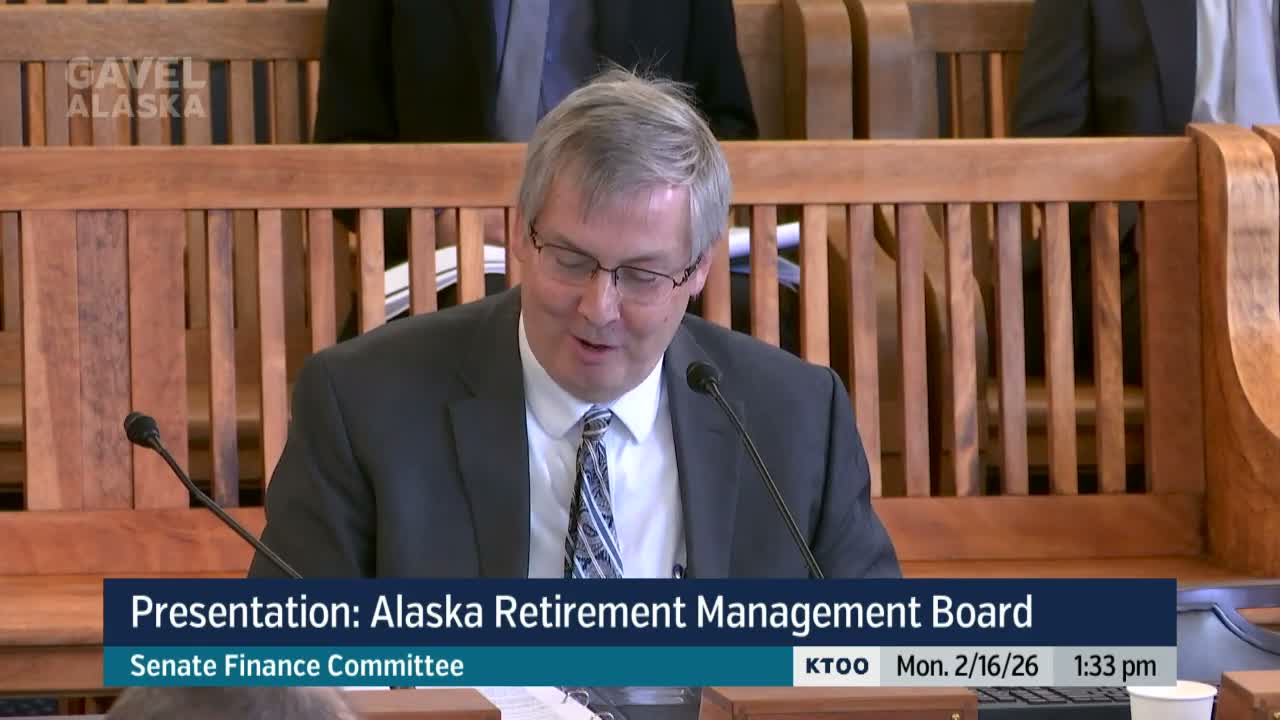
Brian Williams, chair of the Alaska Retirement Management Board, told the Senate Finance Committee on Feb. 16 that the board has shifted new unfunded liability layers from a 25‑year schedule to 15‑year layering and updated payroll growth assumptions to better match recent experience.
"Meeting our 7.25% return assumption is an important piece of funding these pensions," Williams said, explaining the role of the assumed investment return in the actuarial funding equation. He asked the committee to consider both the standard 7.25% discount and an alternate inflation‑only view that makes the implicit value of future investment earnings visible.
Williams and the board argued the changes were needed because earlier assumptions and layering practice pushed substantial debt beyond the board's target payoff year. Using a 25‑year layering approach in recent years, Williams said, produced situations where "you have to pay for 21 years to pay off half of it," and that a 15‑year layer pays off the layer fully in 15 years and limits the risk of turning a finite payoff plan into an open‑ended obligation.
The board reported that under the 15‑year layering policy, the amount of employer obligations projected to extend past 2039 would drop materially (the board presented a projection that PERS obligations past the target date fall from roughly $122 million under 25‑year layers to about $8 million under 15‑year layers). The board also quantified nominal savings in a comparison shown to the committee: roughly $220 million in total savings under 15‑year layers versus continuing 25‑year layers, while stressing the primary benefit is lower long‑term risk.
On payroll growth, Williams said the ARM board examined recent data and set the payroll growth assumption in 2025 to 2% for PERS and 1% for TERS, citing geometric averages of recent experience (PERS ~2.9% over ten years, TERS ~0.76%). "We set PERS to 2% and TERS to 1%, which is better aligned with what our actual experience is," he said.
Committee members pressed the board on practical impacts. Senator Stedman noted the board recommended an additional state contribution totaling $270 million while the administration's budget proposes $232 million; "It's about $40,000,000 and the 40,000,000 is not an easy number to get to here at the table," Stedman said. Williams responded that the board adopted its assumptions and the 15‑year layering policy unanimously and acknowledged there is a separate budget process involving the governor and the Legislature.
Williams emphasized smoothing and risk management: the ARM board uses a five‑year recognition schedule to phase gains and losses so employers and the state avoid sudden contribution spikes. He showed rolling return history (1‑ through 30‑year windows) to illustrate that volatility compresses over longer periods and that long‑term means sit near the board's 7.25% assumption.
Next steps: Williams said the board implemented the 15‑year layering policy in 2025, will continue to monitor payroll and market experience, and will work with the administration and the Legislature during the budget process on contribution funding levels.
"Meeting our 7.25% return assumption is an important piece of funding these pensions," Williams said, explaining the role of the assumed investment return in the actuarial funding equation. He asked the committee to consider both the standard 7.25% discount and an alternate inflation‑only view that makes the implicit value of future investment earnings visible.
Williams and the board argued the changes were needed because earlier assumptions and layering practice pushed substantial debt beyond the board's target payoff year. Using a 25‑year layering approach in recent years, Williams said, produced situations where "you have to pay for 21 years to pay off half of it," and that a 15‑year layer pays off the layer fully in 15 years and limits the risk of turning a finite payoff plan into an open‑ended obligation.
The board reported that under the 15‑year layering policy, the amount of employer obligations projected to extend past 2039 would drop materially (the board presented a projection that PERS obligations past the target date fall from roughly $122 million under 25‑year layers to about $8 million under 15‑year layers). The board also quantified nominal savings in a comparison shown to the committee: roughly $220 million in total savings under 15‑year layers versus continuing 25‑year layers, while stressing the primary benefit is lower long‑term risk.
On payroll growth, Williams said the ARM board examined recent data and set the payroll growth assumption in 2025 to 2% for PERS and 1% for TERS, citing geometric averages of recent experience (PERS ~2.9% over ten years, TERS ~0.76%). "We set PERS to 2% and TERS to 1%, which is better aligned with what our actual experience is," he said.
Committee members pressed the board on practical impacts. Senator Stedman noted the board recommended an additional state contribution totaling $270 million while the administration's budget proposes $232 million; "It's about $40,000,000 and the 40,000,000 is not an easy number to get to here at the table," Stedman said. Williams responded that the board adopted its assumptions and the 15‑year layering policy unanimously and acknowledged there is a separate budget process involving the governor and the Legislature.
Williams emphasized smoothing and risk management: the ARM board uses a five‑year recognition schedule to phase gains and losses so employers and the state avoid sudden contribution spikes. He showed rolling return history (1‑ through 30‑year windows) to illustrate that volatility compresses over longer periods and that long‑term means sit near the board's 7.25% assumption.
Next steps: Williams said the board implemented the 15‑year layering policy in 2025, will continue to monitor payroll and market experience, and will work with the administration and the Legislature during the budget process on contribution funding levels.
Don't Miss a Word: See the Full Meeting!
Go beyond summaries. Unlock every video, transcript, and key insight with a Founder Membership.
✓
Get instant access to full meeting videos
✓
Search and clip any phrase from complete transcripts
✓
Receive AI-powered summaries & custom alerts
✓
Enjoy lifetime, unrestricted access to government data
30-day money-back guarantee
