ARM board recommends four changes to defined contribution retiree medical and disability coverage; offers HRA forfeiture as a funding option
February 16, 2026 | 2026 Legislature Alaska, Alaska
This article was created by AI summarizing key points discussed. AI makes mistakes, so for full details and context, please refer to the video of the full meeting. Please report any errors so we can fix them. Report an error »
Brian Williams, chair of the Alaska Retirement Management Board, presented four resolutions to the Senate Finance Committee on Feb. 16 that the board says would address gaps in retiree medical and disability coverage for defined contribution members.
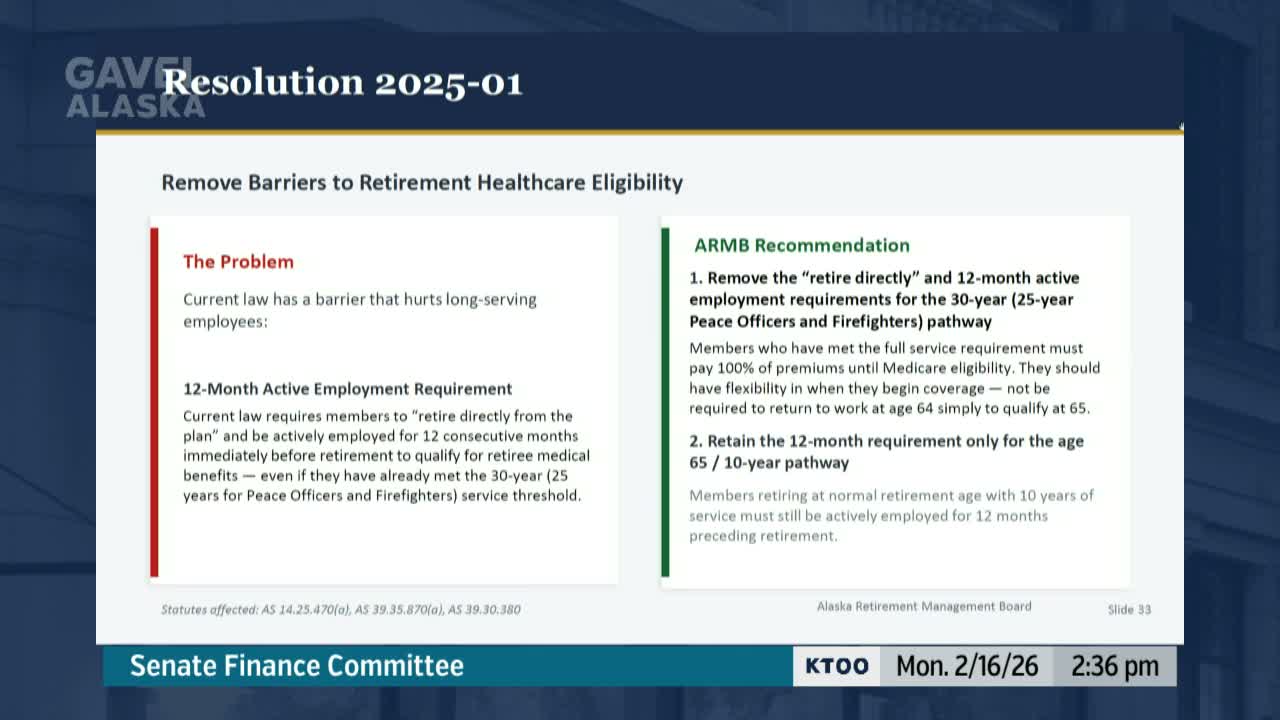
Resolution 2025‑01 would remove the requirement that a defined contribution (DC) member must retire directly from a covered position and be employed for 12 consecutive months immediately before retirement to qualify for retiree medical if they have completed 30 years of service (25 years for peace officers and firefighters). Williams told the committee, "If someone has given the state 30 years of service, they've earned the benefit. They shouldn't have to go find a covered job at age 64 to check a box."
Resolution 2025‑02 proposes reducing years‑of‑service thresholds with three options: 25 years for all employees; a 25/20 split (25 for some groups, 20 for others); or 20 years for all. Williams said the board's actuarial analysis used 2023 valuations but that the board will update cost estimates with the 2025 valuation. He noted prior analysis that the 20‑year option was previously estimated at about $4.75 billion based on older valuations and that the absolute dollar cost would be higher with updated liabilities.
To help fund a lower service‑threshold option, the board proposed a one‑time transfer from expected forfeited balances in the health reimbursement arrangement (HRA) trust. Williams cited numbers: as of June 2025, 56,770 former members who left before vesting hold $334 million in unvested HRA balances, and the board conservatively estimates roughly $285 million of that pool is likely permanently forfeited. The board sized a one‑time transfer for the 20‑year option at roughly $50 million in earlier analysis and said the forfeiture pool could cover that amount without touching active or vested accounts.
A separate resolution would add health care benefits for disabled DC members (pre‑Medicare) and extend non‑occupational disability income to DC members with at least 10 years of service. Williams cautioned that adding pre‑Medicare health care would draw from the retiree medical trust and that instituting both the service‑reduction and disability proposals simultaneously would increase costs; he gave a tentative combined cost figure in one scenario of about $110 million.
Williams emphasized the board's conservative approach to analysis and its intention to update resolution costings using 2025 actuarial valuations. He said the board will continue to refine proposals and work with the Legislature on options that balance coverage improvements and fiscal constraints.
Next steps: ARM board staff will finalize updated actuarial analyses and return to the Legislature with revised cost estimates and bill language as appropriate.
Resolution 2025‑01 would remove the requirement that a defined contribution (DC) member must retire directly from a covered position and be employed for 12 consecutive months immediately before retirement to qualify for retiree medical if they have completed 30 years of service (25 years for peace officers and firefighters). Williams told the committee, "If someone has given the state 30 years of service, they've earned the benefit. They shouldn't have to go find a covered job at age 64 to check a box."
Resolution 2025‑02 proposes reducing years‑of‑service thresholds with three options: 25 years for all employees; a 25/20 split (25 for some groups, 20 for others); or 20 years for all. Williams said the board's actuarial analysis used 2023 valuations but that the board will update cost estimates with the 2025 valuation. He noted prior analysis that the 20‑year option was previously estimated at about $4.75 billion based on older valuations and that the absolute dollar cost would be higher with updated liabilities.
To help fund a lower service‑threshold option, the board proposed a one‑time transfer from expected forfeited balances in the health reimbursement arrangement (HRA) trust. Williams cited numbers: as of June 2025, 56,770 former members who left before vesting hold $334 million in unvested HRA balances, and the board conservatively estimates roughly $285 million of that pool is likely permanently forfeited. The board sized a one‑time transfer for the 20‑year option at roughly $50 million in earlier analysis and said the forfeiture pool could cover that amount without touching active or vested accounts.
A separate resolution would add health care benefits for disabled DC members (pre‑Medicare) and extend non‑occupational disability income to DC members with at least 10 years of service. Williams cautioned that adding pre‑Medicare health care would draw from the retiree medical trust and that instituting both the service‑reduction and disability proposals simultaneously would increase costs; he gave a tentative combined cost figure in one scenario of about $110 million.
Williams emphasized the board's conservative approach to analysis and its intention to update resolution costings using 2025 actuarial valuations. He said the board will continue to refine proposals and work with the Legislature on options that balance coverage improvements and fiscal constraints.
Next steps: ARM board staff will finalize updated actuarial analyses and return to the Legislature with revised cost estimates and bill language as appropriate.
View the Full Meeting & All Its Details
This article offers just a summary. Unlock complete video, transcripts, and insights as a Founder Member.
✓
Watch full, unedited meeting videos
✓
Search every word spoken in unlimited transcripts
✓
AI summaries & real-time alerts (all government levels)
✓
Permanent access to expanding government content
30-day money-back guarantee
