Bill would redirect employer UI tax revenue into workforce training while preserving solvency triggers
February 16, 2026 | 2026 Legislature Alaska, Alaska
This article was created by AI summarizing key points discussed. AI makes mistakes, so for full details and context, please refer to the video of the full meeting. Please report any errors so we can fix them. Report an error »
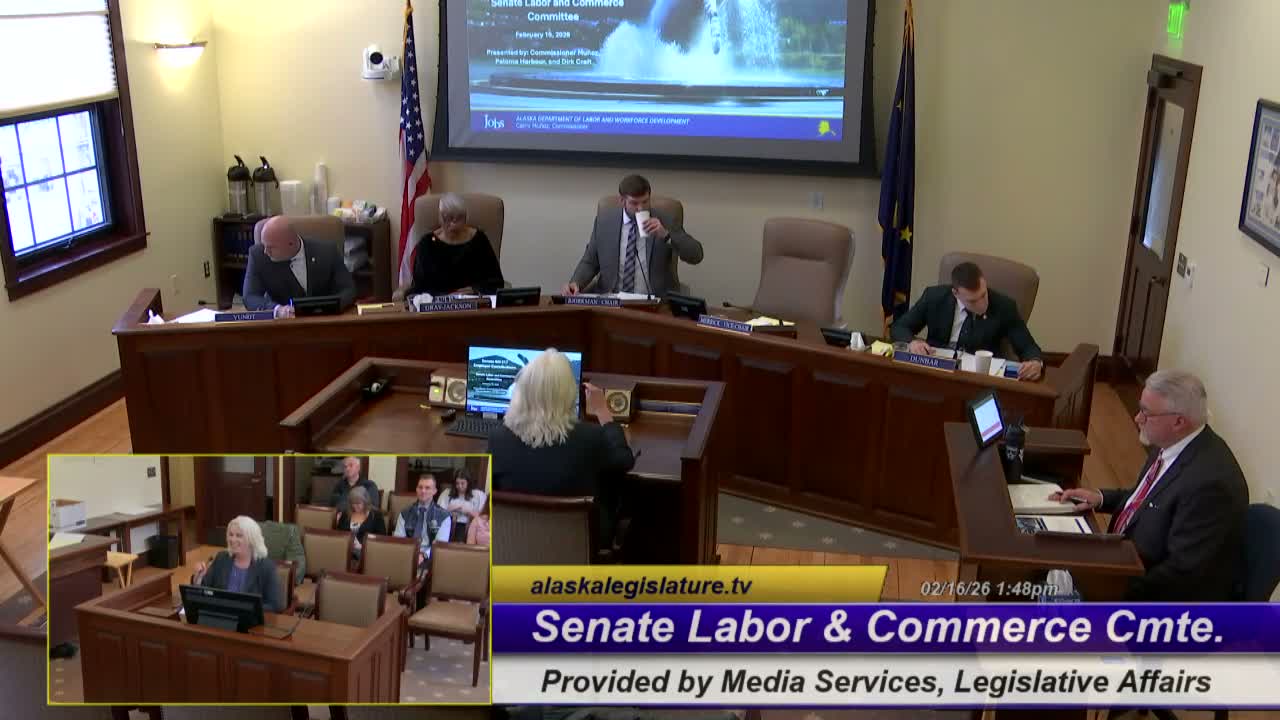
Commissioner Kathy Munoz of the Alaska Department of Labor and Workforce Development presented Senate Bill 217 to the Senate Labor and Commerce Committee on Feb. 16, 2026, proposing to use excess Unemployment Insurance (UI) tax revenue to fund workforce training while preserving the UI trust fund’s solvency.
Munoz told the committee SB217 would remove the statutory 1% employer minimum tax in rate classes 1–20 and replace it with a 0.4% employer STEP (State Training and Employment Program) tax, projected to generate about $45 million per year for workforce development grants distributed through Alaska’s 14 job centers. She said the mechanism would route the 0.4% to STEP until the UI trust fund reached a target solvency balance (discussed in testimony as about $550 million), at which point employer contributions would revert to the UI trust fund.
Paloma Harbor, director of the Division of Employment and Training Services, reviewed UI trust fund history and flows. Harbor said the trust balance recovered after the pandemic and, as of November 2025, stood at roughly $821 million—exceeding statutory solvency targets (described in testimony as a 3%–3.3% wage ratio). Harbor gave FY25 revenue figures (STEP ~$10.8 million, TVEP ~$27.1 million, UI ~$125 million) and said benefit costs were about $40 million in the period cited. She presented projections showing STEP revenue rising under SB217 and UI revenue falling, with modeling through 2040 indicating timing (under baseline assumptions) for when employers might have to recontribute to UI.
Dirk Craft, executive director of the Alaska Workforce Investment Board (AWIB), described how AWIB administers STEP through a competitive RFA process, explained performance safeguards, and said increased STEP funding would help offset rising administrative and delivery costs that limit provider capacity. Craft and Harbor answered senators’ questions about interest earnings (Harbor said UI trust interest remains with the trust and was about $22 million in FY25; STEP interest flows to the general fund), the effect of raising UI benefit levels on solvency timing, and why employers would bear a larger share of STEP contributions (Harbor noted employees already contribute a small share to training and that Alaska is one of few states with employee UI contributions).
Committee members pressed the presenters on modeling assumptions and timelines for when employer contributions would resume to UI if benefit levels or economic conditions changed. No formal vote occurred; Chair Sen. Bjorkman set SB217 aside for further consideration at a future hearing.
Munoz told the committee SB217 would remove the statutory 1% employer minimum tax in rate classes 1–20 and replace it with a 0.4% employer STEP (State Training and Employment Program) tax, projected to generate about $45 million per year for workforce development grants distributed through Alaska’s 14 job centers. She said the mechanism would route the 0.4% to STEP until the UI trust fund reached a target solvency balance (discussed in testimony as about $550 million), at which point employer contributions would revert to the UI trust fund.
Paloma Harbor, director of the Division of Employment and Training Services, reviewed UI trust fund history and flows. Harbor said the trust balance recovered after the pandemic and, as of November 2025, stood at roughly $821 million—exceeding statutory solvency targets (described in testimony as a 3%–3.3% wage ratio). Harbor gave FY25 revenue figures (STEP ~$10.8 million, TVEP ~$27.1 million, UI ~$125 million) and said benefit costs were about $40 million in the period cited. She presented projections showing STEP revenue rising under SB217 and UI revenue falling, with modeling through 2040 indicating timing (under baseline assumptions) for when employers might have to recontribute to UI.
Dirk Craft, executive director of the Alaska Workforce Investment Board (AWIB), described how AWIB administers STEP through a competitive RFA process, explained performance safeguards, and said increased STEP funding would help offset rising administrative and delivery costs that limit provider capacity. Craft and Harbor answered senators’ questions about interest earnings (Harbor said UI trust interest remains with the trust and was about $22 million in FY25; STEP interest flows to the general fund), the effect of raising UI benefit levels on solvency timing, and why employers would bear a larger share of STEP contributions (Harbor noted employees already contribute a small share to training and that Alaska is one of few states with employee UI contributions).
Committee members pressed the presenters on modeling assumptions and timelines for when employer contributions would resume to UI if benefit levels or economic conditions changed. No formal vote occurred; Chair Sen. Bjorkman set SB217 aside for further consideration at a future hearing.
View the Full Meeting & All Its Details
This article offers just a summary. Unlock complete video, transcripts, and insights as a Founder Member.
✓
Watch full, unedited meeting videos
✓
Search every word spoken in unlimited transcripts
✓
AI summaries & real-time alerts (all government levels)
✓
Permanent access to expanding government content
30-day money-back guarantee
