Senate education panel hears bill to codify Indigenous cultural education; SB 210 held for later date
February 16, 2026 | 2026 Legislature Alaska, Alaska
This article was created by AI summarizing key points discussed. AI makes mistakes, so for full details and context, please refer to the video of the full meeting. Please report any errors so we can fix them. Report an error »
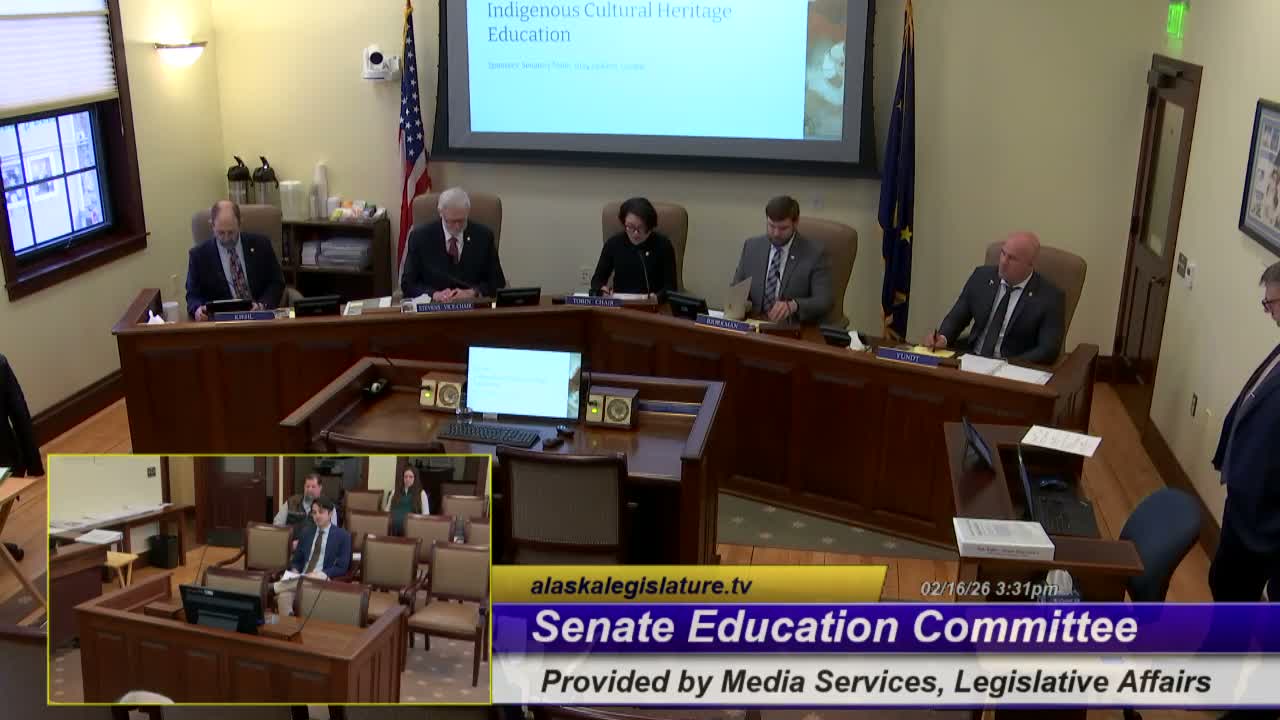
JUNEAU, Alaska — The Senate Education Committee on Monday heard testimony on Senate Bill 210, an effort to codify Indigenous cultural heritage education and tribal consultation into state education policy.
Senator Lukey Tobin, sponsor of SB 210, told the committee the measure would “affirm every child's right to learn about the place in which they live,” and would elevate place‑based and culturally responsive teaching already in practice in many Alaska districts into state statute.
SB 210, as presented by Jason Ritter (staff to Senator Tobin), would require schools to consult with local tribes and, when appropriate, enter contracts so tribal communities can help shape what is taught and how. Ritter said the bill is designed to align assessment with instruction and to protect time for land‑ and story‑based learning. “Fewer than 5% of Alaska public school teachers are Indigenous, while nearly 20% of students are,” Ritter said, arguing that the bill’s provisions would help build belonging and improve outcomes.
Invited testimony came from educators and education groups who voiced strong support. Terry Walker, superintendent of the Northwest Arctic Borough School District, said his district is developing a place‑based science curriculum grounded in Native ways of knowing and aligned with state standards and urged lawmakers to pass SB 210. “Implementing a place‑based education tied to local environment and community projects will help our students achieve successful outcomes,” Walker said.
Melinda Chase, director of the Association of Interior Native Educators, described long‑standing regional work on cultural curricula and professional development, and backed the bill’s emphasis on contracting and formal tribal collaboration to ensure regional authenticity. “A collaborative approach with tribes and a formal agreement can provide a level of rigor with what’s accurate for each region and each community,” Chase said.
Lon Garrison, executive director of the Association of Alaska School Boards, provided public testimony in support and noted that codifying tribal consultation in statute would clarify local boards’ responsibilities and support genuine consultation practices required under federal law.
Committee members asked clarifying questions about implementation and student outcomes; Superintendent Walker said he would follow up with district‑level data on post‑graduation outcomes. Ritter summarized the bill’s sectional analysis, telling the committee the language adds a statutory subsection to require direct school‑tribe collaboration so local Alaska Native and American Indian history and culture is accurately represented in curriculum.
There was no vote. After closing remarks, Senator Tobin said he would hold SB 210 to a later date and invited colleagues to submit amendments or concerns to the sponsor. The committee announced a joint House and Senate education committee meeting scheduled for Feb. 18 at 8 a.m. in the Davis Committee Room as part of the Alaska Municipal League winter legislative conference. The committee adjourned at 4:07 p.m.
Why it matters: Supporters said SB 210 aims to reduce cultural mismatch in classrooms, improve engagement and academic outcomes for Alaska Native students and ensure teacher preparation, assessment and curricula reflect local knowledge and heritage. Opponents or alternative views were not recorded during this hearing; the committee did not act on the bill.
Senator Lukey Tobin, sponsor of SB 210, told the committee the measure would “affirm every child's right to learn about the place in which they live,” and would elevate place‑based and culturally responsive teaching already in practice in many Alaska districts into state statute.
SB 210, as presented by Jason Ritter (staff to Senator Tobin), would require schools to consult with local tribes and, when appropriate, enter contracts so tribal communities can help shape what is taught and how. Ritter said the bill is designed to align assessment with instruction and to protect time for land‑ and story‑based learning. “Fewer than 5% of Alaska public school teachers are Indigenous, while nearly 20% of students are,” Ritter said, arguing that the bill’s provisions would help build belonging and improve outcomes.
Invited testimony came from educators and education groups who voiced strong support. Terry Walker, superintendent of the Northwest Arctic Borough School District, said his district is developing a place‑based science curriculum grounded in Native ways of knowing and aligned with state standards and urged lawmakers to pass SB 210. “Implementing a place‑based education tied to local environment and community projects will help our students achieve successful outcomes,” Walker said.
Melinda Chase, director of the Association of Interior Native Educators, described long‑standing regional work on cultural curricula and professional development, and backed the bill’s emphasis on contracting and formal tribal collaboration to ensure regional authenticity. “A collaborative approach with tribes and a formal agreement can provide a level of rigor with what’s accurate for each region and each community,” Chase said.
Lon Garrison, executive director of the Association of Alaska School Boards, provided public testimony in support and noted that codifying tribal consultation in statute would clarify local boards’ responsibilities and support genuine consultation practices required under federal law.
Committee members asked clarifying questions about implementation and student outcomes; Superintendent Walker said he would follow up with district‑level data on post‑graduation outcomes. Ritter summarized the bill’s sectional analysis, telling the committee the language adds a statutory subsection to require direct school‑tribe collaboration so local Alaska Native and American Indian history and culture is accurately represented in curriculum.
There was no vote. After closing remarks, Senator Tobin said he would hold SB 210 to a later date and invited colleagues to submit amendments or concerns to the sponsor. The committee announced a joint House and Senate education committee meeting scheduled for Feb. 18 at 8 a.m. in the Davis Committee Room as part of the Alaska Municipal League winter legislative conference. The committee adjourned at 4:07 p.m.
Why it matters: Supporters said SB 210 aims to reduce cultural mismatch in classrooms, improve engagement and academic outcomes for Alaska Native students and ensure teacher preparation, assessment and curricula reflect local knowledge and heritage. Opponents or alternative views were not recorded during this hearing; the committee did not act on the bill.
Don't Miss a Word: See the Full Meeting!
Go beyond summaries. Unlock every video, transcript, and key insight with a Founder Membership.
✓
Get instant access to full meeting videos
✓
Search and clip any phrase from complete transcripts
✓
Receive AI-powered summaries & custom alerts
✓
Enjoy lifetime, unrestricted access to government data
30-day money-back guarantee
