Senate Resources Committee advances major tax rewrite, adopts committee substitute for SB 227
February 16, 2026 | 2026 Legislature Alaska, Alaska
This article was created by AI summarizing key points discussed. AI makes mistakes, so for full details and context, please refer to the video of the full meeting. Please report any errors so we can fix them. Report an error »
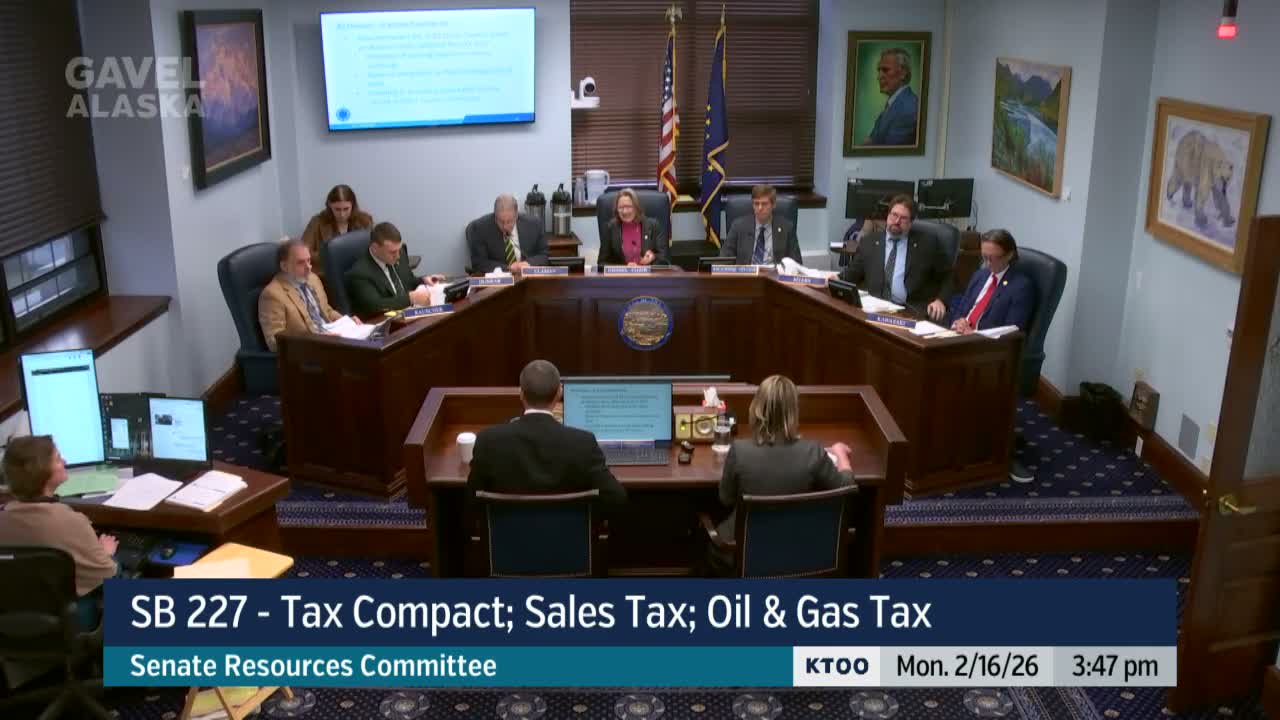
Juneau — The Senate Resources Committee on Monday advanced a substantial overhaul of the states tax structure by adopting a committee substitute (version I) for Senate Bill 227, a governor-supported fiscal package that reshapes oil-and-gas taxes and adds new revenue tools for the state.
Chair Senator Giesel placed the substitute before the committee after staff described multiple changes from the governors draft, and committee members heard legal and fiscal briefings before limited public testimony.
The committee substitute removes the sales-tax proposal that drew public opposition, eliminates conditional-effect language tying the bills effectiveness to the passage of other measures, and keeps a permanent 6% minimum production tax with new language preventing tax credits from reducing liability below that floor. "There are no sunsets in this version," Senate majority legal counsel Sonia Kawasaki said, describing the measures structure and the decision to harden the minimum tax.
Legal staff also flagged constitutional questions. Emily Naumann, director of Legislative Legal Services, told the committee she had concerns that one provision—creating a pipeline corridor maintenance fund and directing surcharge proceeds to that purpose—"could be a potential single-subject violation," citing Croft v. Parnell as analogous precedent. She said a separate conditional-effect provision that made the bill contingent on other enactments posed a second, but less clear, constitutional risk because Alaska courts have not yet addressed that drafting device.
The Department of Revenue described the bills fiscal mechanics. Chief economist Dan Stickel said the committees version retains a $0.15-per-barrel fee on taxable oil production paid with production tax returns and modeled on an existing hazardous-release surcharge. "We estimate that that would bring in about $25,000,000 per year and actually . . . increase to about $30,000,000 per year," Stickel said, noting revenues could grow as new fields come online. He and an OMB policy analyst said the fee is intended to provide a sustainable source of funds for corridor maintenance—citing the Dalton Highway as a likely primary beneficiary—but would not fully cover projected highway needs.
The substitute also adds several notable revenue provisions:
- An education "head tax" authorizing the Department of Revenue to collect a bracketed tax on wages and Alaska-source self-employment income, with proposed brackets of $10 (≤ $30,000), $15 ($30k–$90k), $20 ($90k–$150k) and $30 (>$150k); the committee has not completed fiscal modeling for this provision. (Paige Brown, staff to the chair)
- Section 12 imports reforms from Senate Bill 113 to apply a single-sales-factor and market-based sourcing for "highly digitized" C corporations; committee staff and revenue estimates tied to SB 113 suggested additional revenue in the range of tens of millions annually. David Dunsmore, staff to Senator Wilikowski, said the single-sales-factor provision aims to apportion online business income more accurately to Alaska.
- A new S-corporation/LLC tax aimed at capturing pass-through oil-and-gas entities, with bracketed rates and a $1,000,000 automatic deduction; legal counsel described that provision as designed to achieve greater parity between pass-through entities and traditional C corporations and defended it under rational-basis review if challenged on equal-protection grounds.
- Changes to the per-barrel sliding-scale credit: the substitute reduces the maximum per-barrel credit from $8 to $5 in low-price ranges and ensures credits cannot lower the hardened 6% minimum production tax.
Committee members pressed legal staff on whether courts could later invalidate parts of the measure and whether conditional dependencies could create implementation problems. Naumann said courts in other states have upheld conditional-effect drafting in some contexts, but Alaska lacks specific precedent and the state adviser of statutes would not give effect to conditional sections unless the specified companion bills were enacted or equivalent measures existed.
Public testimony was brief and split along familiar lines. Rob Christensen, a trucking-industry representative, warned that higher oil-and-gas taxes could ripple through the supply chain and hurt small, capital-intensive haulers. "When oil and gas is taxed more and investment declines, the trucking industry feels it almost immediately," Christensen said. Industry witnesses urged stable fiscal terms to preserve investment and jobs; other callers opposed sales taxes and urged more focus on capturing revenue from industries that currently pay little to the state.
Procedural next steps: the committee set an amendment deadline for SB 227 at noon Wednesday, Feb. 18, and said it will consider amendments at its Feb. 18 meeting at 3:30 p.m. Chair Giesel adjourned the meeting at 4:59 p.m.
What the committee acted on and what remains: The committee adopted version I as its working document for SB 227 and placed it before the committee for amendment; members and legal staff signaled continued scrutiny on constitutional questions (single-subject and conditional-effect drafting) and on fiscal modeling for several provisions, including the education head tax and the S-corp/LLC tax. The committee set follow-up modeling and invited revenue and OMB staff to provide more technical estimates.
The committee left Senate Bill 180 (LNG import facilities) set aside for a future meeting after opening and immediately closing public testimony.
Chair Senator Giesel placed the substitute before the committee after staff described multiple changes from the governors draft, and committee members heard legal and fiscal briefings before limited public testimony.
The committee substitute removes the sales-tax proposal that drew public opposition, eliminates conditional-effect language tying the bills effectiveness to the passage of other measures, and keeps a permanent 6% minimum production tax with new language preventing tax credits from reducing liability below that floor. "There are no sunsets in this version," Senate majority legal counsel Sonia Kawasaki said, describing the measures structure and the decision to harden the minimum tax.
Legal staff also flagged constitutional questions. Emily Naumann, director of Legislative Legal Services, told the committee she had concerns that one provision—creating a pipeline corridor maintenance fund and directing surcharge proceeds to that purpose—"could be a potential single-subject violation," citing Croft v. Parnell as analogous precedent. She said a separate conditional-effect provision that made the bill contingent on other enactments posed a second, but less clear, constitutional risk because Alaska courts have not yet addressed that drafting device.
The Department of Revenue described the bills fiscal mechanics. Chief economist Dan Stickel said the committees version retains a $0.15-per-barrel fee on taxable oil production paid with production tax returns and modeled on an existing hazardous-release surcharge. "We estimate that that would bring in about $25,000,000 per year and actually . . . increase to about $30,000,000 per year," Stickel said, noting revenues could grow as new fields come online. He and an OMB policy analyst said the fee is intended to provide a sustainable source of funds for corridor maintenance—citing the Dalton Highway as a likely primary beneficiary—but would not fully cover projected highway needs.
The substitute also adds several notable revenue provisions:
- An education "head tax" authorizing the Department of Revenue to collect a bracketed tax on wages and Alaska-source self-employment income, with proposed brackets of $10 (≤ $30,000), $15 ($30k–$90k), $20 ($90k–$150k) and $30 (>$150k); the committee has not completed fiscal modeling for this provision. (Paige Brown, staff to the chair)
- Section 12 imports reforms from Senate Bill 113 to apply a single-sales-factor and market-based sourcing for "highly digitized" C corporations; committee staff and revenue estimates tied to SB 113 suggested additional revenue in the range of tens of millions annually. David Dunsmore, staff to Senator Wilikowski, said the single-sales-factor provision aims to apportion online business income more accurately to Alaska.
- A new S-corporation/LLC tax aimed at capturing pass-through oil-and-gas entities, with bracketed rates and a $1,000,000 automatic deduction; legal counsel described that provision as designed to achieve greater parity between pass-through entities and traditional C corporations and defended it under rational-basis review if challenged on equal-protection grounds.
- Changes to the per-barrel sliding-scale credit: the substitute reduces the maximum per-barrel credit from $8 to $5 in low-price ranges and ensures credits cannot lower the hardened 6% minimum production tax.
Committee members pressed legal staff on whether courts could later invalidate parts of the measure and whether conditional dependencies could create implementation problems. Naumann said courts in other states have upheld conditional-effect drafting in some contexts, but Alaska lacks specific precedent and the state adviser of statutes would not give effect to conditional sections unless the specified companion bills were enacted or equivalent measures existed.
Public testimony was brief and split along familiar lines. Rob Christensen, a trucking-industry representative, warned that higher oil-and-gas taxes could ripple through the supply chain and hurt small, capital-intensive haulers. "When oil and gas is taxed more and investment declines, the trucking industry feels it almost immediately," Christensen said. Industry witnesses urged stable fiscal terms to preserve investment and jobs; other callers opposed sales taxes and urged more focus on capturing revenue from industries that currently pay little to the state.
Procedural next steps: the committee set an amendment deadline for SB 227 at noon Wednesday, Feb. 18, and said it will consider amendments at its Feb. 18 meeting at 3:30 p.m. Chair Giesel adjourned the meeting at 4:59 p.m.
What the committee acted on and what remains: The committee adopted version I as its working document for SB 227 and placed it before the committee for amendment; members and legal staff signaled continued scrutiny on constitutional questions (single-subject and conditional-effect drafting) and on fiscal modeling for several provisions, including the education head tax and the S-corp/LLC tax. The committee set follow-up modeling and invited revenue and OMB staff to provide more technical estimates.
The committee left Senate Bill 180 (LNG import facilities) set aside for a future meeting after opening and immediately closing public testimony.
View the Full Meeting & All Its Details
This article offers just a summary. Unlock complete video, transcripts, and insights as a Founder Member.
✓
Watch full, unedited meeting videos
✓
Search every word spoken in unlimited transcripts
✓
AI summaries & real-time alerts (all government levels)
✓
Permanent access to expanding government content
30-day money-back guarantee
