Oak Harbor council approves falconry pilot to deter downtown seagulls
February 18, 2026 | Oak Harbor, Island County, Washington
This article was created by AI summarizing key points discussed. AI makes mistakes, so for full details and context, please refer to the video of the full meeting. Please report any errors so we can fix them. Report an error »
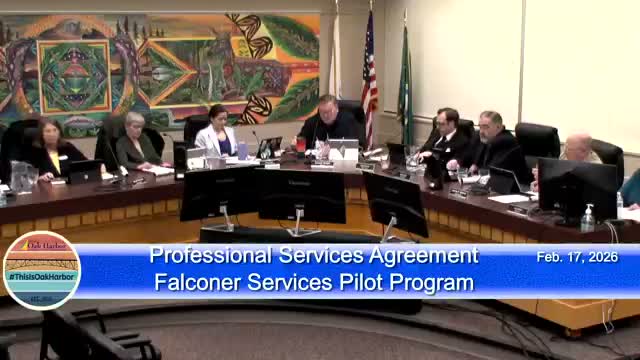
Oak Harbor’s City Council voted to authorize a pilot bird-deterrence program that will deploy a licensed falconer in the downtown waterfront area from March through July 2026.
Public Works Director Steve Schuler told the council the program aims to address recurring seagull nuisance problems—accumulated droppings, effects on businesses, and potential water-quality impacts—by introducing a predator presence that encourages birds to relocate. Schuler said the city plans adaptive deployments two to three days per week, combined with in-house efforts to improve waste handling, business coordination and stormwater monitoring.
The pilot contract, to be executed with Sky Patrol Bird Services LLC and capped at $35,000, was approved after a motion that directs staff to implement the complementary solid-waste and stormwater measures. Schuler described the cost as about $640 per day and said funding is already available within the Public Works budget and will be split equally among the solid-waste, stormwater and streets accounts.
"It is humane, nonlethal, environmentally responsible," Schuler said, explaining that birds instinctively avoid areas where trained raptors hunt. He told the council staff will evaluate bird activity, cleanliness, business feedback, observed stormwater conditions and cost effectiveness and will return with a summary and recommendations on whether to continue, modify or end the program.
Mayor Wright said the mayor’s office had received complaints that existing noise-based deterrents are loud and disruptive at a Safeway fuel pump and in nearby housing areas, which contributed to exploring alternatives. "They actually scare people at the fuel pumps," the mayor said.
Councilmember Stuckey asked about legal limits, noting the council must consider protections for birds under the Migratory Bird Treaty Act; Schuler replied the approach is permissible and that the proposed pilot’s timing and scope can be adjusted after evaluation. Stuckey disclosed he owns a business in the pilot area and abstained from the vote for that reason.
Councilmember Peterson, who seconded the motion, voiced support but asked where displaced birds would go; Schuler said exact destinations are uncertain and emphasized that complementary measures—such as signage and discouraging public feeding in parks—are part of the strategy.
The motion passed with six yes votes and one abstention. Councilmembers directed staff to proceed with the professional services agreement and to report back with findings after the pilot.
Public Works Director Steve Schuler told the council the program aims to address recurring seagull nuisance problems—accumulated droppings, effects on businesses, and potential water-quality impacts—by introducing a predator presence that encourages birds to relocate. Schuler said the city plans adaptive deployments two to three days per week, combined with in-house efforts to improve waste handling, business coordination and stormwater monitoring.
The pilot contract, to be executed with Sky Patrol Bird Services LLC and capped at $35,000, was approved after a motion that directs staff to implement the complementary solid-waste and stormwater measures. Schuler described the cost as about $640 per day and said funding is already available within the Public Works budget and will be split equally among the solid-waste, stormwater and streets accounts.
"It is humane, nonlethal, environmentally responsible," Schuler said, explaining that birds instinctively avoid areas where trained raptors hunt. He told the council staff will evaluate bird activity, cleanliness, business feedback, observed stormwater conditions and cost effectiveness and will return with a summary and recommendations on whether to continue, modify or end the program.
Mayor Wright said the mayor’s office had received complaints that existing noise-based deterrents are loud and disruptive at a Safeway fuel pump and in nearby housing areas, which contributed to exploring alternatives. "They actually scare people at the fuel pumps," the mayor said.
Councilmember Stuckey asked about legal limits, noting the council must consider protections for birds under the Migratory Bird Treaty Act; Schuler replied the approach is permissible and that the proposed pilot’s timing and scope can be adjusted after evaluation. Stuckey disclosed he owns a business in the pilot area and abstained from the vote for that reason.
Councilmember Peterson, who seconded the motion, voiced support but asked where displaced birds would go; Schuler said exact destinations are uncertain and emphasized that complementary measures—such as signage and discouraging public feeding in parks—are part of the strategy.
The motion passed with six yes votes and one abstention. Councilmembers directed staff to proceed with the professional services agreement and to report back with findings after the pilot.
View the Full Meeting & All Its Details
This article offers just a summary. Unlock complete video, transcripts, and insights as a Founder Member.
✓
Watch full, unedited meeting videos
✓
Search every word spoken in unlimited transcripts
✓
AI summaries & real-time alerts (all government levels)
✓
Permanent access to expanding government content
30-day money-back guarantee
