AGDC tells House panel state retains 25% of 8 Star Alaska; proposes Alaskan investment vehicle
February 17, 2026 | 2026 Legislature Alaska, Alaska
This article was created by AI summarizing key points discussed. AI makes mistakes, so for full details and context, please refer to the video of the full meeting. Please report any errors so we can fix them. Report an error »
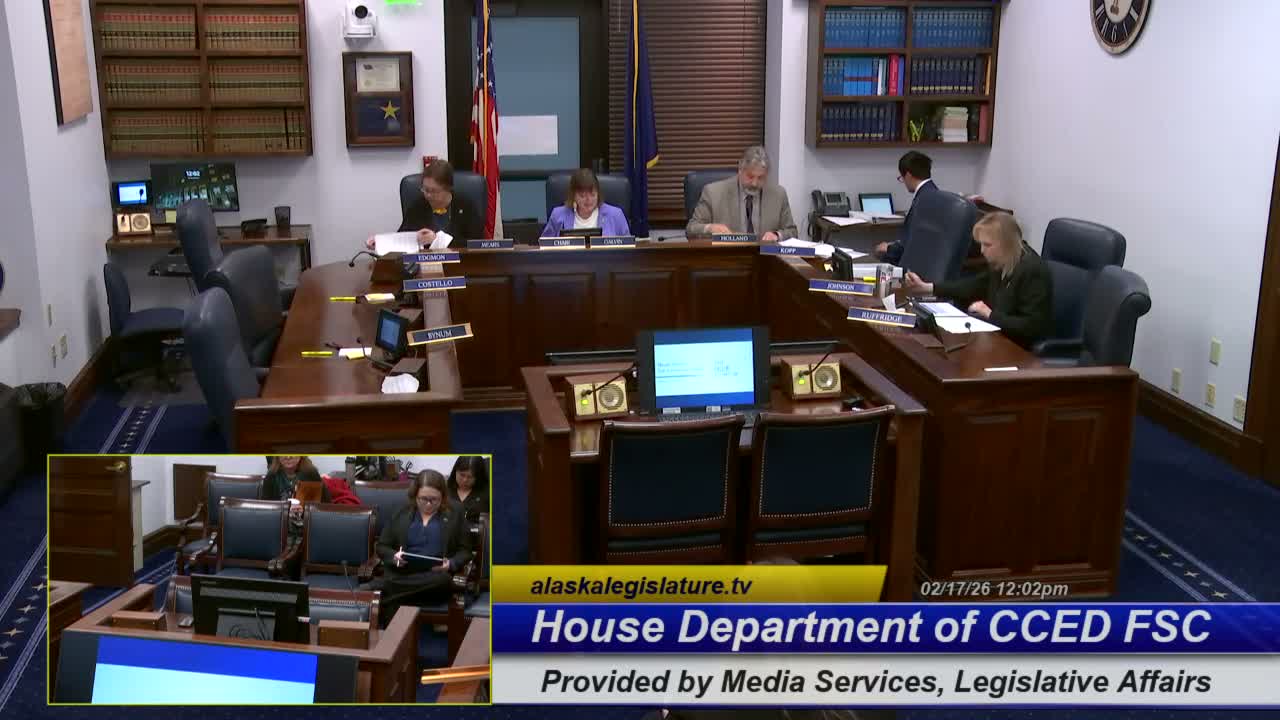
Juneau — The Alaska Gas Line Development Corporation told a House Finance subcommittee on Feb. 17 that the state retains a 25% ownership interest in the project entity 8 Star Alaska and will not be diluted as GlenFarm moves forward as developer and equity raiser.
"No, there is no dilution. We retain, 25% ownership rights in 8 star Alaska," AGDC President Frank Richards told the DCCED finance subcommittee. Richards said GlenFarm holds 75% and has taken on the responsibility of financing the project through a final investment decision (FID).
The presentation described where AGDC had placed project assets — designs, permits and federal authorizations — into 8 Star Alaska LLC and then authorized GlenFarm to step in as developer. Richards said the state corporation is now a minority owner and an active overseer of governance, regulatory compliance and the project developer's adherence to what AGDC calls the "Alaska advantage" principles.
"Alaska will get the priority rights for the first 500,000,000 senior cubic feet a day, for in state needs," Richards said, describing a senior in‑state offtake allocation the board expects to protect Alaskan consumers and users.
Why it matters: lawmakers pressed AGDC on what a passive 25% carried interest means compared with an investor role. Majority Leader Kopp told the panel the difference is consequential for how the state would share in pipeline economics (tariffs and investor returns) versus only receiving the value of gas sales and severance taxes. Kopp said the legislature needs an "in the simplest possible explanation" of how investor status would change access to project economics and confidential information.
AGDC said it is developing a special‑purpose subsidiary and an "Alaskan investment" offering intended to ring‑fence equity for state entities, municipalities, Alaskan corporations and individual Alaskans. Richards said the offering would require legal, SEC and governance workstreams and public outreach so Alaskans could choose to invest; the state would have a six‑month preemptive window after FID to exercise rights to acquire a portion of the 25% stake.
"When Glenfarm moves forward to seek equity investors and ultimately takes that final investment decision ... we reserve the right to be able to come in for a period of time 6 months after that FID for the state to ask us to 25% interest," Richards said.
Staffing, budget and oversight: lawmakers also questioned whether AGDC's proposed FY27 operating request gives the corporation enough capacity to review FEED (front‑end engineering design) materials and to protect the state's interests. Richards described a "very minimal" core staff and reliance on contractors: three direct AGDC employees plus roughly five to six contracted specialists (commercial director, program manager, regulatory and IT support) who handle regulatory compliance and technical review.
Representative Kai Holland pressed whether AGDC had the resources to "critically assess" FEED results; Richards said he and the contracted directors have the background and can assess the engineering and design standards necessary to reach FID. Representative Delaney Johnson confirmed AGDC has three direct employees; Mary Cirochi, AGDC staff in the room, said the commodities line has historically been $40,000.
Funds and capital: Members asked about apparent authority shown in the budget documents to use AKLNG funds; Richards and AGDC staff said the AKLNG fund balance is roughly $200,000 and that amount has been used to cover capital contracts and some costs. Richards warned that sweeping that small remaining balance to the general fund would remove funds that currently cover contracted work.
Regulatory and financing context: the presentation referenced federal permitting (FERC), Bureau of Land Management land actions and Department of Energy loan guarantee authority that the project hopes to access; AGDC said it is addressing SEC disclosure and investor rules as it develops the state investment vehicle.
Requests for clarification and follow-up: legislators asked for clearer, written guidance on how the state's 25% interest would change if Alaska elects to invest and what confidential information an investor would receive. Mary Cirochi offered to provide more detailed written responses and Richards apologized for spotty audio during parts of the remote presentation.
Next steps: The subcommittee postponed the scheduled Alaska Energy Authority presentation and adjourned, setting a follow‑up meeting for Feb. 24 to hear AEA and department FY27 governor's amendments. The committee also requested written follow‑up from AGDC on investor‑status implications and other technical questions that members said required more nuance than time allowed.
Methodology note: This article is based on the DCCED finance subcommittee transcript for the Feb. 17 meeting, including direct quotations from President Frank Richards and AGDC director Mary Cirochi.
"No, there is no dilution. We retain, 25% ownership rights in 8 star Alaska," AGDC President Frank Richards told the DCCED finance subcommittee. Richards said GlenFarm holds 75% and has taken on the responsibility of financing the project through a final investment decision (FID).
The presentation described where AGDC had placed project assets — designs, permits and federal authorizations — into 8 Star Alaska LLC and then authorized GlenFarm to step in as developer. Richards said the state corporation is now a minority owner and an active overseer of governance, regulatory compliance and the project developer's adherence to what AGDC calls the "Alaska advantage" principles.
"Alaska will get the priority rights for the first 500,000,000 senior cubic feet a day, for in state needs," Richards said, describing a senior in‑state offtake allocation the board expects to protect Alaskan consumers and users.
Why it matters: lawmakers pressed AGDC on what a passive 25% carried interest means compared with an investor role. Majority Leader Kopp told the panel the difference is consequential for how the state would share in pipeline economics (tariffs and investor returns) versus only receiving the value of gas sales and severance taxes. Kopp said the legislature needs an "in the simplest possible explanation" of how investor status would change access to project economics and confidential information.
AGDC said it is developing a special‑purpose subsidiary and an "Alaskan investment" offering intended to ring‑fence equity for state entities, municipalities, Alaskan corporations and individual Alaskans. Richards said the offering would require legal, SEC and governance workstreams and public outreach so Alaskans could choose to invest; the state would have a six‑month preemptive window after FID to exercise rights to acquire a portion of the 25% stake.
"When Glenfarm moves forward to seek equity investors and ultimately takes that final investment decision ... we reserve the right to be able to come in for a period of time 6 months after that FID for the state to ask us to 25% interest," Richards said.
Staffing, budget and oversight: lawmakers also questioned whether AGDC's proposed FY27 operating request gives the corporation enough capacity to review FEED (front‑end engineering design) materials and to protect the state's interests. Richards described a "very minimal" core staff and reliance on contractors: three direct AGDC employees plus roughly five to six contracted specialists (commercial director, program manager, regulatory and IT support) who handle regulatory compliance and technical review.
Representative Kai Holland pressed whether AGDC had the resources to "critically assess" FEED results; Richards said he and the contracted directors have the background and can assess the engineering and design standards necessary to reach FID. Representative Delaney Johnson confirmed AGDC has three direct employees; Mary Cirochi, AGDC staff in the room, said the commodities line has historically been $40,000.
Funds and capital: Members asked about apparent authority shown in the budget documents to use AKLNG funds; Richards and AGDC staff said the AKLNG fund balance is roughly $200,000 and that amount has been used to cover capital contracts and some costs. Richards warned that sweeping that small remaining balance to the general fund would remove funds that currently cover contracted work.
Regulatory and financing context: the presentation referenced federal permitting (FERC), Bureau of Land Management land actions and Department of Energy loan guarantee authority that the project hopes to access; AGDC said it is addressing SEC disclosure and investor rules as it develops the state investment vehicle.
Requests for clarification and follow-up: legislators asked for clearer, written guidance on how the state's 25% interest would change if Alaska elects to invest and what confidential information an investor would receive. Mary Cirochi offered to provide more detailed written responses and Richards apologized for spotty audio during parts of the remote presentation.
Next steps: The subcommittee postponed the scheduled Alaska Energy Authority presentation and adjourned, setting a follow‑up meeting for Feb. 24 to hear AEA and department FY27 governor's amendments. The committee also requested written follow‑up from AGDC on investor‑status implications and other technical questions that members said required more nuance than time allowed.
Methodology note: This article is based on the DCCED finance subcommittee transcript for the Feb. 17 meeting, including direct quotations from President Frank Richards and AGDC director Mary Cirochi.
Don't Miss a Word: See the Full Meeting!
Go beyond summaries. Unlock every video, transcript, and key insight with a Founder Membership.
✓
Get instant access to full meeting videos
✓
Search and clip any phrase from complete transcripts
✓
Receive AI-powered summaries & custom alerts
✓
Enjoy lifetime, unrestricted access to government data
30-day money-back guarantee
