Alaska DOT proposes functional reorganization, says 23 position deletions will protect frontline maintenance
February 17, 2026 | 2026 Legislature Alaska, Alaska
This article was created by AI summarizing key points discussed. AI makes mistakes, so for full details and context, please refer to the video of the full meeting. Please report any errors so we can fix them. Report an error »
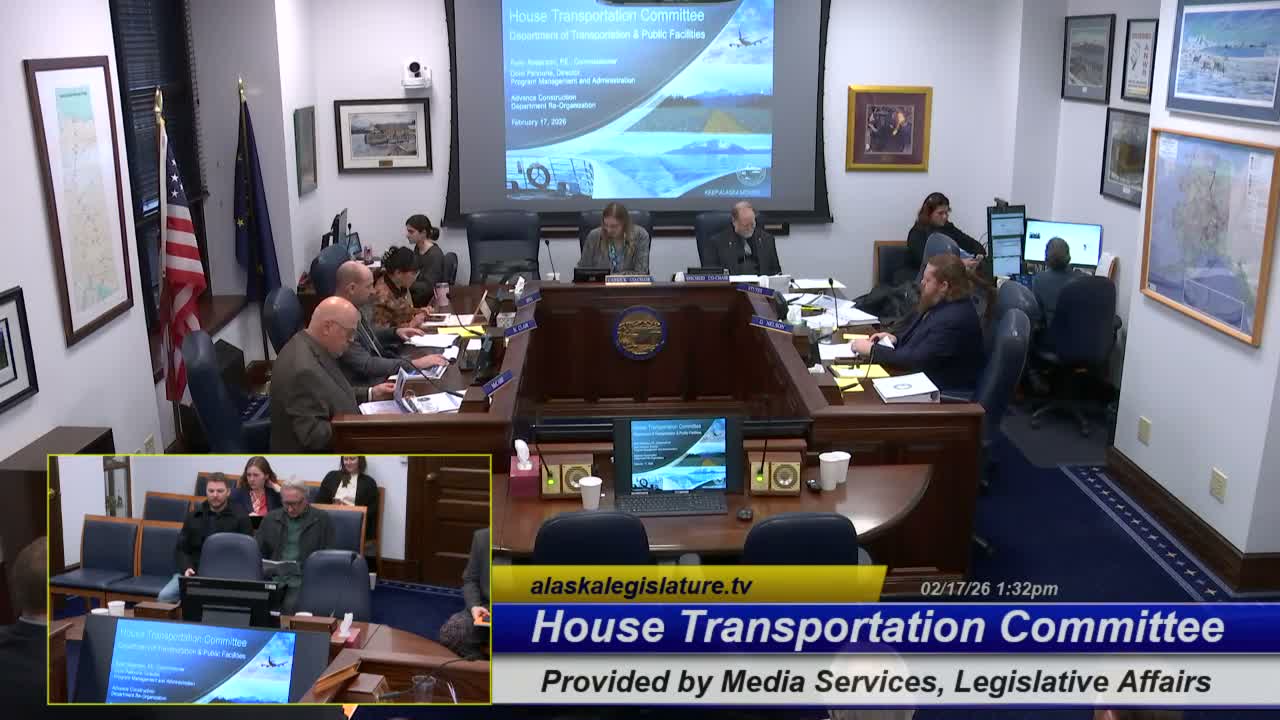
The Alaska Department of Transportation and Public Facilities on Feb. 17 told the House Transportation Committee it will reorganize leadership by function rather than by region and delete 23 higher‑level positions to preserve frontline maintenance, department officials said.
Ryan Anderson, commissioner of the Alaska Department of Transportation and Public Facilities, said the change would create statewide functional directors for infrastructure development and maintenance while retaining Northern, Central and South Coast region boundaries and district superintendents. "We're absolutely trying to reduce... our footprint just because we recognize the fiscal challenges right now," Anderson said during the committee hearing.
The proposal, presented as part of the governor's budget package, would align the department's organizational structure with its budget and place program and functional leadership above regional execution. Dom Pinon, director of program management and administration, told the panel the budget includes a $5,200,000 reduction in the current year and a proposal to delete 23 positions; five of those are exempt, nonunion posts and four are supervisory. Pinon said the workforce impact represents less than 1 percent of DOT's roughly 3,400 positions.
Legislators pressed DOT officials on potential loss of institutional knowledge and on whether statutory appointment requirements for regional directors (AS 44.42.0040) would be affected. Representative Mina quoted the statute and asked whether regional offices would still have directors appointed by the commissioner; Anderson and Pinon said district engineers and district staffing remain and that legal counsel reviewed the reorganization. "The appointments come on the functional level, so there's still the functional director of the district offices," Anderson said.
Several lawmakers raised concerns that centralizing decision‑making could deprioritize outlying regions or concentrate authority in Anchorage. Representative Stutes cautioned that past reorganizations had placed many responsibilities on single individuals and asked how DOT would avoid creating roles that are ‘‘spread so thin that they just can't possibly be responsible’’ for multiple duties. Anderson replied the department intends to recruit people with targeted expertise for specific functional director roles to reduce the need for individuals to wear multiple disparate hats.
Pinon described implementation phases: team work sessions and transitions now, formal alignments and position transfers in the summer, and stabilization afterward. He said DOT has been communicating with affected staff since the budget was released, using virtual all‑staff meetings, an action plan website, recorded briefings and anonymous surveys. Pinon said staff on the deletion list were contacted the day the governor's budget was published and that DOT is working to find alternative placements where possible.
Committee members also asked how the reorganization was developed. Pinon said the plan was largely an internal DOT leadership effort rather than an external consultant product. He added the department is seeking to expand capital teams and requested $2.2 million to reposition engineers and designers closer to the communities they serve.
No formal action or vote occurred at the hearing. The committee adjourned at 2:47 p.m.; members were reminded a House Transportation Committee meeting is scheduled for Feb. 19 at 1:30 p.m.
Ending: DOT officials said the reorganization is intended to standardize business practices, protect maintenance funding and improve statewide resource sharing; legislators said they will continue to press DOT for statutory clarity, workforce protections and performance metrics.
Ryan Anderson, commissioner of the Alaska Department of Transportation and Public Facilities, said the change would create statewide functional directors for infrastructure development and maintenance while retaining Northern, Central and South Coast region boundaries and district superintendents. "We're absolutely trying to reduce... our footprint just because we recognize the fiscal challenges right now," Anderson said during the committee hearing.
The proposal, presented as part of the governor's budget package, would align the department's organizational structure with its budget and place program and functional leadership above regional execution. Dom Pinon, director of program management and administration, told the panel the budget includes a $5,200,000 reduction in the current year and a proposal to delete 23 positions; five of those are exempt, nonunion posts and four are supervisory. Pinon said the workforce impact represents less than 1 percent of DOT's roughly 3,400 positions.
Legislators pressed DOT officials on potential loss of institutional knowledge and on whether statutory appointment requirements for regional directors (AS 44.42.0040) would be affected. Representative Mina quoted the statute and asked whether regional offices would still have directors appointed by the commissioner; Anderson and Pinon said district engineers and district staffing remain and that legal counsel reviewed the reorganization. "The appointments come on the functional level, so there's still the functional director of the district offices," Anderson said.
Several lawmakers raised concerns that centralizing decision‑making could deprioritize outlying regions or concentrate authority in Anchorage. Representative Stutes cautioned that past reorganizations had placed many responsibilities on single individuals and asked how DOT would avoid creating roles that are ‘‘spread so thin that they just can't possibly be responsible’’ for multiple duties. Anderson replied the department intends to recruit people with targeted expertise for specific functional director roles to reduce the need for individuals to wear multiple disparate hats.
Pinon described implementation phases: team work sessions and transitions now, formal alignments and position transfers in the summer, and stabilization afterward. He said DOT has been communicating with affected staff since the budget was released, using virtual all‑staff meetings, an action plan website, recorded briefings and anonymous surveys. Pinon said staff on the deletion list were contacted the day the governor's budget was published and that DOT is working to find alternative placements where possible.
Committee members also asked how the reorganization was developed. Pinon said the plan was largely an internal DOT leadership effort rather than an external consultant product. He added the department is seeking to expand capital teams and requested $2.2 million to reposition engineers and designers closer to the communities they serve.
No formal action or vote occurred at the hearing. The committee adjourned at 2:47 p.m.; members were reminded a House Transportation Committee meeting is scheduled for Feb. 19 at 1:30 p.m.
Ending: DOT officials said the reorganization is intended to standardize business practices, protect maintenance funding and improve statewide resource sharing; legislators said they will continue to press DOT for statutory clarity, workforce protections and performance metrics.
Don't Miss a Word: See the Full Meeting!
Go beyond summaries. Unlock every video, transcript, and key insight with a Founder Membership.
✓
Get instant access to full meeting videos
✓
Search and clip any phrase from complete transcripts
✓
Receive AI-powered summaries & custom alerts
✓
Enjoy lifetime, unrestricted access to government data
30-day money-back guarantee
