House committee amends AIDEA oversight and finance provisions, moves HB124 forward
February 17, 2026 | 2026 Legislature Alaska, Alaska
This article was created by AI summarizing key points discussed. AI makes mistakes, so for full details and context, please refer to the video of the full meeting. Please report any errors so we can fix them. Report an error »
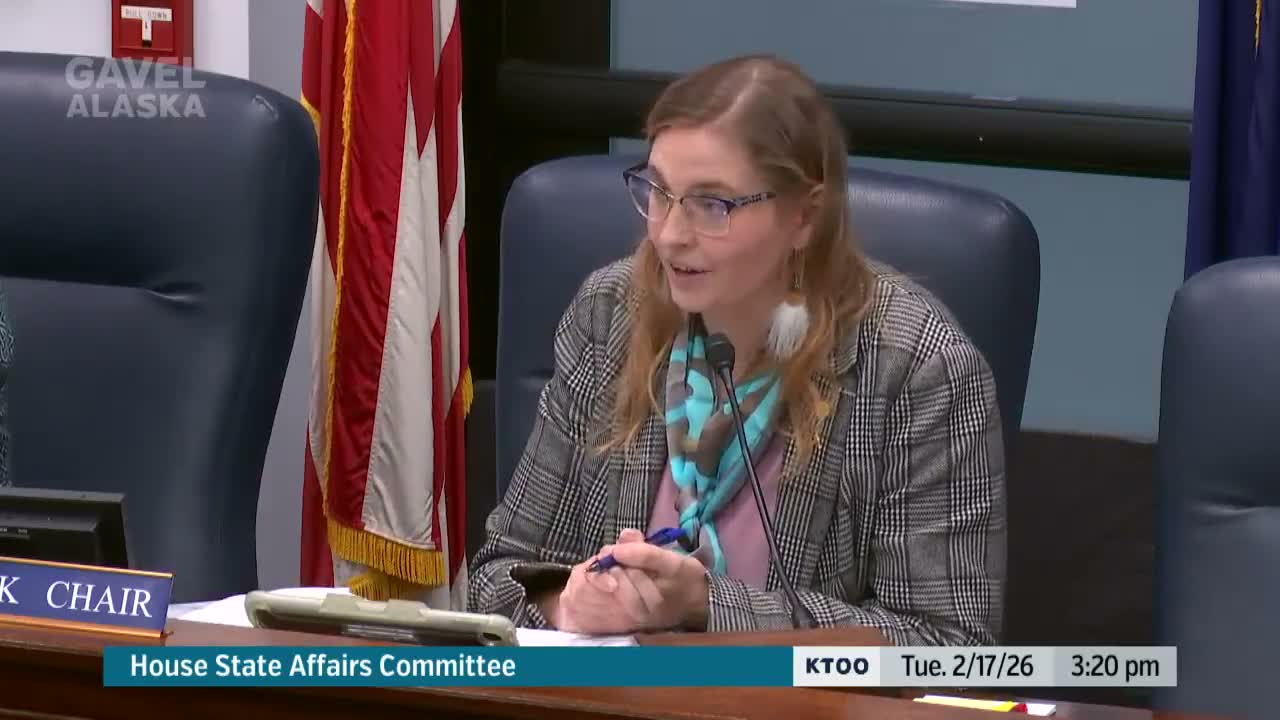
The House State Affairs Committee on Feb. 17 approved multiple amendments to House Bill 124, a bill addressing governance and financial rules for the Alaska Industrial Development and Export Authority (AIDEA), and voted 4–3 to move the bill out of committee.
Sponsor Representative Kerrick said the amendment process produced a ‘‘stronger bill’’ after extensive debate and technical changes, noting the committee removed certain provisions, increased the revolving fund cap, and clarified conflict-of-interest and project-approval thresholds.
Representative Holland offered a set of amendments that, as adopted, remove an explicit $3 billion cap on AIDEA funds and clarify that AIDEA’s net income is subject to legislative appropriation while preserving the authority’s corpus. The adopted language also sets aside 20% of net income to remain with AIDEA to support its operations. Holland emphasized the changes are intended to align AIDEA’s operations with the legislature’s role while keeping AIDEA funded for its public‑purpose projects.
Opponents raised constitutional concerns. Representative McCabe argued the changes amount to an ‘‘unconstitutional’’ reallocation of executive-branch assets and warned the measure could destabilize AIDEA’s ability to finance rural and infrastructure projects. Legislative Legal Services attorney Ian Walsh and AIDEA Executive Director Randy Raro both briefed the committee on constitutional uncertainties: Walsh pointed to the state constitution’s dedicated‑funds clause and said courts have not squarely decided this exact question, while Executive Director Raro cited DeArmond (1962) to argue prior decisions permitted AIDEA to treat certain revenues as separate and warned broad changes could affect bonding capacity.
The committee also adopted Amendment 19, which clarifies that public comments must be published with personal contact information redacted (rather than requiring AIDEA to respond to every comment) and tightens conflict‑of‑interest language to address indirect interests that could disqualify a board member from voting. Members debated whether the conflict‑of‑interest language duplicates or extends standards already in statute and in the Executive Branch Ethics Act.
Roll calls: Amendment 8 (which would have deleted section 8 related to the cap) failed on a 3–3 vote; Amendment 17 (the sponsor’s narrower version clarifying appropriation and the 20% retention) passed 4–3 after a conceptual correction; Amendment 19 (public comment redaction and conflict‑of‑interest clarifications) passed 4–3 after a procedural reconsideration. The committee then voted 4–3 to move HB124, version n as amended, from committee with individual recommendations and attached fiscal notes.
What happens next: HB124 now proceeds to the House Finance Committee for further consideration. Members and staff acknowledged outstanding legal questions and signaled legislative legal services will refine statutory language and technical conforming changes as the bill advances.
Sponsor Representative Kerrick said the amendment process produced a ‘‘stronger bill’’ after extensive debate and technical changes, noting the committee removed certain provisions, increased the revolving fund cap, and clarified conflict-of-interest and project-approval thresholds.
Representative Holland offered a set of amendments that, as adopted, remove an explicit $3 billion cap on AIDEA funds and clarify that AIDEA’s net income is subject to legislative appropriation while preserving the authority’s corpus. The adopted language also sets aside 20% of net income to remain with AIDEA to support its operations. Holland emphasized the changes are intended to align AIDEA’s operations with the legislature’s role while keeping AIDEA funded for its public‑purpose projects.
Opponents raised constitutional concerns. Representative McCabe argued the changes amount to an ‘‘unconstitutional’’ reallocation of executive-branch assets and warned the measure could destabilize AIDEA’s ability to finance rural and infrastructure projects. Legislative Legal Services attorney Ian Walsh and AIDEA Executive Director Randy Raro both briefed the committee on constitutional uncertainties: Walsh pointed to the state constitution’s dedicated‑funds clause and said courts have not squarely decided this exact question, while Executive Director Raro cited DeArmond (1962) to argue prior decisions permitted AIDEA to treat certain revenues as separate and warned broad changes could affect bonding capacity.
The committee also adopted Amendment 19, which clarifies that public comments must be published with personal contact information redacted (rather than requiring AIDEA to respond to every comment) and tightens conflict‑of‑interest language to address indirect interests that could disqualify a board member from voting. Members debated whether the conflict‑of‑interest language duplicates or extends standards already in statute and in the Executive Branch Ethics Act.
Roll calls: Amendment 8 (which would have deleted section 8 related to the cap) failed on a 3–3 vote; Amendment 17 (the sponsor’s narrower version clarifying appropriation and the 20% retention) passed 4–3 after a conceptual correction; Amendment 19 (public comment redaction and conflict‑of‑interest clarifications) passed 4–3 after a procedural reconsideration. The committee then voted 4–3 to move HB124, version n as amended, from committee with individual recommendations and attached fiscal notes.
What happens next: HB124 now proceeds to the House Finance Committee for further consideration. Members and staff acknowledged outstanding legal questions and signaled legislative legal services will refine statutory language and technical conforming changes as the bill advances.
View the Full Meeting & All Its Details
This article offers just a summary. Unlock complete video, transcripts, and insights as a Founder Member.
✓
Watch full, unedited meeting videos
✓
Search every word spoken in unlimited transcripts
✓
AI summaries & real-time alerts (all government levels)
✓
Permanent access to expanding government content
30-day money-back guarantee
