Committee reviews bill to repeal obsolete Catastrophic Acute Medical Assistance statute
February 17, 2026 | 2026 Legislature Alaska, Alaska
This article was created by AI summarizing key points discussed. AI makes mistakes, so for full details and context, please refer to the video of the full meeting. Please report any errors so we can fix them. Report an error »
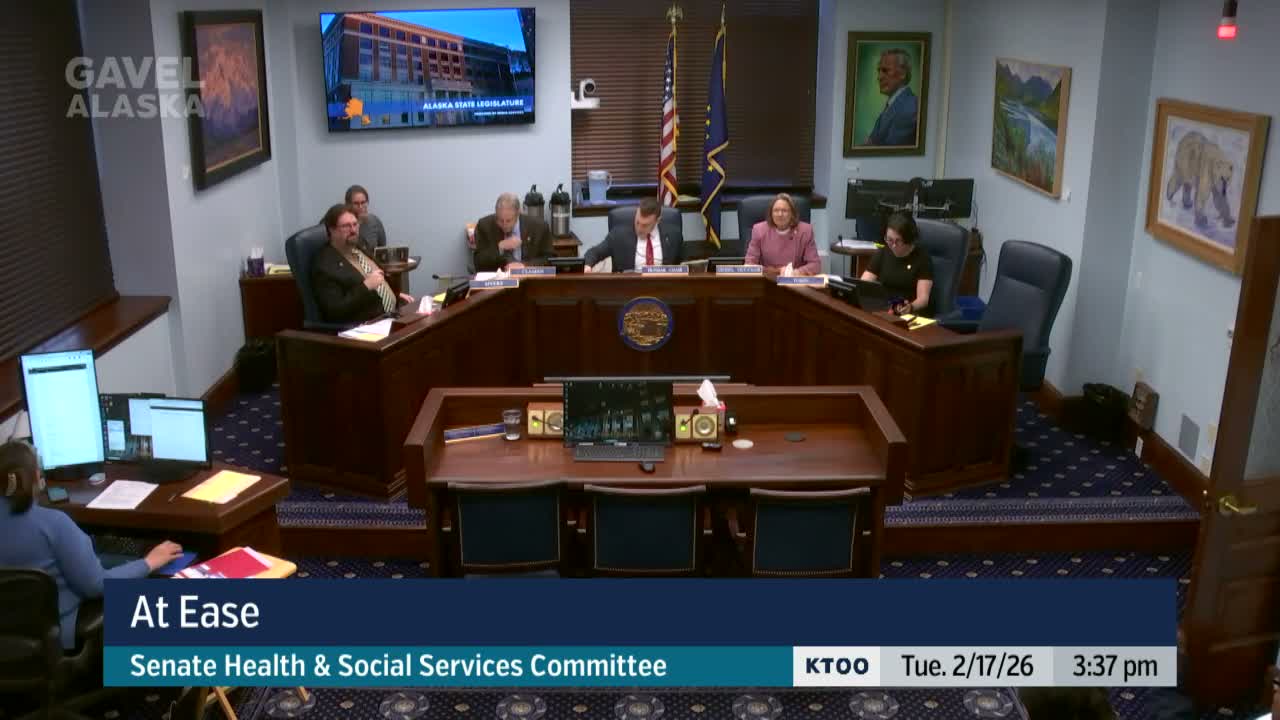
Senators on the Health and Social Services Committee heard sponsor and agency testimony Feb. 17 on House Bill 14, a statutory cleanup measure that would repeal the Catastrophic Acute Medical Assistance (CAMA) program from state law.
Representative Will Staff, on the record as the bill sponsor, told the committee HB14 removes obsolete statutory language that no longer reflects current medical assistance practice. He said CAMA was originally designed as a narrow stop‑gap program for people whose income fell between earlier Medicaid eligibility thresholds; after Medicaid expansion that population largely became eligible for Medicaid, and participation in CAMA dropped to near zero. Representative Staff said he eliminated the program’s appropriation during prior budget work to avoid unnecessary administrative denials.
Deb Etheridge, director for the Division of Public Assistance, testified that CAMA had been a checkbox on the department’s multi‑program application but that very few CAMA cases remain. She said, “We had no funding and authority to operate the program” after the appropriation was removed and cited AS 47.08.01B as governing annual determinations by the commissioner on program administration. Etheridge told the committee the department can identify and process CAMA determinations when they appear in the system, but that general relief and multi‑program applications can complicate extracting historical counts.
Committee members probed whether recent federal changes to marketplace subsidies (HR1/ACA) or future Medicaid eligibility rules might increase demand for the kinds of services CAMA provided; Etheridge said she did not anticipate a major increase because CAMA services and eligibility were narrow, but she agreed to provide the committee a detailed list of historical eligibility criteria. Senator Giesel read packet materials summarizing CAMA diagnoses and limited covered services (terminal illness, chemotherapy for cancer, chronic seizure disorder, chronic hypertension, up to three prescriptions per month, and medical supplies limited to a 30‑day supply).
After discussion the committee set HB14 aside for a future meeting that will include public testimony.
Representative Will Staff, on the record as the bill sponsor, told the committee HB14 removes obsolete statutory language that no longer reflects current medical assistance practice. He said CAMA was originally designed as a narrow stop‑gap program for people whose income fell between earlier Medicaid eligibility thresholds; after Medicaid expansion that population largely became eligible for Medicaid, and participation in CAMA dropped to near zero. Representative Staff said he eliminated the program’s appropriation during prior budget work to avoid unnecessary administrative denials.
Deb Etheridge, director for the Division of Public Assistance, testified that CAMA had been a checkbox on the department’s multi‑program application but that very few CAMA cases remain. She said, “We had no funding and authority to operate the program” after the appropriation was removed and cited AS 47.08.01B as governing annual determinations by the commissioner on program administration. Etheridge told the committee the department can identify and process CAMA determinations when they appear in the system, but that general relief and multi‑program applications can complicate extracting historical counts.
Committee members probed whether recent federal changes to marketplace subsidies (HR1/ACA) or future Medicaid eligibility rules might increase demand for the kinds of services CAMA provided; Etheridge said she did not anticipate a major increase because CAMA services and eligibility were narrow, but she agreed to provide the committee a detailed list of historical eligibility criteria. Senator Giesel read packet materials summarizing CAMA diagnoses and limited covered services (terminal illness, chemotherapy for cancer, chronic seizure disorder, chronic hypertension, up to three prescriptions per month, and medical supplies limited to a 30‑day supply).
After discussion the committee set HB14 aside for a future meeting that will include public testimony.
View the Full Meeting & All Its Details
This article offers just a summary. Unlock complete video, transcripts, and insights as a Founder Member.
✓
Watch full, unedited meeting videos
✓
Search every word spoken in unlimited transcripts
✓
AI summaries & real-time alerts (all government levels)
✓
Permanent access to expanding government content
30-day money-back guarantee
