Committee hears extensive testimony on SB193 to allow temporary prescriptive endorsements for naturopathic doctors
February 17, 2026 | 2026 Legislature Alaska, Alaska
This article was created by AI summarizing key points discussed. AI makes mistakes, so for full details and context, please refer to the video of the full meeting. Please report any errors so we can fix them. Report an error »
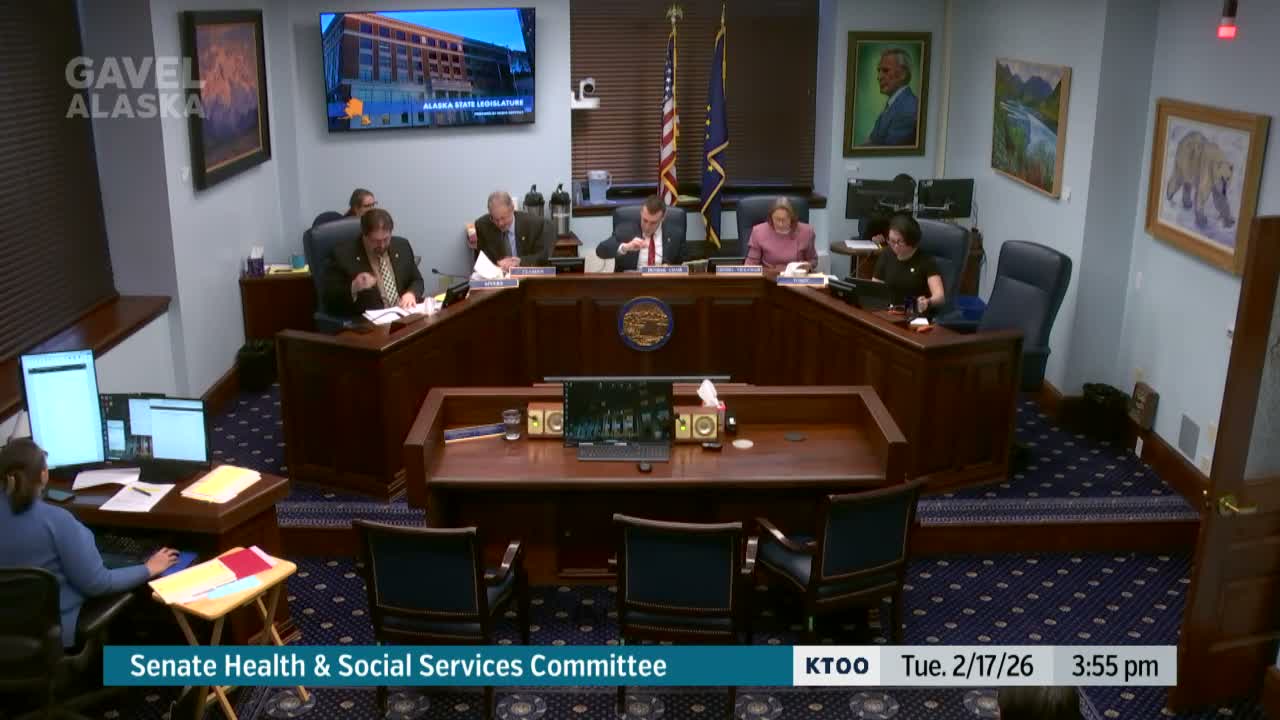
The Senate Health and Social Services Committee on Feb. 17 held the first hearing on Senate Bill 193, a committee bill that would create a temporary endorsement pathway allowing licensed Alaska naturopathic doctors to prescribe a limited range of medications under a written collaborative agreement with a supervising medical doctor or osteopathic physician.
Senator Kawasaki, sponsor, said SB193 is intended to address a shortage of primary‑care providers by enabling naturopathic doctors to practice closer to their training while preserving public‑safety limits. The bill’s text (as read by staff) creates new statutory sections in AS 8.45 to authorize a temporary endorsement, requires the collaborating physician to have at least five years’ prescribing experience, establishes a minimum 12‑month period for the collaborative agreement, and directs the Division of Corporations, Business and Professional Licensing (DCBPL) to receive reports on collaborative oversight and to decide whether to issue an ongoing endorsement after the supervised period.
Invited testimony was strongly supportive. Laura Farr, executive director of the American Association of Naturopathic Physicians, described naturopathic doctoral programs as 4–5 year programs totaling about 4,100 hours that include integrated pharmacology training and roughly 1,200 supervised clinical hours; she described the NPLEX licensing exam structure (NPLEX 1, NPLEX 2 — a ~400‑question clinical decision exam — and an elective pharmacology exam) and said the elective pharmacology exam is administered nationally by the North American Board of Naturopathic Examiners. Rebecca Mitchell, president of the Federation of Naturopathic Medicine Regulatory Authorities, reiterated that naturopathic licensing includes accreditation and national exams, said other states with prescriptive authority show no pattern of disproportionate prescribing discipline, and described SB193 as a regulatory approach that balances access and safety.
Alaska practitioners described practical impacts. A clinician who put herself on the record as Natalie Higgins said she treats hundreds of primary‑care patients in Anchorage but cannot currently prescribe in Alaska; she said prescriptive restrictions force patients to seek duplicate visits with unfamiliar providers. Dr. Scott Looper (Fairbanks) said lack of prescriptive rights has reduced recruitment and retention of naturopathic physicians in Alaska and that prescriptive authority in other states helped retain clinicians.
The bill would prohibit naturopathic prescribers from prescribing controlled substances, chemotherapy, antipsychotic drugs, radioactive substances or performing invasive surgeries; it would also require 60 hours of continuing education every two years, including 20 hours specifically in pharmacotherapy. Committee members asked about exam development, interstate licensure compacts (the witnesses said none exists for naturopathic licenses), liability insurance, and vaccine administration; witnesses said the elective pharmacology exam is a national exam administered by NPLEX and that permitting administration of vaccines in Alaska would require statutory change (witness testimony indicated the bill would allow that function).
Senator Kawasaki described SB193 as a compromise and thanked the committee for an open mind. The committee set the bill aside for future public testimony and additional consideration.
Senator Kawasaki, sponsor, said SB193 is intended to address a shortage of primary‑care providers by enabling naturopathic doctors to practice closer to their training while preserving public‑safety limits. The bill’s text (as read by staff) creates new statutory sections in AS 8.45 to authorize a temporary endorsement, requires the collaborating physician to have at least five years’ prescribing experience, establishes a minimum 12‑month period for the collaborative agreement, and directs the Division of Corporations, Business and Professional Licensing (DCBPL) to receive reports on collaborative oversight and to decide whether to issue an ongoing endorsement after the supervised period.
Invited testimony was strongly supportive. Laura Farr, executive director of the American Association of Naturopathic Physicians, described naturopathic doctoral programs as 4–5 year programs totaling about 4,100 hours that include integrated pharmacology training and roughly 1,200 supervised clinical hours; she described the NPLEX licensing exam structure (NPLEX 1, NPLEX 2 — a ~400‑question clinical decision exam — and an elective pharmacology exam) and said the elective pharmacology exam is administered nationally by the North American Board of Naturopathic Examiners. Rebecca Mitchell, president of the Federation of Naturopathic Medicine Regulatory Authorities, reiterated that naturopathic licensing includes accreditation and national exams, said other states with prescriptive authority show no pattern of disproportionate prescribing discipline, and described SB193 as a regulatory approach that balances access and safety.
Alaska practitioners described practical impacts. A clinician who put herself on the record as Natalie Higgins said she treats hundreds of primary‑care patients in Anchorage but cannot currently prescribe in Alaska; she said prescriptive restrictions force patients to seek duplicate visits with unfamiliar providers. Dr. Scott Looper (Fairbanks) said lack of prescriptive rights has reduced recruitment and retention of naturopathic physicians in Alaska and that prescriptive authority in other states helped retain clinicians.
The bill would prohibit naturopathic prescribers from prescribing controlled substances, chemotherapy, antipsychotic drugs, radioactive substances or performing invasive surgeries; it would also require 60 hours of continuing education every two years, including 20 hours specifically in pharmacotherapy. Committee members asked about exam development, interstate licensure compacts (the witnesses said none exists for naturopathic licenses), liability insurance, and vaccine administration; witnesses said the elective pharmacology exam is a national exam administered by NPLEX and that permitting administration of vaccines in Alaska would require statutory change (witness testimony indicated the bill would allow that function).
Senator Kawasaki described SB193 as a compromise and thanked the committee for an open mind. The committee set the bill aside for future public testimony and additional consideration.
Don't Miss a Word: See the Full Meeting!
Go beyond summaries. Unlock every video, transcript, and key insight with a Founder Membership.
✓
Get instant access to full meeting videos
✓
Search and clip any phrase from complete transcripts
✓
Receive AI-powered summaries & custom alerts
✓
Enjoy lifetime, unrestricted access to government data
30-day money-back guarantee
