Alaska prioritizes crisis contact center as grants shift toward Medicaid reimbursements
February 17, 2026 | 2026 Legislature Alaska, Alaska
This article was created by AI summarizing key points discussed. AI makes mistakes, so for full details and context, please refer to the video of the full meeting. Please report any errors so we can fix them. Report an error »
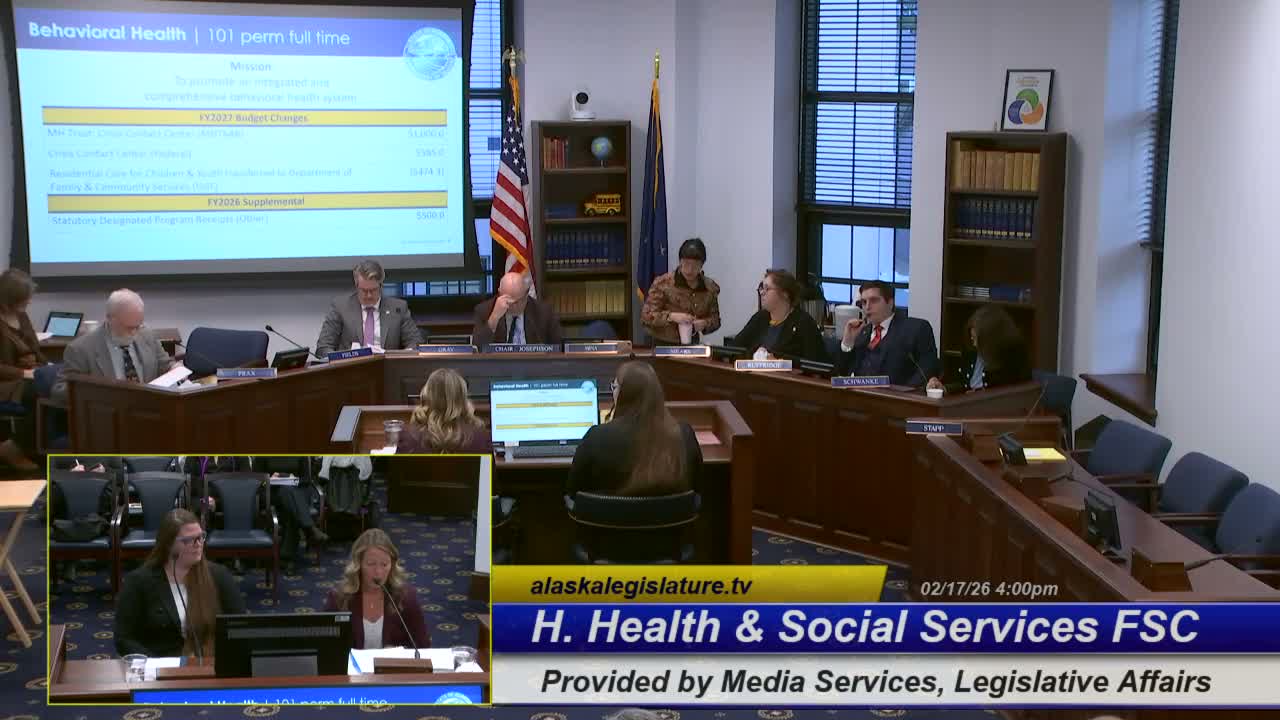
Jen Carson, director of the Division of Behavioral Health, told the House Finance Health Subcommittee on Feb. 17 that the division will prioritize funding for Alaska’s crisis contact center while overall operating resources remain constrained.
The crisis contact center provides free, round‑the‑clock support to Alaskans in need, Carson said, and the division has seen a roughly 120% increase in call volume since FY2020. “Ninety‑eight percent of the calls that are received through the crisis contact center are resolved there,” Carson said, a metric she cited to argue the center diverts more intensive responses such as hospitalization or law‑enforcement interventions.
Why it matters: committee members pressed division officials about how the center will be sustained as pandemic-era federal COVID funds wind down and the division leans on a mix of funding—designated general funds, federal authority, and support from the Mental Health Trust. Carson said the federal COVID line has been zeroed out after FY25 and the division requested $5 million of federal authority to spend down recent grants; the Mental Health Trust committed $1 million toward the crisis contact center for FY27, a $250,000 increase over FY26.
Lawmakers pressed on long‑term plans and funding mix. Representative Prox asked whether the Trust’s contribution is intended as a startup subsidy or an ongoing operating source; Carson said she would follow up with the trust. “I don’t know how long the Mental Health Trust will support” the program, Carson said.
Several members raised measurement and sustainability questions. Representative Gray and others argued prevention and early‑intervention grants had been reduced and asked whether shifting services into Medicaid leaves gaps in upstream work that prevents crises. Carson said grants fill gaps that Medicaid does not cover and noted that the division awarded 164 grants totaling about $52 million in FY25 across prevention, treatment and recovery, and system‑of‑care programs.
The division proposed partial strategies to protect the center’s funding: seeking approximately $585,000 in federal authority to offset general fund costs, transferring $474,000 to the Department of Children, Youth and Family Services for related functions, and requesting $500,000 in statutory designated program receipt authority to spend down funds received for specific programs.
What lawmakers asked for next: committee members requested clearer public metrics and trend visuals to assess whether increases in community‑based Medicaid reimbursement are delivering downstream cost savings. The deputy commissioner said materials about the Section 1115 waiver and related actuarial measures are publicly posted and the department meets regularly with CMS to align projections.
The committee adjourned after the division moved on to other presentations; members set a follow‑up review of Medicaid components for a later meeting.
Sources: Testimony and slides presented by Jen Carson, Director, Division of Behavioral Health; Amaris Rosario, Acting Deputy Director; and committee questioning at the Alaska House Finance Health Subcommittee meeting, Feb. 17, 2026.
The crisis contact center provides free, round‑the‑clock support to Alaskans in need, Carson said, and the division has seen a roughly 120% increase in call volume since FY2020. “Ninety‑eight percent of the calls that are received through the crisis contact center are resolved there,” Carson said, a metric she cited to argue the center diverts more intensive responses such as hospitalization or law‑enforcement interventions.
Why it matters: committee members pressed division officials about how the center will be sustained as pandemic-era federal COVID funds wind down and the division leans on a mix of funding—designated general funds, federal authority, and support from the Mental Health Trust. Carson said the federal COVID line has been zeroed out after FY25 and the division requested $5 million of federal authority to spend down recent grants; the Mental Health Trust committed $1 million toward the crisis contact center for FY27, a $250,000 increase over FY26.
Lawmakers pressed on long‑term plans and funding mix. Representative Prox asked whether the Trust’s contribution is intended as a startup subsidy or an ongoing operating source; Carson said she would follow up with the trust. “I don’t know how long the Mental Health Trust will support” the program, Carson said.
Several members raised measurement and sustainability questions. Representative Gray and others argued prevention and early‑intervention grants had been reduced and asked whether shifting services into Medicaid leaves gaps in upstream work that prevents crises. Carson said grants fill gaps that Medicaid does not cover and noted that the division awarded 164 grants totaling about $52 million in FY25 across prevention, treatment and recovery, and system‑of‑care programs.
The division proposed partial strategies to protect the center’s funding: seeking approximately $585,000 in federal authority to offset general fund costs, transferring $474,000 to the Department of Children, Youth and Family Services for related functions, and requesting $500,000 in statutory designated program receipt authority to spend down funds received for specific programs.
What lawmakers asked for next: committee members requested clearer public metrics and trend visuals to assess whether increases in community‑based Medicaid reimbursement are delivering downstream cost savings. The deputy commissioner said materials about the Section 1115 waiver and related actuarial measures are publicly posted and the department meets regularly with CMS to align projections.
The committee adjourned after the division moved on to other presentations; members set a follow‑up review of Medicaid components for a later meeting.
Sources: Testimony and slides presented by Jen Carson, Director, Division of Behavioral Health; Amaris Rosario, Acting Deputy Director; and committee questioning at the Alaska House Finance Health Subcommittee meeting, Feb. 17, 2026.
Don't Miss a Word: See the Full Meeting!
Go beyond summaries. Unlock every video, transcript, and key insight with a Founder Membership.
✓
Get instant access to full meeting videos
✓
Search and clip any phrase from complete transcripts
✓
Receive AI-powered summaries & custom alerts
✓
Enjoy lifetime, unrestricted access to government data
30-day money-back guarantee
