Municipal leaders urge Legislature to restore predictable school capital funding and reinstate bond reimbursement
February 18, 2026 | 2026 Legislature Alaska, Alaska
This article was created by AI summarizing key points discussed. AI makes mistakes, so for full details and context, please refer to the video of the full meeting. Please report any errors so we can fix them. Report an error »
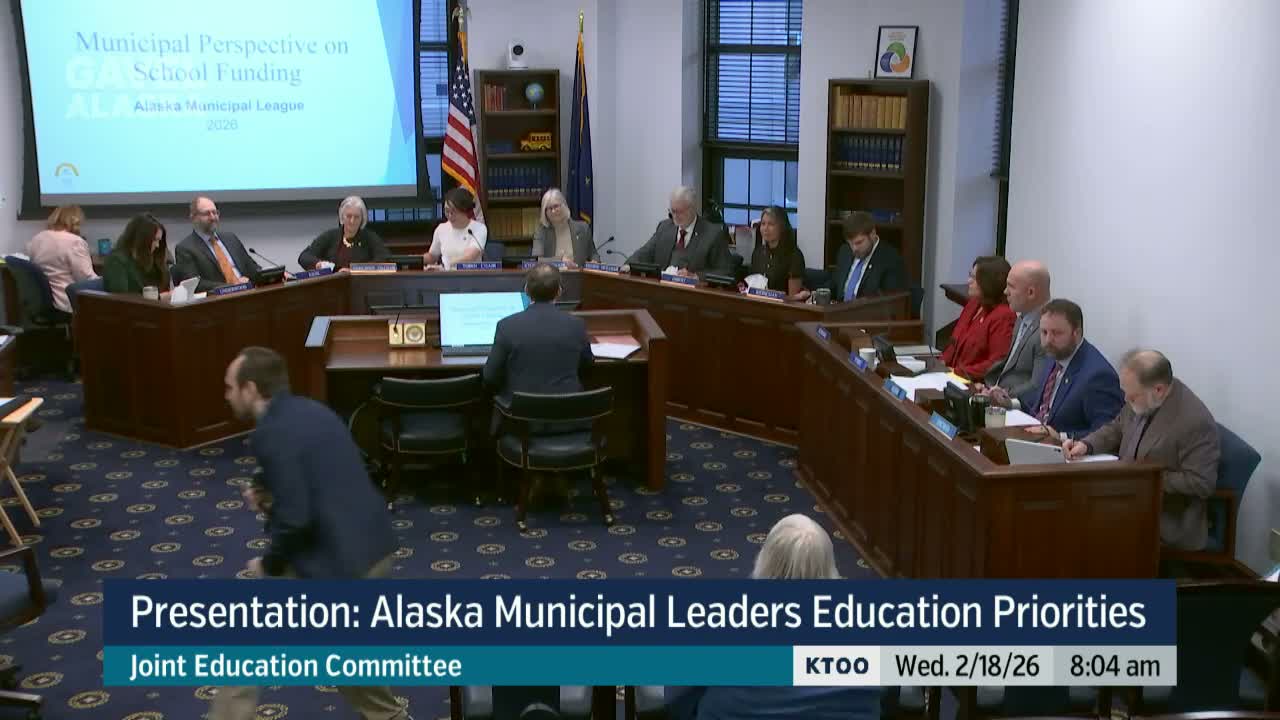
Juneau — Municipal leaders from across Alaska told a joint House and Senate education committee on Feb. 18 that the state must restore predictable funding for school facilities and reestablish full school bond debt reimbursement to prevent further deferred maintenance and higher local property taxes.
Nils Andreassen, executive director of the Alaska Municipal League, said local governments are often the primary funders of K–12 education while having limited authority over educational decisions. "Who pays matters," Andreassen said, summarizing AML’s view that Impact Aid, the required local contribution, and the state’s disparity test interact to produce inequities across districts.
The AML presentation focused on facilities. Andreassen cited Department of Education facilities dashboard numbers that show roughly $6.3 billion in 10‑year facility needs, with $3.7 billion of that described as immediate, front‑loaded needs. "That's pent up need," he said, and noted the average annual submitted need in six‑year plans has been about $300 million, while what has been funded is typically far less.
Why it matters: witnesses said deferred maintenance and unpredictable capital support force local governments to choose between classroom spending and building upkeep, shifting costs to property taxpayers. "When the state of Alaska fails, that's going right on your mill rate at home," Sen. Yundt said, describing how missed state reimbursements translate into higher local property taxes because local governments must meet bond obligations.
Testimony from local officials: Beth Weldon, mayor of the City and Borough of Juneau, thanked the Legislature for last year's BSA increase but said it amounted to one‑time funding and left districts facing deficits. "When new policies arrive without funding, the pressure lands on CBJ to fill the gaps," Weldon said, urging an inflation‑responsive BSA and restoration of predictable state participation in capital programs so municipalities can plan responsibly.
Chris Noll, mayor of Denali Borough, told the committee the borough consistently funds its district up to statutory limits and that the borough's school budget is one of the largest local expenditures. He asked the Legislature to consider changing the preschool count from a half‑child to a full‑child for funding purposes and stressed that school buildings serve as emergency shelters and community centers.
Jared Griffin, mayor of the Kodiak Island Borough, recounted a specific shortfall when the Department of Education cut Kodiak's bond debt reimbursement from 75% to 69%, forcing the borough to draw on its repair and replacement fund. "So we had to dig into the only place where we could — our own R and R fund — to balance around that surprise," Griffin said, and he urged the committee to consider village‑school guardrails in HB 261 so stabilization rules do not harm very small schools.
Cynna Smith, assistant borough manager for Ketchikan Gateway Borough, raised fiscal‑accountability concerns about how DEED monitors district budgets. Smith said DEED previously monitored and could sanction districts — including threatening superintendent certification — but that enforcement has softened. "Under the current arrangement, DEED is no longer enforcing state statute and that is falling to the borough by default," she said, asking the committee to require enforcement of fiscal standards and improved public financial reporting.
Craig McConnell of the Northwest Arctic Borough said his borough subsidizes schools heavily and is paying debt on roughly $92 million in bonds; he described village schools that have closed because water or heating systems failed and urged restoration of bond reimbursement to maintain basic operations.
What was not decided: Committee members and witnesses discussed policy options — including a base facilities allocation separate from the BSA, three‑year averaging proposals in HB 261, and improved DEED application requirements to increase data trustworthiness — but no formal votes or legislative actions were taken at the hearing.
Next steps: Chairs and AML representatives said they will follow up with more detail on timing of counts and DEED reporting formats; the committee scheduled related task‑force work on major maintenance and school capital improvements for March 9.
Closing note: Witnesses emphasized a consistent theme — unpredictability in capital support increases local costs and impedes planning. The hearing ended with committee members acknowledging the need for both better data and clearer policy on how state funding interacts with local contributions.
Nils Andreassen, executive director of the Alaska Municipal League, said local governments are often the primary funders of K–12 education while having limited authority over educational decisions. "Who pays matters," Andreassen said, summarizing AML’s view that Impact Aid, the required local contribution, and the state’s disparity test interact to produce inequities across districts.
The AML presentation focused on facilities. Andreassen cited Department of Education facilities dashboard numbers that show roughly $6.3 billion in 10‑year facility needs, with $3.7 billion of that described as immediate, front‑loaded needs. "That's pent up need," he said, and noted the average annual submitted need in six‑year plans has been about $300 million, while what has been funded is typically far less.
Why it matters: witnesses said deferred maintenance and unpredictable capital support force local governments to choose between classroom spending and building upkeep, shifting costs to property taxpayers. "When the state of Alaska fails, that's going right on your mill rate at home," Sen. Yundt said, describing how missed state reimbursements translate into higher local property taxes because local governments must meet bond obligations.
Testimony from local officials: Beth Weldon, mayor of the City and Borough of Juneau, thanked the Legislature for last year's BSA increase but said it amounted to one‑time funding and left districts facing deficits. "When new policies arrive without funding, the pressure lands on CBJ to fill the gaps," Weldon said, urging an inflation‑responsive BSA and restoration of predictable state participation in capital programs so municipalities can plan responsibly.
Chris Noll, mayor of Denali Borough, told the committee the borough consistently funds its district up to statutory limits and that the borough's school budget is one of the largest local expenditures. He asked the Legislature to consider changing the preschool count from a half‑child to a full‑child for funding purposes and stressed that school buildings serve as emergency shelters and community centers.
Jared Griffin, mayor of the Kodiak Island Borough, recounted a specific shortfall when the Department of Education cut Kodiak's bond debt reimbursement from 75% to 69%, forcing the borough to draw on its repair and replacement fund. "So we had to dig into the only place where we could — our own R and R fund — to balance around that surprise," Griffin said, and he urged the committee to consider village‑school guardrails in HB 261 so stabilization rules do not harm very small schools.
Cynna Smith, assistant borough manager for Ketchikan Gateway Borough, raised fiscal‑accountability concerns about how DEED monitors district budgets. Smith said DEED previously monitored and could sanction districts — including threatening superintendent certification — but that enforcement has softened. "Under the current arrangement, DEED is no longer enforcing state statute and that is falling to the borough by default," she said, asking the committee to require enforcement of fiscal standards and improved public financial reporting.
Craig McConnell of the Northwest Arctic Borough said his borough subsidizes schools heavily and is paying debt on roughly $92 million in bonds; he described village schools that have closed because water or heating systems failed and urged restoration of bond reimbursement to maintain basic operations.
What was not decided: Committee members and witnesses discussed policy options — including a base facilities allocation separate from the BSA, three‑year averaging proposals in HB 261, and improved DEED application requirements to increase data trustworthiness — but no formal votes or legislative actions were taken at the hearing.
Next steps: Chairs and AML representatives said they will follow up with more detail on timing of counts and DEED reporting formats; the committee scheduled related task‑force work on major maintenance and school capital improvements for March 9.
Closing note: Witnesses emphasized a consistent theme — unpredictability in capital support increases local costs and impedes planning. The hearing ended with committee members acknowledging the need for both better data and clearer policy on how state funding interacts with local contributions.
View the Full Meeting & All Its Details
This article offers just a summary. Unlock complete video, transcripts, and insights as a Founder Member.
✓
Watch full, unedited meeting videos
✓
Search every word spoken in unlimited transcripts
✓
AI summaries & real-time alerts (all government levels)
✓
Permanent access to expanding government content
30-day money-back guarantee
