Infant Learning Program urges expanding Part C eligibility, backs SB178 to bill Medicaid
February 18, 2026 | 2026 Legislature Alaska, Alaska
This article was created by AI summarizing key points discussed. AI makes mistakes, so for full details and context, please refer to the video of the full meeting. Please report any errors so we can fix them. Report an error »
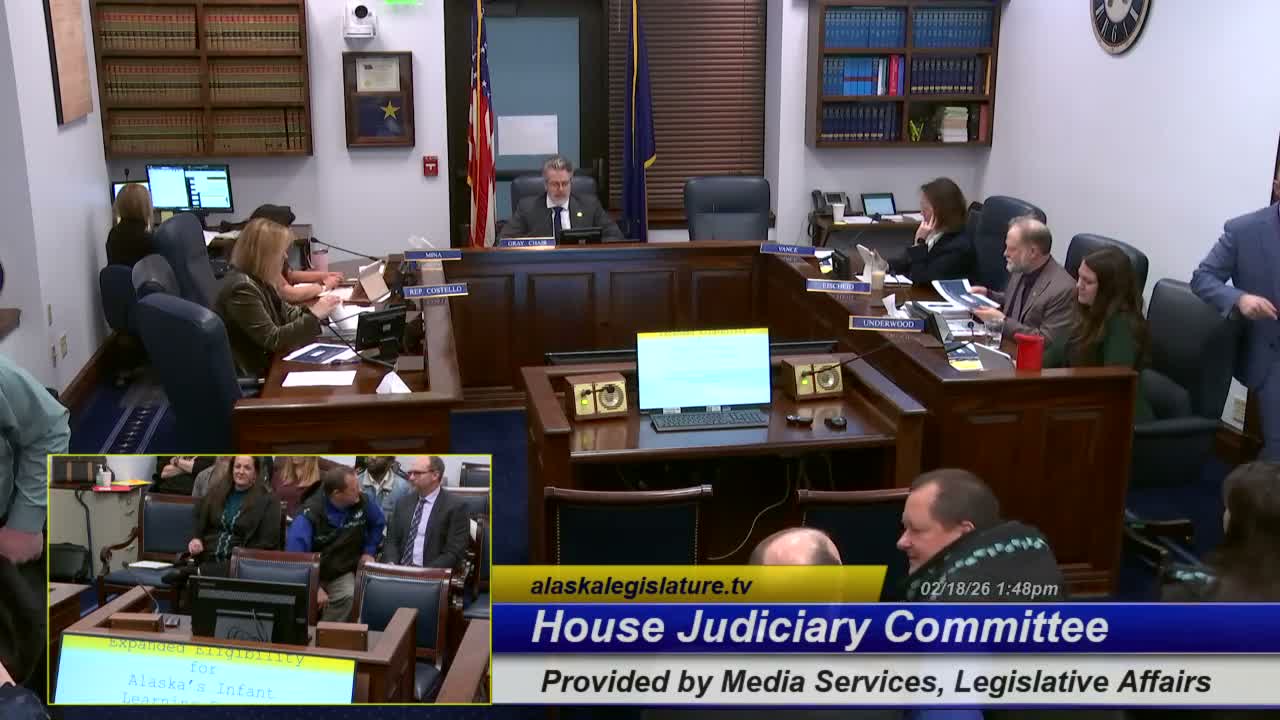
Amy Simpson, executive director of programs for the Anchorage Infant Learning Program, told the House Judiciary Committee that Alaska’s birth-to-3 Part C early intervention system is excessively restrictive and that changing eligibility would provide earlier services, reduce later special-education costs and improve life outcomes.
Simpson said Alaska currently requires a 50% developmental delay for eligibility under state-adopted Part C standards, a stricter threshold than most states. She summarized finance-subcommittee work recommending expansion to a 25% delay and said that change would allow the system to serve an additional 1,600 children a year. Simpson added that the task group is seeking Medicaid statute changes so Part C providers can bill for services, and she cited Senate Bill 178 as the legislative vehicle discussed with providers.
Simpson described program structure: 15 grantees across the state, obligations under the Individuals with Disabilities Education Act (Part C) and referral duties tied to CAPTA (Child Abuse Prevention and Treatment Act). She said roughly one-third of ILP referrals historically come from the Office of Children’s Services (OCS) and that only about 24% of OCS-referred children currently enroll in ILP services, a gap Simpson attributed to restrictive eligibility standards.
During Q&A Representative Eisheiding asked which benchmark states the ILP compared with; Simpson named Massachusetts and New Mexico as examples of states that opened eligibility and emphasized those states include social risk factors in automatic enrollment. Simpson said she did not have direct test-score comparisons available in committee.
Simpson and other presenters stressed that early investment reduces later costs, citing a rule-of-thumb estimate that one dollar spent early can save many dollars later in special-education and justice system costs. No formal committee action was taken; Simpson invited lawmakers to consider SB178 and eligibility changes as part of the session’s bill drafting and budgeting process.
Simpson said Alaska currently requires a 50% developmental delay for eligibility under state-adopted Part C standards, a stricter threshold than most states. She summarized finance-subcommittee work recommending expansion to a 25% delay and said that change would allow the system to serve an additional 1,600 children a year. Simpson added that the task group is seeking Medicaid statute changes so Part C providers can bill for services, and she cited Senate Bill 178 as the legislative vehicle discussed with providers.
Simpson described program structure: 15 grantees across the state, obligations under the Individuals with Disabilities Education Act (Part C) and referral duties tied to CAPTA (Child Abuse Prevention and Treatment Act). She said roughly one-third of ILP referrals historically come from the Office of Children’s Services (OCS) and that only about 24% of OCS-referred children currently enroll in ILP services, a gap Simpson attributed to restrictive eligibility standards.
During Q&A Representative Eisheiding asked which benchmark states the ILP compared with; Simpson named Massachusetts and New Mexico as examples of states that opened eligibility and emphasized those states include social risk factors in automatic enrollment. Simpson said she did not have direct test-score comparisons available in committee.
Simpson and other presenters stressed that early investment reduces later costs, citing a rule-of-thumb estimate that one dollar spent early can save many dollars later in special-education and justice system costs. No formal committee action was taken; Simpson invited lawmakers to consider SB178 and eligibility changes as part of the session’s bill drafting and budgeting process.
Don't Miss a Word: See the Full Meeting!
Go beyond summaries. Unlock every video, transcript, and key insight with a Founder Membership.
✓
Get instant access to full meeting videos
✓
Search and clip any phrase from complete transcripts
✓
Receive AI-powered summaries & custom alerts
✓
Enjoy lifetime, unrestricted access to government data
30-day money-back guarantee
