Administration outlines multi‑year plan to modernize Alaska’s pay and classification system
February 18, 2026 | 2026 Legislature Alaska, Alaska
This article was created by AI summarizing key points discussed. AI makes mistakes, so for full details and context, please refer to the video of the full meeting. Please report any errors so we can fix them. Report an error »
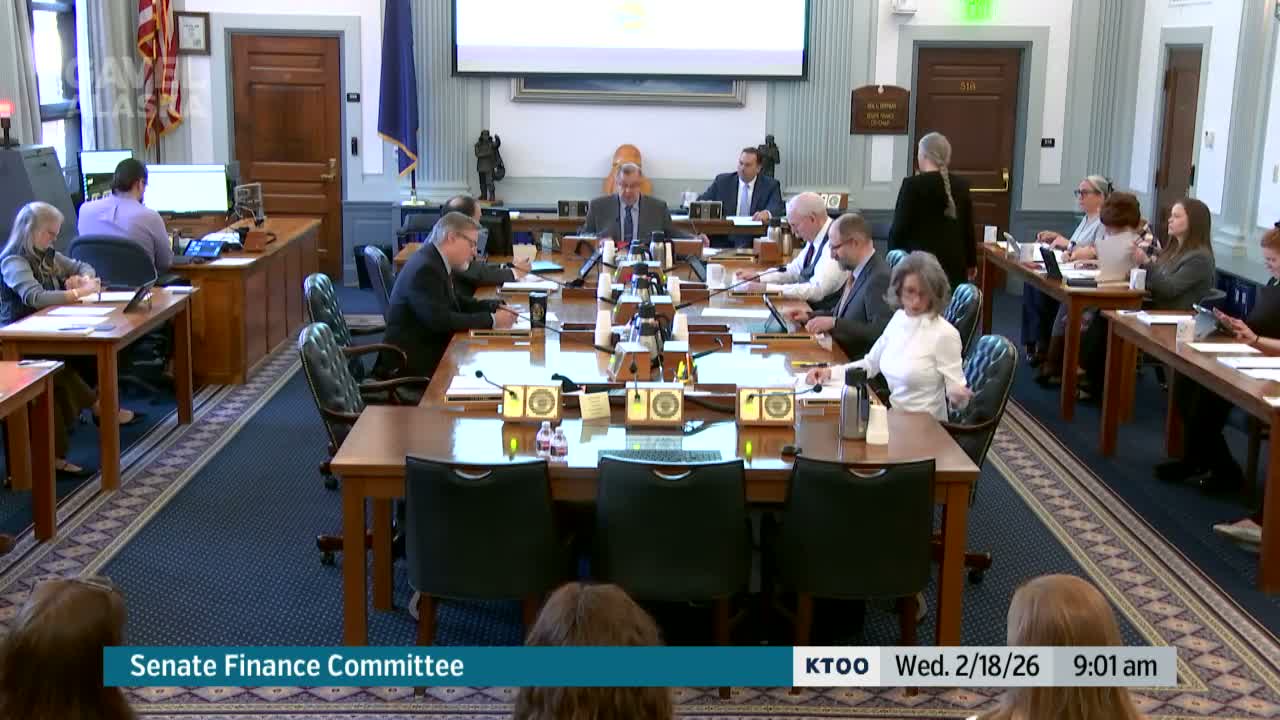
The Alaska Department of Administration told the Senate Finance Committee on Feb. 18 that a 2025 statewide salary study shows most benchmarked state jobs are near market but that structural changes will be needed to modernize the state’s classification and pay plans.
Commissioner Paula Grama, commissioner of the Department of Administration, said the Segal study covered 404 benchmark classifications across the executive branch and reported that about 72% of benchmark jobs are at or above market at the 50th percentile and 57% are at or above market at the 60th percentile. "We must be methodical in our approach," Grama said, cautioning that implementing a systemic redesign would be complex and costly.
The study was funded by a legislative appropriation of $1,000,000 and finalized in 2025. Grama said the division issued a Request for Information (RFI) that closed Feb. 2, 2026, to gather vendor input on tools, approaches and costs for redesigning classification and pay systems. Amy De Vares, director of the Division of Personnel, described RFI responses as wide in scope and said some vendors offered automated market‑review tools and software to modernize position descriptions and salary administration.
De Vares said the division is shifting from ad hoc, department‑driven class studies to a strategic maintenance plan that will update classifications by job family on a rotational cycle, using criteria such as salary‑study results, recruitment and retention pressure and job complexity. "This will allow us to plan more impactful changes but spread those costs out incrementally by budgeting, by family or occupational group," De Vares said.
The department also reported it currently has nine job‑class studies under way — including park rangers; Alaska State Commission on Human Rights field representatives; community care licensing specialists; vocational rehabilitation; public assistance field services; forest and fire management; emergency services dispatchers and supervisors; and forensic laboratory positions — and that two of those target classes the study flagged as more than 10% under market.
When senators asked how the study squares with ongoing hiring shortfalls, especially in Corrections and Public Safety, Grama and De Vares emphasized the study measured base pay and that recruitment and retention are shaped by additional factors such as premium pay, geographic differentials, working conditions and retention incentives. "The salary study really looked at base pay," De Vares said. She added exit interview data are collected monthly and can be shared with departments and the committee to help diagnose turnover drivers.
Grama provided OMB’s high‑level implementation estimate for a comprehensive update: about $93,000,000 at the 50th percentile and about $180,000,000 at the 60th percentile. She stressed those figures are recurring costs and that each job family and position would need individual evaluation before any implementation.
Committee members asked about timing and future‑proofing the system against technological change such as wider AI adoption. Staff advising the committee said RFI responses suggested a contracting option could require a timeframe similar to the study itself and that implementation of a fully redesigned classification system would be a multi‑year effort, not months.
De Vares and Grama said next steps include reviewing RFI responses, considering a request for proposals if appropriate, and continuing the strategic maintenance plan to prioritize near‑term class studies while evaluating whether to pursue a larger redesign. The committee asked the administration to provide payroll forecasts or OMB projections to help model long‑term cost impacts and requested aggregated exit interview summaries to inform retention policy.
The committee adjourned and scheduled its next meeting for Feb. 19 at 9 a.m.
Commissioner Paula Grama, commissioner of the Department of Administration, said the Segal study covered 404 benchmark classifications across the executive branch and reported that about 72% of benchmark jobs are at or above market at the 50th percentile and 57% are at or above market at the 60th percentile. "We must be methodical in our approach," Grama said, cautioning that implementing a systemic redesign would be complex and costly.
The study was funded by a legislative appropriation of $1,000,000 and finalized in 2025. Grama said the division issued a Request for Information (RFI) that closed Feb. 2, 2026, to gather vendor input on tools, approaches and costs for redesigning classification and pay systems. Amy De Vares, director of the Division of Personnel, described RFI responses as wide in scope and said some vendors offered automated market‑review tools and software to modernize position descriptions and salary administration.
De Vares said the division is shifting from ad hoc, department‑driven class studies to a strategic maintenance plan that will update classifications by job family on a rotational cycle, using criteria such as salary‑study results, recruitment and retention pressure and job complexity. "This will allow us to plan more impactful changes but spread those costs out incrementally by budgeting, by family or occupational group," De Vares said.
The department also reported it currently has nine job‑class studies under way — including park rangers; Alaska State Commission on Human Rights field representatives; community care licensing specialists; vocational rehabilitation; public assistance field services; forest and fire management; emergency services dispatchers and supervisors; and forensic laboratory positions — and that two of those target classes the study flagged as more than 10% under market.
When senators asked how the study squares with ongoing hiring shortfalls, especially in Corrections and Public Safety, Grama and De Vares emphasized the study measured base pay and that recruitment and retention are shaped by additional factors such as premium pay, geographic differentials, working conditions and retention incentives. "The salary study really looked at base pay," De Vares said. She added exit interview data are collected monthly and can be shared with departments and the committee to help diagnose turnover drivers.
Grama provided OMB’s high‑level implementation estimate for a comprehensive update: about $93,000,000 at the 50th percentile and about $180,000,000 at the 60th percentile. She stressed those figures are recurring costs and that each job family and position would need individual evaluation before any implementation.
Committee members asked about timing and future‑proofing the system against technological change such as wider AI adoption. Staff advising the committee said RFI responses suggested a contracting option could require a timeframe similar to the study itself and that implementation of a fully redesigned classification system would be a multi‑year effort, not months.
De Vares and Grama said next steps include reviewing RFI responses, considering a request for proposals if appropriate, and continuing the strategic maintenance plan to prioritize near‑term class studies while evaluating whether to pursue a larger redesign. The committee asked the administration to provide payroll forecasts or OMB projections to help model long‑term cost impacts and requested aggregated exit interview summaries to inform retention policy.
The committee adjourned and scheduled its next meeting for Feb. 19 at 9 a.m.
View the Full Meeting & All Its Details
This article offers just a summary. Unlock complete video, transcripts, and insights as a Founder Member.
✓
Watch full, unedited meeting videos
✓
Search every word spoken in unlimited transcripts
✓
AI summaries & real-time alerts (all government levels)
✓
Permanent access to expanding government content
30-day money-back guarantee
