Madison transportation staff and community press for short-term fixes and long-term redesign after Park Street pedestrian death
February 19, 2026 | Madison, Dane County, Wisconsin
This article was created by AI summarizing key points discussed. AI makes mistakes, so for full details and context, please refer to the video of the full meeting. Please report any errors so we can fix them. Report an error »
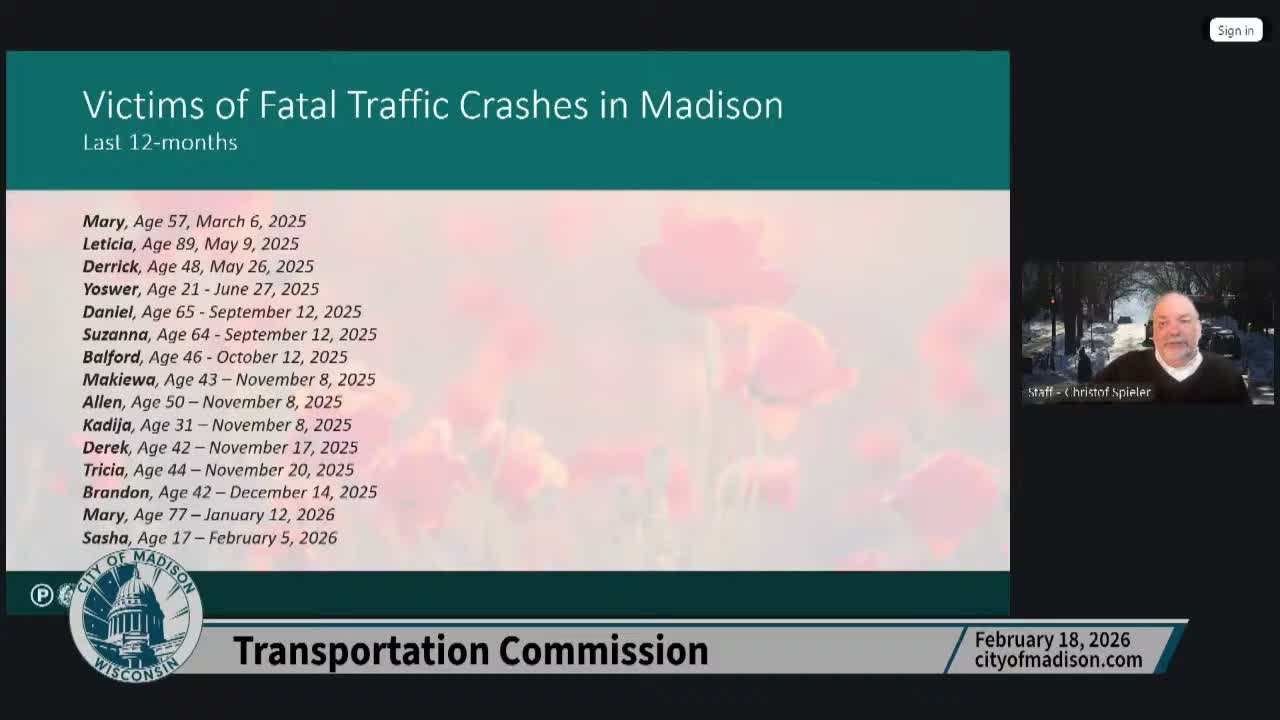
Madison transportation staff and community members on Feb. 18 called for immediate and sustained action to reduce dangerous speeds on South Park Street after the recent death of 17-year-old Sasha Rosen.
City Transportation Director Christophe Spiehler opened the discussion by emphasizing the human cost of crashes and the limits of any single presentation to address community grief. Spiehler said staff would present what is known about Park Street, the city’s approach to street safety and how the city responds to fatal crashes.
“We are here not just to present, but to listen,” Spiehler told the commission. He described a reconstruction project tied to the North–South bus rapid transit (BRT) route that would rebuild Park Street from south of Wingra Drive to Fish Hatchery Road and add pedestrian and bicycle facilities, but said that project requires federal funding and is on a multi-year schedule.
Yang Tao, who leads the city’s Vision 0 safe-systems program, summarized the city’s safety strategy — design, speed management, enforcement and data-driven targeting — and the city’s progress since adopting Vision 0 in 2020. Yang said the city has delivered hundreds of Safe Streets projects and secured more than $20,000,000 in federal safety-related funding for traffic projects.
Members of Madison’s police department described investigative and enforcement work after fatal crashes. A traffic captain said investigators determined speed was a ‘‘significant and reckless factor’’ in the crash that killed Sasha Rosen and that police estimate the suspect vehicle was traveling approximately 62 miles per hour in a 25 mph zone; the suspect was arrested and charged and a court set a cash bond. Police said they increased enforcement on Park Street after the crash but acknowledged the department assigns five traffic investigators citywide and staffing limits enforcement capacity.
Family members and dozens of residents told the commission that existing measures — a flashing beacon, continental crosswalk markings and a 25-mph limit implemented in 2021 — have not prevented deadly collisions. Margaret Rosen, Sasha’s aunt, urged the commission to pursue “swift implementation of interim decisions” and to evaluate how long proposed measures will take to become effective.
Public speakers and commissioners pressed staff for short-term ‘‘quick-build’’ pilots that could be implemented before reconstruction: temporary lane reductions with barrels or cones, speed radar display signs, clearer bicycle/bus-lane markings, curb-ramp improvements, signage and highly visible crosswalk treatments. Commissioners asked staff to return with concrete short-term options for Park Street that could be implemented without waiting for federal reconstruction funds.
Staff said they have considered many temporary measures and have installed flags and additional signing; they expressed caution about some temporary devices in winter (snow removal) and concern that certain interventions could create other safety or operational problems. Yang said staff will review pilot options — including tubular markers, temporary lane configurations and additional speed-display signs — and bring specific proposals back to the commission for approval.
Speakers also urged state-level changes. Yang and a WisDOT representative said automated speed-enforcement cameras are currently prohibited by Wisconsin state law; Yang said a legislative bill is in process that would enable limited pilots in class-1 cities but would not immediately allow broader use statewide.
Commissioners and staff framed the problem as both technical and cultural: they called for sustained funding and staffing to deliver Vision 0 projects, better coordination with WisDOT on state-controlled arterials and public outreach to shift long-standing driving behaviors. The commission requested a future briefing on the city’s Safe Routes to School work and directed staff to return with short-term Park Street options at an upcoming meeting.
The most recent procedural action at the meeting was the commission’s request for follow-up: staff committed to evaluate and propose short-term pilots for Park Street and to provide updated crash and project timelines to the commission. The longer-term Park Street reconstruction remains tied to federal environmental review and grant approvals, with construction likely in the 2028 timeframe if federal funding is secured.
What’s next: staff will prepare specific short-term pilot options for Park Street, present Vision 0 progress materials including crash heat maps and safe-routes planning to the commission, and continue coordination with MPD and WisDOT on project scoping and approvals.
City Transportation Director Christophe Spiehler opened the discussion by emphasizing the human cost of crashes and the limits of any single presentation to address community grief. Spiehler said staff would present what is known about Park Street, the city’s approach to street safety and how the city responds to fatal crashes.
“We are here not just to present, but to listen,” Spiehler told the commission. He described a reconstruction project tied to the North–South bus rapid transit (BRT) route that would rebuild Park Street from south of Wingra Drive to Fish Hatchery Road and add pedestrian and bicycle facilities, but said that project requires federal funding and is on a multi-year schedule.
Yang Tao, who leads the city’s Vision 0 safe-systems program, summarized the city’s safety strategy — design, speed management, enforcement and data-driven targeting — and the city’s progress since adopting Vision 0 in 2020. Yang said the city has delivered hundreds of Safe Streets projects and secured more than $20,000,000 in federal safety-related funding for traffic projects.
Members of Madison’s police department described investigative and enforcement work after fatal crashes. A traffic captain said investigators determined speed was a ‘‘significant and reckless factor’’ in the crash that killed Sasha Rosen and that police estimate the suspect vehicle was traveling approximately 62 miles per hour in a 25 mph zone; the suspect was arrested and charged and a court set a cash bond. Police said they increased enforcement on Park Street after the crash but acknowledged the department assigns five traffic investigators citywide and staffing limits enforcement capacity.
Family members and dozens of residents told the commission that existing measures — a flashing beacon, continental crosswalk markings and a 25-mph limit implemented in 2021 — have not prevented deadly collisions. Margaret Rosen, Sasha’s aunt, urged the commission to pursue “swift implementation of interim decisions” and to evaluate how long proposed measures will take to become effective.
Public speakers and commissioners pressed staff for short-term ‘‘quick-build’’ pilots that could be implemented before reconstruction: temporary lane reductions with barrels or cones, speed radar display signs, clearer bicycle/bus-lane markings, curb-ramp improvements, signage and highly visible crosswalk treatments. Commissioners asked staff to return with concrete short-term options for Park Street that could be implemented without waiting for federal reconstruction funds.
Staff said they have considered many temporary measures and have installed flags and additional signing; they expressed caution about some temporary devices in winter (snow removal) and concern that certain interventions could create other safety or operational problems. Yang said staff will review pilot options — including tubular markers, temporary lane configurations and additional speed-display signs — and bring specific proposals back to the commission for approval.
Speakers also urged state-level changes. Yang and a WisDOT representative said automated speed-enforcement cameras are currently prohibited by Wisconsin state law; Yang said a legislative bill is in process that would enable limited pilots in class-1 cities but would not immediately allow broader use statewide.
Commissioners and staff framed the problem as both technical and cultural: they called for sustained funding and staffing to deliver Vision 0 projects, better coordination with WisDOT on state-controlled arterials and public outreach to shift long-standing driving behaviors. The commission requested a future briefing on the city’s Safe Routes to School work and directed staff to return with short-term Park Street options at an upcoming meeting.
The most recent procedural action at the meeting was the commission’s request for follow-up: staff committed to evaluate and propose short-term pilots for Park Street and to provide updated crash and project timelines to the commission. The longer-term Park Street reconstruction remains tied to federal environmental review and grant approvals, with construction likely in the 2028 timeframe if federal funding is secured.
What’s next: staff will prepare specific short-term pilot options for Park Street, present Vision 0 progress materials including crash heat maps and safe-routes planning to the commission, and continue coordination with MPD and WisDOT on project scoping and approvals.
Don't Miss a Word: See the Full Meeting!
Go beyond summaries. Unlock every video, transcript, and key insight with a Founder Membership.
✓
Get instant access to full meeting videos
✓
Search and clip any phrase from complete transcripts
✓
Receive AI-powered summaries & custom alerts
✓
Enjoy lifetime, unrestricted access to government data
30-day money-back guarantee
