Dunn County staff warn of growing property-deed fraud as state updates transfer-return system
February 18, 2026 | Dunn County, Wisconsin
This article was created by AI summarizing key points discussed. AI makes mistakes, so for full details and context, please refer to the video of the full meeting. Please report any errors so we can fix them. Report an error »
Heather, Dunn County’s register of deeds, told the committee that the Wisconsin Department of Revenue updated the real estate transfer-return system in January and that the change requires counties to connect conveyance recording with the transfer-return process. Heather said the system update is primarily technical and does not increase local transfer fees: “There there isn't a fee increase with that transfer fee change,” she said.
Tom in the county survey division told the committee that land‑record professionals at a recent conference highlighted a rise in property‑deed fraud, including cases where a fraudulent grantor conveys property and a subsequent buyer begins construction before an owner discovers the sale. “Basically, you have fraudulent grantor, somebody purporting to be the real owner selling property,” Tom said, describing how online tax records and other tools have made some parcels — especially vacant land with out‑of‑area owners — attractive targets.
Staff discussed available responses and limits. Tom and Heather said counties and title companies can issue property‑fraud alerts to notify the public, and an affected owner can record an affidavit asserting rightful ownership and, if necessary, pursue a court action to obtain a judgment restoring title. Those remedies take time and expense: Tom said litigating to restore title can be lengthy and costly. Heather noted the alert systems are reactive; by the time an alert is issued a deed likely already has been recorded.
County staff said they are watching statutory proposals in other states and are working with professional associations to identify possible protections but have not settled on a statutory change. Heather cited a recent case in Ozaukee County and said the county association is “working on it” but that “we haven't come up with a great solution.”
The committee was told practical protections include monitoring property records, especially for vacant parcels, and considering local outreach and technological monitoring, though staff emphasized there is no simple statutory fix in place yet. The meeting closed the discussion by noting staff would continue tracking legislation and industry options.
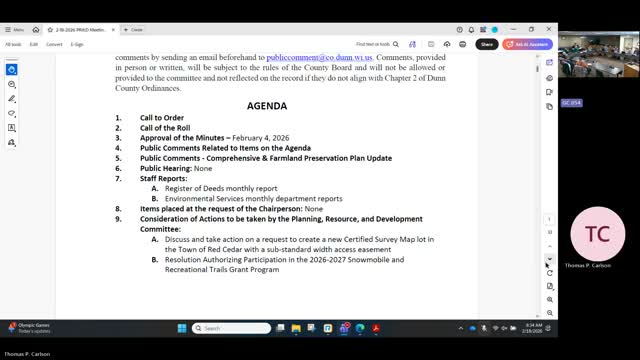
The committee also approved the Feb. 4 minutes at the start of the meeting as part of routine procedure.
Tom in the county survey division told the committee that land‑record professionals at a recent conference highlighted a rise in property‑deed fraud, including cases where a fraudulent grantor conveys property and a subsequent buyer begins construction before an owner discovers the sale. “Basically, you have fraudulent grantor, somebody purporting to be the real owner selling property,” Tom said, describing how online tax records and other tools have made some parcels — especially vacant land with out‑of‑area owners — attractive targets.
Staff discussed available responses and limits. Tom and Heather said counties and title companies can issue property‑fraud alerts to notify the public, and an affected owner can record an affidavit asserting rightful ownership and, if necessary, pursue a court action to obtain a judgment restoring title. Those remedies take time and expense: Tom said litigating to restore title can be lengthy and costly. Heather noted the alert systems are reactive; by the time an alert is issued a deed likely already has been recorded.
County staff said they are watching statutory proposals in other states and are working with professional associations to identify possible protections but have not settled on a statutory change. Heather cited a recent case in Ozaukee County and said the county association is “working on it” but that “we haven't come up with a great solution.”
The committee was told practical protections include monitoring property records, especially for vacant parcels, and considering local outreach and technological monitoring, though staff emphasized there is no simple statutory fix in place yet. The meeting closed the discussion by noting staff would continue tracking legislation and industry options.
The committee also approved the Feb. 4 minutes at the start of the meeting as part of routine procedure.
View the Full Meeting & All Its Details
This article offers just a summary. Unlock complete video, transcripts, and insights as a Founder Member.
✓
Watch full, unedited meeting videos
✓
Search every word spoken in unlimited transcripts
✓
AI summaries & real-time alerts (all government levels)
✓
Permanent access to expanding government content
30-day money-back guarantee
