Aurora to begin orthophosphate dosing as short-term step to reduce lead in drinking water
February 18, 2026 | Aurora, DuPage County, Illinois
This article was created by AI summarizing key points discussed. AI makes mistakes, so for full details and context, please refer to the video of the full meeting. Please report any errors so we can fix them. Report an error »
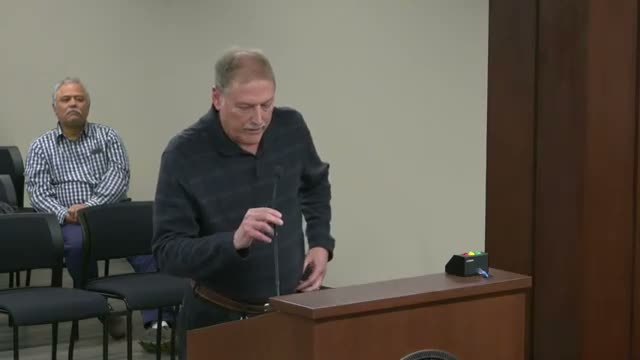
Mayor Lesch and the Committee of the Whole heard a technical briefing Feb. 17 from Bob Lively, the city's water production superintendent, on steps Aurora will take to reduce lead in drinking water.
Lively said the city's consultant, CDM Smith, completed a corrosion-control study with pipe-loop tests that compared three orthophosphate dosing levels. "We studied 3 different doses, a 1 part per million or milligram per liter, a 2 milligram per liter, and a 3 milligram per liter dose," Lively said, and he added that the 2 mg/L dose "was determined to be the most cost effective and produced the best overall result." He said the study will inform a recommendation the city submits to the Illinois Environmental Protection Agency (IEPA).
Why it matters: Aurora's 2025 monitoring showed lead at the 90th percentile above the prior action level under revised sampling and analysis procedures. Lively told the council that orthophosphate is an established corrosion inhibitor that forms protective scales inside pipes and can lower lead concentrations when added at the treatment plant.
What staff plan to do: Lively said the city will install a temporary feed system at the treatment plant and is "shooting for some time in March to actually turn the pump on and start feeding the chemical." He said a permanent feed system will require engineering, permitting and construction. The chemical form under consideration is di-potassium orthophosphate (K2HPO4); Lively called it NSF/ANSI 60 certified and said the IEPA has been actively involved in reviewing the study results.
Timing and expectations: Council members asked whether the change in 2025 results reflected a true deterioration or simply a change in sampling and analysis. Lively responded that the monitoring and sampling methodology changed and that can drive apparent increases; he said the city is under a new monitoring protocol while addressing the exceedance. On how quickly numbers could fall, Lively said improvements might be visible in the next monitoring period but were not guaranteed immediately: "The sooner we can get it into the system, we can start seeing some benefits," he said.
Costs and regulation: Lively estimated the City's contract for the chemical this year at roughly $300,000 and noted the city recently received $1,000,000 in federal funding to help with lead line replacement. He also discussed federal rulemaking (Lead and Copper Rule Improvements) that would set a lower federal limit (10 ppb at the 90th percentile) if finalized; the study indicates the proposed treatment approach could achieve lower levels.
Next steps: City staff said they will pursue procurement for the temporary feed, submit the corrosion-control recommendation to the IEPA, and return with details on the permanent feed system permitting and timeline. The council was told replacement of individual lead service lines will continue — the orthophosphate dosing is presented as a system-wide, interim corrosion-control measure.
Ending: Lively closed by noting the IEPA's involvement and the city's intent to both accelerate service-line replacement and apply corrosion control to reduce lead exposure while replacements proceed.
Lively said the city's consultant, CDM Smith, completed a corrosion-control study with pipe-loop tests that compared three orthophosphate dosing levels. "We studied 3 different doses, a 1 part per million or milligram per liter, a 2 milligram per liter, and a 3 milligram per liter dose," Lively said, and he added that the 2 mg/L dose "was determined to be the most cost effective and produced the best overall result." He said the study will inform a recommendation the city submits to the Illinois Environmental Protection Agency (IEPA).
Why it matters: Aurora's 2025 monitoring showed lead at the 90th percentile above the prior action level under revised sampling and analysis procedures. Lively told the council that orthophosphate is an established corrosion inhibitor that forms protective scales inside pipes and can lower lead concentrations when added at the treatment plant.
What staff plan to do: Lively said the city will install a temporary feed system at the treatment plant and is "shooting for some time in March to actually turn the pump on and start feeding the chemical." He said a permanent feed system will require engineering, permitting and construction. The chemical form under consideration is di-potassium orthophosphate (K2HPO4); Lively called it NSF/ANSI 60 certified and said the IEPA has been actively involved in reviewing the study results.
Timing and expectations: Council members asked whether the change in 2025 results reflected a true deterioration or simply a change in sampling and analysis. Lively responded that the monitoring and sampling methodology changed and that can drive apparent increases; he said the city is under a new monitoring protocol while addressing the exceedance. On how quickly numbers could fall, Lively said improvements might be visible in the next monitoring period but were not guaranteed immediately: "The sooner we can get it into the system, we can start seeing some benefits," he said.
Costs and regulation: Lively estimated the City's contract for the chemical this year at roughly $300,000 and noted the city recently received $1,000,000 in federal funding to help with lead line replacement. He also discussed federal rulemaking (Lead and Copper Rule Improvements) that would set a lower federal limit (10 ppb at the 90th percentile) if finalized; the study indicates the proposed treatment approach could achieve lower levels.
Next steps: City staff said they will pursue procurement for the temporary feed, submit the corrosion-control recommendation to the IEPA, and return with details on the permanent feed system permitting and timeline. The council was told replacement of individual lead service lines will continue — the orthophosphate dosing is presented as a system-wide, interim corrosion-control measure.
Ending: Lively closed by noting the IEPA's involvement and the city's intent to both accelerate service-line replacement and apply corrosion control to reduce lead exposure while replacements proceed.
View the Full Meeting & All Its Details
This article offers just a summary. Unlock complete video, transcripts, and insights as a Founder Member.
✓
Watch full, unedited meeting videos
✓
Search every word spoken in unlimited transcripts
✓
AI summaries & real-time alerts (all government levels)
✓
Permanent access to expanding government content
30-day money-back guarantee
