House education panel hears UPR virtual campus proposal; university warns of cost, accreditation and governance risks
February 18, 2026 | House of Representatives, House, Committees, Legislative, Puerto Rico, International
This article was created by AI summarizing key points discussed. AI makes mistakes, so for full details and context, please refer to the video of the full meeting. Please report any errors so we can fix them. Report an error »
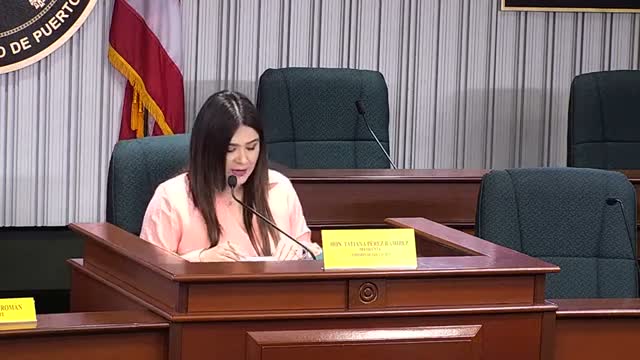
San Juan — The House of Representatives’ Commission on Education heard extensive testimony Feb. 18 on two measures aimed at expanding the University of Puerto Rico’s international online footprint: Joint Resolution 134 (author Héctor Ferrer Santiago) and Bill 993 (author and commission president Tatiana Pérez Ramírez).
Committee members and invited witnesses described the proposal as an opportunity to boost enrollment and diversify revenue, but university officials warned the measure, as written, would create governance and fiscal challenges that require careful amendment and additional time for planning.
Private providers and industry back the idea
Vanessa Blanco, director of Nova Southeastern University’s Puerto Rico campus, and Carol Morales, rector of Universidad Internacional Iberoamericana, told legislators their institutions have long experience offering online and hybrid programs and said the measures could help UPR expand access and reach diasporic and Spanish‑speaking students abroad. Karen Mojica, vice president of the Asociación de Industriales, said her organization (about 880 member firms) supports the proposals and urged the committee to align program offerings with workforce needs, propose internships with industry partners and avoid duplicative bureaucracy.
"This initiative can expand academic offerings beyond our territorial limits and create revenue that strengthens UPR’s finances," Mojica said, while recommending careful phasing of initial budget allocations so the measure does not conflict with PROMESA and certified fiscal plans.
UPR: strategic opportunity but legislative timing and funding raise red flags
Representatives of the University of Puerto Rico, including Edna Shar Santana (vicepresident, distance professional programs) and Wilmar Santiago (vicepresidency representative), said the institution endorses the idea of expanding virtual offerings but cautioned that creating a new administrative 'recinto' (campus) or a separate office carries major implications for governance, accreditation and recurring costs. They told the committee the university already administers virtual programs across its recintos and suggested strengthening the role of existing vice‑presidential structures instead of creating parallel entities.
UPR provided preliminary fiscal estimates, describing them as conceptual and subject to analysis: an initial implementation cost in the order of $13,000,000 and recurring annual operational costs around $8,000,000. UPR officials said those figures do not come from vendor quotes or approved institutional budgets and asked the legislature to allow time for detailed financial study and for governance approvals required under the university’s organic law.
"The creation of a new institutional structure of this magnitude requires planning, accreditation review and budgetary sustainability; the timelines in the resolution (including operationalization before the next academic year and full implementation in 24 months) are not feasible without risking academic and fiscal standards," Wilmar Santiago said.
Data and process demands from the committee
Lawmakers pressed witnesses for specific enrollment and program data. UPR reported roughly 597 students currently registered in fully online academic programs and said the system has 29 accredited virtual programs with two more in process. Private institutions gave rough enrollment and course‑operation figures (Interamericana ~2,000 students; NSU ~600 courses per semester) and agreed to provide detailed counts and pricing differentials for residents vs. non‑residents.
To inform committee work, the chair set clear deliverables: UPR and other witnesses were asked to submit updated program‑by‑program enrollment figures, up‑to‑date website and program inventories, and detailed fiscal tables within five business days; a broader memorial and further financial inputs were given a 10‑business‑day deadline.
Committee discussion focused on three practical choices: (1) amend the bills to avoid creating an unnecessary parallel administrative entity by empowering the existing vice‑presidency or integrating the special fund into existing structures; (2) define sustainable recurrent funding and transparent rules for the special fund; and (3) lengthen legislative timelines to permit accreditation reviews, curricular processes and board approvals that protect university autonomy.
What happens next
The commission will receive the written materials requested from UPR, private providers and the Association of Industriales and use those inputs to draft amendments. No formal vote on either measure occurred at the hearing. The committee adjourned after setting the deadlines for the requested documents and stating it will consider recommended edits to align the legislation with accreditation, fiscal and governance requirements.
Committee members and invited witnesses described the proposal as an opportunity to boost enrollment and diversify revenue, but university officials warned the measure, as written, would create governance and fiscal challenges that require careful amendment and additional time for planning.
Private providers and industry back the idea
Vanessa Blanco, director of Nova Southeastern University’s Puerto Rico campus, and Carol Morales, rector of Universidad Internacional Iberoamericana, told legislators their institutions have long experience offering online and hybrid programs and said the measures could help UPR expand access and reach diasporic and Spanish‑speaking students abroad. Karen Mojica, vice president of the Asociación de Industriales, said her organization (about 880 member firms) supports the proposals and urged the committee to align program offerings with workforce needs, propose internships with industry partners and avoid duplicative bureaucracy.
"This initiative can expand academic offerings beyond our territorial limits and create revenue that strengthens UPR’s finances," Mojica said, while recommending careful phasing of initial budget allocations so the measure does not conflict with PROMESA and certified fiscal plans.
UPR: strategic opportunity but legislative timing and funding raise red flags
Representatives of the University of Puerto Rico, including Edna Shar Santana (vicepresident, distance professional programs) and Wilmar Santiago (vicepresidency representative), said the institution endorses the idea of expanding virtual offerings but cautioned that creating a new administrative 'recinto' (campus) or a separate office carries major implications for governance, accreditation and recurring costs. They told the committee the university already administers virtual programs across its recintos and suggested strengthening the role of existing vice‑presidential structures instead of creating parallel entities.
UPR provided preliminary fiscal estimates, describing them as conceptual and subject to analysis: an initial implementation cost in the order of $13,000,000 and recurring annual operational costs around $8,000,000. UPR officials said those figures do not come from vendor quotes or approved institutional budgets and asked the legislature to allow time for detailed financial study and for governance approvals required under the university’s organic law.
"The creation of a new institutional structure of this magnitude requires planning, accreditation review and budgetary sustainability; the timelines in the resolution (including operationalization before the next academic year and full implementation in 24 months) are not feasible without risking academic and fiscal standards," Wilmar Santiago said.
Data and process demands from the committee
Lawmakers pressed witnesses for specific enrollment and program data. UPR reported roughly 597 students currently registered in fully online academic programs and said the system has 29 accredited virtual programs with two more in process. Private institutions gave rough enrollment and course‑operation figures (Interamericana ~2,000 students; NSU ~600 courses per semester) and agreed to provide detailed counts and pricing differentials for residents vs. non‑residents.
To inform committee work, the chair set clear deliverables: UPR and other witnesses were asked to submit updated program‑by‑program enrollment figures, up‑to‑date website and program inventories, and detailed fiscal tables within five business days; a broader memorial and further financial inputs were given a 10‑business‑day deadline.
Committee discussion focused on three practical choices: (1) amend the bills to avoid creating an unnecessary parallel administrative entity by empowering the existing vice‑presidency or integrating the special fund into existing structures; (2) define sustainable recurrent funding and transparent rules for the special fund; and (3) lengthen legislative timelines to permit accreditation reviews, curricular processes and board approvals that protect university autonomy.
What happens next
The commission will receive the written materials requested from UPR, private providers and the Association of Industriales and use those inputs to draft amendments. No formal vote on either measure occurred at the hearing. The committee adjourned after setting the deadlines for the requested documents and stating it will consider recommended edits to align the legislation with accreditation, fiscal and governance requirements.
View the Full Meeting & All Its Details
This article offers just a summary. Unlock complete video, transcripts, and insights as a Founder Member.
✓
Watch full, unedited meeting videos
✓
Search every word spoken in unlimited transcripts
✓
AI summaries & real-time alerts (all government levels)
✓
Permanent access to expanding government content
30-day money-back guarantee
