Santa Fe approves one-year gunshot-detection contract funded by DOH grant
February 19, 2026 | Santa Fe, Santa Fe County, New Mexico
This article was created by AI summarizing key points discussed. AI makes mistakes, so for full details and context, please refer to the video of the full meeting. Please report any errors so we can fix them. Report an error »
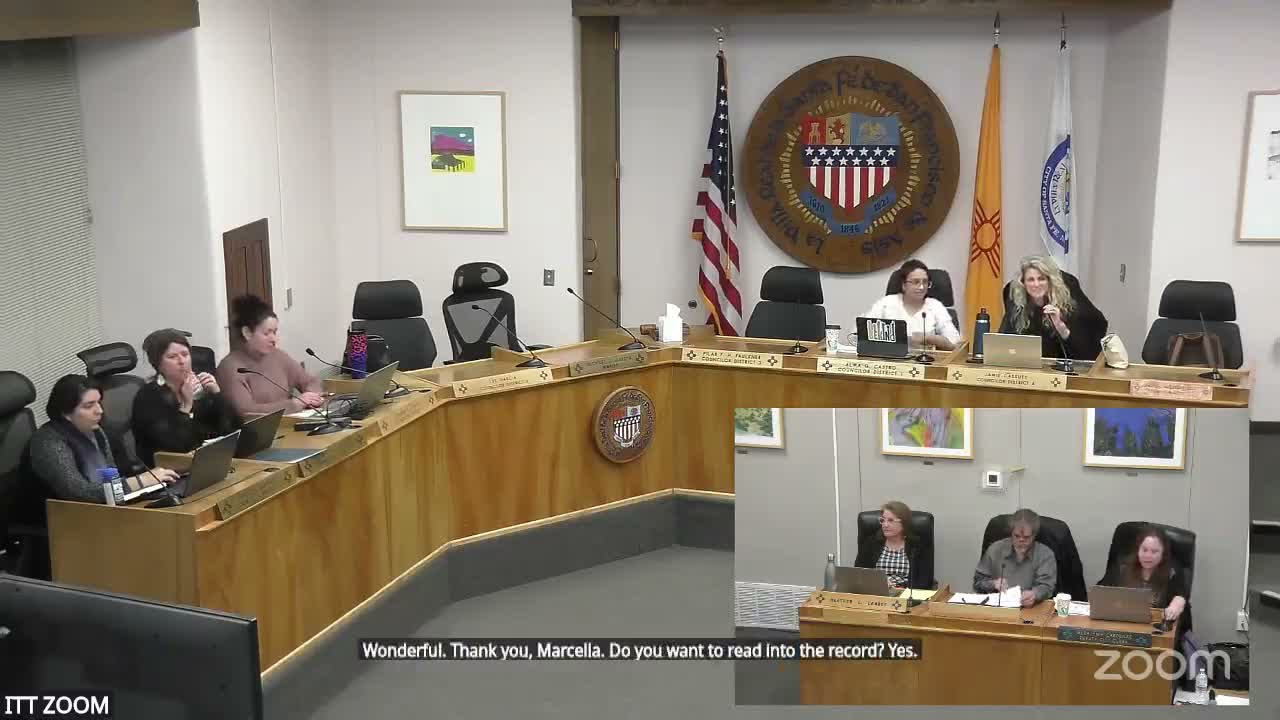
The Santa Fe Quality of Life Committee voted to approve a one-year, $354,000 service agreement with Sound Thinking (formerly ShotSpotter) to provide gunshot-detection, location and forensic-support services. City staff said the purchase is a deliverable under a New Mexico Department of Health violence-prevention grant and will be used to accelerate response, improve evidence mapping and target youth and family services.
"This system does not record conversations. It's not a surveillance platform," Alfred Lures, vice president of trauma response and community engagement at Sound Thinking, told the committee, describing privacy controls the company adopted after an NYU privacy audit.
What the city will get: Staff described coverage of roughly 5.5 square miles focused on historical hot spots (downtown, Midtown and parts of the south side) and said the service includes acoustic vetting (analysts review alerts before forwarding) and data-and-analytics dashboards for transparency and planning. A Sound Thinking representative said the expected sensor density is roughly 15 to 20 sensors per square mile and that the vendor bears responsibility for installation and maintenance.
Use and governance: Police and youth-services staff said the data will be shared with youth-and-family-services teams to guide preventive contracts and direct outreach to schools and neighborhoods identified as high need. Police said the system can push an alert into mobile CAD systems within 60 seconds to speed precise response and improve evidence recovery. Police also said earlier incidents suggest multiple occasions where faster, more localized information might have altered outcomes.
Funding and limits: City staff said the $354,000 purchase is paid through the DOH grant and that the grant expires June 30; staff also warned that future subscriptions will require budget requests. Chief Grundler and other presenters emphasized the program's role as an information tool to support a broader violence-intervention strategy rather than a substitute for community-based prevention.
Council concerns and vote: Councilors pressed on measurement of success, privacy, potential over-policing, and program sustainability if the city must assume future costs. After discussion, the committee approved the contract by roll call; most councilors voted yes while the chair recorded a no. The recorded roll-call sequence on the record included affirmative votes from Councilors Fagali, Barrett, Chavez and Cassett and a no from Chair Castro.
Next steps: Staff said Sound Thinking will assist with policy development, community briefings and dashboards to track agreed metrics. The contract includes trauma-response and community-engagement services and forensic-support with no additional per-alert cost, staff said.
"This system does not record conversations. It's not a surveillance platform," Alfred Lures, vice president of trauma response and community engagement at Sound Thinking, told the committee, describing privacy controls the company adopted after an NYU privacy audit.
What the city will get: Staff described coverage of roughly 5.5 square miles focused on historical hot spots (downtown, Midtown and parts of the south side) and said the service includes acoustic vetting (analysts review alerts before forwarding) and data-and-analytics dashboards for transparency and planning. A Sound Thinking representative said the expected sensor density is roughly 15 to 20 sensors per square mile and that the vendor bears responsibility for installation and maintenance.
Use and governance: Police and youth-services staff said the data will be shared with youth-and-family-services teams to guide preventive contracts and direct outreach to schools and neighborhoods identified as high need. Police said the system can push an alert into mobile CAD systems within 60 seconds to speed precise response and improve evidence recovery. Police also said earlier incidents suggest multiple occasions where faster, more localized information might have altered outcomes.
Funding and limits: City staff said the $354,000 purchase is paid through the DOH grant and that the grant expires June 30; staff also warned that future subscriptions will require budget requests. Chief Grundler and other presenters emphasized the program's role as an information tool to support a broader violence-intervention strategy rather than a substitute for community-based prevention.
Council concerns and vote: Councilors pressed on measurement of success, privacy, potential over-policing, and program sustainability if the city must assume future costs. After discussion, the committee approved the contract by roll call; most councilors voted yes while the chair recorded a no. The recorded roll-call sequence on the record included affirmative votes from Councilors Fagali, Barrett, Chavez and Cassett and a no from Chair Castro.
Next steps: Staff said Sound Thinking will assist with policy development, community briefings and dashboards to track agreed metrics. The contract includes trauma-response and community-engagement services and forensic-support with no additional per-alert cost, staff said.
Don't Miss a Word: See the Full Meeting!
Go beyond summaries. Unlock every video, transcript, and key insight with a Founder Membership.
✓
Get instant access to full meeting videos
✓
Search and clip any phrase from complete transcripts
✓
Receive AI-powered summaries & custom alerts
✓
Enjoy lifetime, unrestricted access to government data
30-day money-back guarantee
