TennCare leaders pitch 4‑year pilot to ease families off Medicaid and seek committee approval for FY‑27 budget
February 18, 2026 | 2026 Legislature TN, Tennessee
This article was created by AI summarizing key points discussed. AI makes mistakes, so for full details and context, please refer to the video of the full meeting. Please report any errors so we can fix them. Report an error »
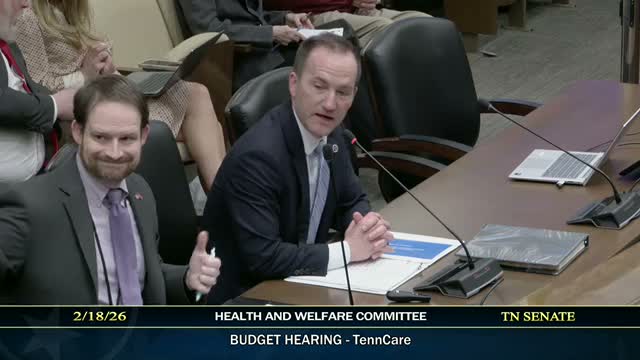
TennCare officials presented the agency’s FY‑27 budget to the Senate Health Committee on Thursday and outlined a proposed 4‑year pilot to help parents transition off Medicaid into private coverage.
Director Steven Smith (referred to in committee as the TennCare director) described program improvements under the state’s waiver and said shared‑savings dollars have allowed record provider investments, including roughly $4 billion for hospitals and $700 million for nursing homes over the past several years. Smith said the budget package includes an innovation called Pathway to Independence, a pilot designed to reduce “benefit cliffs” by providing time‑limited premium assistance and support for parents who gain income.
Under the plan TennCare described, eligible parents who lose TennCare coverage because of increased income could receive up to $2,000 in assistance over 12 months to help pay private insurance premiums or verified cost‑sharing; participants would pay $15 per month unless the premium itself is less than $15. The pilot would be statewide, limited to 15,000 people, and target parent/caretaker adults with incomes up to 250% of the federal poverty level. The agency said it will use independent evaluation and shared‑savings dollars to assess whether the program reduces churn back onto TennCare.
Committee members pressed agency officials about capacity, costs and implementation details. Senator Reeves and others asked about the pilot’s selection method and statewide distribution; the agency said enrollment will be first‑come, first‑served but rules will target the parent category and seek geographic diversity. Members also asked how the pilot would be evaluated; TennCare said it would contract an independent evaluator and track whether participants remain in private coverage and whether churn back onto TennCare falls.
Officials also described other year‑4 shared‑savings requests, including a $125 million one‑time allocation intended to complement a rural health transformation fund and a rural infrastructure grant program administered by the Department of Health. TennCare’s CFO said IT modernization spending has peaked and will decline in FY‑27, with a roughly $50 million decrease from the recent high, and that large procurements (eligibility and MMIS systems) are entering maintenance or reimplementation phases.
Agency staff answered questions about pharmacy benefit arrangements, saying TennCare uses a pharmacy benefits administrator model (Optum) with transparent pass‑through rebates and uniform dispensing fees and that the concerns raised in a separate Commerce audit of national PBMs do not apply to TennCare’s contracts.
After the presentation and questions, the committee approved the budget motion by roll call and advanced the related items to the next steps in the process. TennCare staff said several details, including precise pilot rules and provider‑tax impacts tied to federal match rates, remain subject to rulemaking and further legislative oversight.
The agency said it does not yet know whether Pathway to Independence will produce net savings but described the pilot as an experiment using nonrecurring shared‑savings funds; if successful, officials said, the program could inform longer‑term policy decisions about transitions from Medicaid.
Director Steven Smith (referred to in committee as the TennCare director) described program improvements under the state’s waiver and said shared‑savings dollars have allowed record provider investments, including roughly $4 billion for hospitals and $700 million for nursing homes over the past several years. Smith said the budget package includes an innovation called Pathway to Independence, a pilot designed to reduce “benefit cliffs” by providing time‑limited premium assistance and support for parents who gain income.
Under the plan TennCare described, eligible parents who lose TennCare coverage because of increased income could receive up to $2,000 in assistance over 12 months to help pay private insurance premiums or verified cost‑sharing; participants would pay $15 per month unless the premium itself is less than $15. The pilot would be statewide, limited to 15,000 people, and target parent/caretaker adults with incomes up to 250% of the federal poverty level. The agency said it will use independent evaluation and shared‑savings dollars to assess whether the program reduces churn back onto TennCare.
Committee members pressed agency officials about capacity, costs and implementation details. Senator Reeves and others asked about the pilot’s selection method and statewide distribution; the agency said enrollment will be first‑come, first‑served but rules will target the parent category and seek geographic diversity. Members also asked how the pilot would be evaluated; TennCare said it would contract an independent evaluator and track whether participants remain in private coverage and whether churn back onto TennCare falls.
Officials also described other year‑4 shared‑savings requests, including a $125 million one‑time allocation intended to complement a rural health transformation fund and a rural infrastructure grant program administered by the Department of Health. TennCare’s CFO said IT modernization spending has peaked and will decline in FY‑27, with a roughly $50 million decrease from the recent high, and that large procurements (eligibility and MMIS systems) are entering maintenance or reimplementation phases.
Agency staff answered questions about pharmacy benefit arrangements, saying TennCare uses a pharmacy benefits administrator model (Optum) with transparent pass‑through rebates and uniform dispensing fees and that the concerns raised in a separate Commerce audit of national PBMs do not apply to TennCare’s contracts.
After the presentation and questions, the committee approved the budget motion by roll call and advanced the related items to the next steps in the process. TennCare staff said several details, including precise pilot rules and provider‑tax impacts tied to federal match rates, remain subject to rulemaking and further legislative oversight.
The agency said it does not yet know whether Pathway to Independence will produce net savings but described the pilot as an experiment using nonrecurring shared‑savings funds; if successful, officials said, the program could inform longer‑term policy decisions about transitions from Medicaid.
Don't Miss a Word: See the Full Meeting!
Go beyond summaries. Unlock every video, transcript, and key insight with a Founder Membership.
✓
Get instant access to full meeting videos
✓
Search and clip any phrase from complete transcripts
✓
Receive AI-powered summaries & custom alerts
✓
Enjoy lifetime, unrestricted access to government data
30-day money-back guarantee
