Senate committee clears bill letting optometrists perform limited laser procedures after heated safety debate
February 18, 2026 | 2026 Legislature TN, Tennessee
This article was created by AI summarizing key points discussed. AI makes mistakes, so for full details and context, please refer to the video of the full meeting. Please report any errors so we can fix them. Report an error »
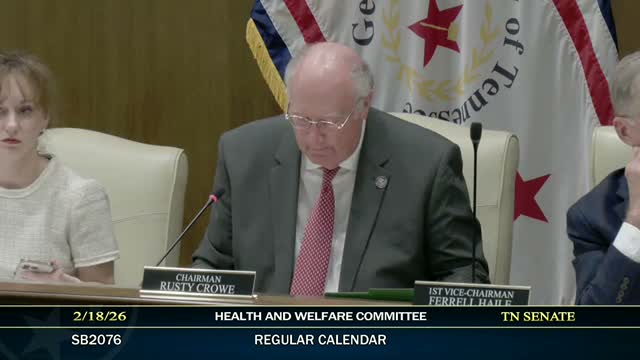
The Senate Health Committee on Thursday voted to advance SB 2076, an amended bill that would allow Tennessee optometrists to perform three specified laser procedures on the anterior segment of the eye within the limits of their training and board rules.
Sponsor Senator Watson said the amendment mostly restates current law and carefully narrows the added procedures to YAG capsulotomy, selective laser trabeculoplasty and peripheral iridotomy, and that the bill removes language that earlier raised member concerns about unregulated board approvals. Watson said training pathways at the Southern College of Optometry support the change and that 15 other states already permit comparable practice.
Ophthalmology witnesses described serious safety concerns. Dr. Bahin Barahimi, immediate past president of the Tennessee Society of Eye Surgeons, told the committee that the procedures require precise lens placement and focusing; without correct technique, he said, laser energy can damage retina tissue and cause irreversible vision loss. "Once the retina is scarred, the vision can never be restored," Barahimi said in testimony urging the committee to restrict the procedures to ophthalmologists.
Optometrists and educators pushed back, arguing the college and accreditation standards already teach these techniques. Dr. David Hall, a Southern College of Optometry instructor, said students receive extensive didactic and clinical training and perform supervised procedures during externships. Dr. Francis Bynum, a Tennessee optometrist, described a patient he said lost vision after being unable to travel to an ophthalmologist 60 miles away, and argued that allowing trained optometrists to perform limited procedures could improve rural access.
Committee members questioned training volumes, oversight and how future procedures would be added. Sponsor Watson told the committee that new techniques would follow the same legislative and board rule processes and that the bill does not provide a shortcut for unvetted procedures. The committee adopted the amendment and approved the bill by roll call (8 ayes, 1 no), sending it to the calendar.
The record shows a clear divide: practicing ophthalmologists raised patient‑safety and complication risks, while optometrists emphasized accreditation, supervised training and expanded access in underserved counties. The committee's amendment added language to require that optometrists perform the procedures only within their training and that boards adopt standards and oversight measures.
Sponsor Senator Watson said the amendment mostly restates current law and carefully narrows the added procedures to YAG capsulotomy, selective laser trabeculoplasty and peripheral iridotomy, and that the bill removes language that earlier raised member concerns about unregulated board approvals. Watson said training pathways at the Southern College of Optometry support the change and that 15 other states already permit comparable practice.
Ophthalmology witnesses described serious safety concerns. Dr. Bahin Barahimi, immediate past president of the Tennessee Society of Eye Surgeons, told the committee that the procedures require precise lens placement and focusing; without correct technique, he said, laser energy can damage retina tissue and cause irreversible vision loss. "Once the retina is scarred, the vision can never be restored," Barahimi said in testimony urging the committee to restrict the procedures to ophthalmologists.
Optometrists and educators pushed back, arguing the college and accreditation standards already teach these techniques. Dr. David Hall, a Southern College of Optometry instructor, said students receive extensive didactic and clinical training and perform supervised procedures during externships. Dr. Francis Bynum, a Tennessee optometrist, described a patient he said lost vision after being unable to travel to an ophthalmologist 60 miles away, and argued that allowing trained optometrists to perform limited procedures could improve rural access.
Committee members questioned training volumes, oversight and how future procedures would be added. Sponsor Watson told the committee that new techniques would follow the same legislative and board rule processes and that the bill does not provide a shortcut for unvetted procedures. The committee adopted the amendment and approved the bill by roll call (8 ayes, 1 no), sending it to the calendar.
The record shows a clear divide: practicing ophthalmologists raised patient‑safety and complication risks, while optometrists emphasized accreditation, supervised training and expanded access in underserved counties. The committee's amendment added language to require that optometrists perform the procedures only within their training and that boards adopt standards and oversight measures.
Don't Miss a Word: See the Full Meeting!
Go beyond summaries. Unlock every video, transcript, and key insight with a Founder Membership.
✓
Get instant access to full meeting videos
✓
Search and clip any phrase from complete transcripts
✓
Receive AI-powered summaries & custom alerts
✓
Enjoy lifetime, unrestricted access to government data
30-day money-back guarantee
