Committee advances bill to strengthen protections for autologous and directed blood donations despite Red Cross safety concerns
February 18, 2026 | 2026 Legislature TN, Tennessee
This article was created by AI summarizing key points discussed. AI makes mistakes, so for full details and context, please refer to the video of the full meeting. Please report any errors so we can fix them. Report an error »
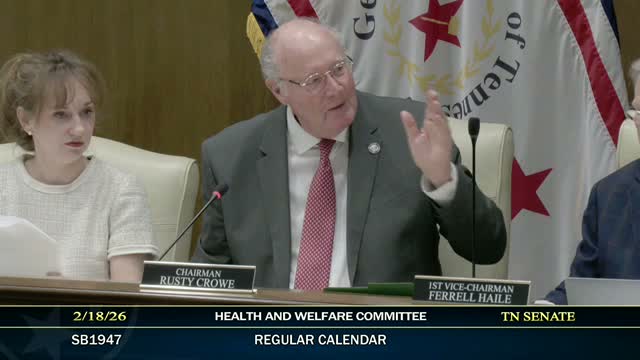
The Senate Health Committee voted to advance SB 1947 after a contested hearing that included opposing testimony from the American Red Cross and supporting testimony from physicians and hospital representatives.
Sponsor Senator Bolling said the bill clarifies statutory protections for autologous (self‑donation) and directed (designated donor) blood collections, and that a specific section would require blood banks to comply with a physician’s order for such donations. Bolling and supporting clinicians said the change corrects what the sponsor described as interference with physician‑ordered directed donations beginning in 2023.
The American Red Cross, represented by Dr. Bialaske (executive medical director), urged the committee to oppose the bill. In testimony Dr. Bialaske said Tennessee law already permits autologous and directed donations and that additional statutory mandates could undermine the general blood supply, increase costs, divert resources and remove vital physician oversight provided by blood center physicians. "This law would remove the necessary oversight of such donations by blood center physicians…Removal of this physician oversight would increase risks and compromise donor and patient safety," Dr. Bialaske said.
Pathology and transfusion experts testified in favor. Dr. Sibley, a pathologist and former blood‑bank medical director, said autologous and directed donations have long existed and that clarifying the law would promote patient autonomy and allow hospitals and labs to adopt policies consistent with physician orders. Dr. Sibley noted testing and laboratory safeguards and said some labs already accept such units under controlled practices.
The Tennessee Hospital Association raised operational concerns including storage capacity and staffing, noting smaller hospitals may lack the ability to accept on‑demand directed collections; the association urged caution about mandating compliance without addressing operational constraints.
Committee counsel and members discussed the bill’s new statutory language and confirmed it would create an express requirement that blood banks comply with physician orders for autologous and directed donations — language the counsel said is not currently in statute. After questions and deliberations the committee voted to report the bill favorably (committee reported a majority in favor) and sent it to the calendar for further consideration.
The record captures the central tension: patient choice and statutory clarity versus concerns from blood centers and transfusion medicine experts about safety, oversight and supply management. The committee acknowledged operational questions raised by hospitals and indicated further implementation details would be determined in practice and policy if the bill advances.
Sponsor Senator Bolling said the bill clarifies statutory protections for autologous (self‑donation) and directed (designated donor) blood collections, and that a specific section would require blood banks to comply with a physician’s order for such donations. Bolling and supporting clinicians said the change corrects what the sponsor described as interference with physician‑ordered directed donations beginning in 2023.
The American Red Cross, represented by Dr. Bialaske (executive medical director), urged the committee to oppose the bill. In testimony Dr. Bialaske said Tennessee law already permits autologous and directed donations and that additional statutory mandates could undermine the general blood supply, increase costs, divert resources and remove vital physician oversight provided by blood center physicians. "This law would remove the necessary oversight of such donations by blood center physicians…Removal of this physician oversight would increase risks and compromise donor and patient safety," Dr. Bialaske said.
Pathology and transfusion experts testified in favor. Dr. Sibley, a pathologist and former blood‑bank medical director, said autologous and directed donations have long existed and that clarifying the law would promote patient autonomy and allow hospitals and labs to adopt policies consistent with physician orders. Dr. Sibley noted testing and laboratory safeguards and said some labs already accept such units under controlled practices.
The Tennessee Hospital Association raised operational concerns including storage capacity and staffing, noting smaller hospitals may lack the ability to accept on‑demand directed collections; the association urged caution about mandating compliance without addressing operational constraints.
Committee counsel and members discussed the bill’s new statutory language and confirmed it would create an express requirement that blood banks comply with physician orders for autologous and directed donations — language the counsel said is not currently in statute. After questions and deliberations the committee voted to report the bill favorably (committee reported a majority in favor) and sent it to the calendar for further consideration.
The record captures the central tension: patient choice and statutory clarity versus concerns from blood centers and transfusion medicine experts about safety, oversight and supply management. The committee acknowledged operational questions raised by hospitals and indicated further implementation details would be determined in practice and policy if the bill advances.
View the Full Meeting & All Its Details
This article offers just a summary. Unlock complete video, transcripts, and insights as a Founder Member.
✓
Watch full, unedited meeting videos
✓
Search every word spoken in unlimited transcripts
✓
AI summaries & real-time alerts (all government levels)
✓
Permanent access to expanding government content
30-day money-back guarantee
