TWRA warns of funding shortfall, proposes license and revenue options to avert 2030 'fiscal cliff'
February 18, 2026 | 2026 Legislature TN, Tennessee
This article was created by AI summarizing key points discussed. AI makes mistakes, so for full details and context, please refer to the video of the full meeting. Please report any errors so we can fix them. Report an error »
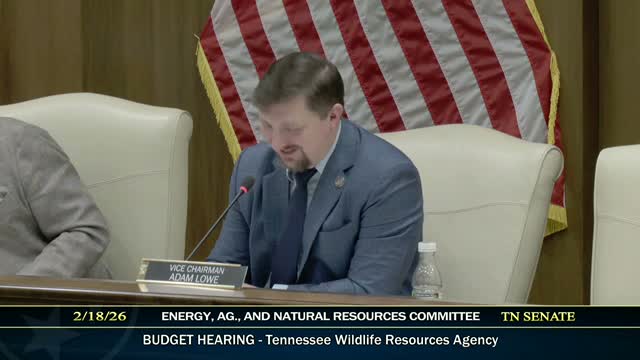
Leadership from the Tennessee Wildlife Resources Agency told the Senate Energy, Agriculture and Natural Resources Committee that the agency faces a structural funding problem and outlined personnel and capital priorities alongside proposed revenue options.
The agency requested a 4.5% step increase for wildlife-class employees (about $3.4 million), highlighted a $10 million one-time capital and maintenance allocation moved forward by the governor, and described recurring general-fund support to reimburse sportsman's licenses for active-duty Tennessee National Guard members (about $2.5 million reoccurring) as well as a $100,000 recurring grant for the 'Hunters for the Hungry' program that will be administered through a nonprofit.
Agency leadership said the wildlife fund’s structural deficit — driven by rising operational costs and no license-fee adjustments since 2015 — could exhaust reserves by FY2030 without corrective action. Two bills were identified as possible fixes: SB2183 (a proposal to direct a portion of TVA payments to the agency) and SB2609 (a revenue bill the Department of Revenue estimated could generate about $284 million by imposing an outdoor-products tax). The agency said the two bills would largely address its approximately $18.5 million recurring deficit.
Senators queried fund balances and whether reserves could be tapped. The agency reported FY25 closing balances (approximately $68 million wildlife fund, $23 million boating fund and $27 million wetland fund) and explained that some reserve balances are needed to secure federal reimbursement and to meet matching requirements. The agency also noted that only a small portion of recent wetland-acquisition funds will be available next year for law-enforcement operations.
The committee voted to move the agency’s budget item to finance.
The agency requested a 4.5% step increase for wildlife-class employees (about $3.4 million), highlighted a $10 million one-time capital and maintenance allocation moved forward by the governor, and described recurring general-fund support to reimburse sportsman's licenses for active-duty Tennessee National Guard members (about $2.5 million reoccurring) as well as a $100,000 recurring grant for the 'Hunters for the Hungry' program that will be administered through a nonprofit.
Agency leadership said the wildlife fund’s structural deficit — driven by rising operational costs and no license-fee adjustments since 2015 — could exhaust reserves by FY2030 without corrective action. Two bills were identified as possible fixes: SB2183 (a proposal to direct a portion of TVA payments to the agency) and SB2609 (a revenue bill the Department of Revenue estimated could generate about $284 million by imposing an outdoor-products tax). The agency said the two bills would largely address its approximately $18.5 million recurring deficit.
Senators queried fund balances and whether reserves could be tapped. The agency reported FY25 closing balances (approximately $68 million wildlife fund, $23 million boating fund and $27 million wetland fund) and explained that some reserve balances are needed to secure federal reimbursement and to meet matching requirements. The agency also noted that only a small portion of recent wetland-acquisition funds will be available next year for law-enforcement operations.
The committee voted to move the agency’s budget item to finance.
View the Full Meeting & All Its Details
This article offers just a summary. Unlock complete video, transcripts, and insights as a Founder Member.
✓
Watch full, unedited meeting videos
✓
Search every word spoken in unlimited transcripts
✓
AI summaries & real-time alerts (all government levels)
✓
Permanent access to expanding government content
30-day money-back guarantee
