Senate committee advances licensure bill for deaf interpreters after emotional testimony
February 18, 2026 | 2026 Legislature TN, Tennessee
This article was created by AI summarizing key points discussed. AI makes mistakes, so for full details and context, please refer to the video of the full meeting. Please report any errors so we can fix them. Report an error »
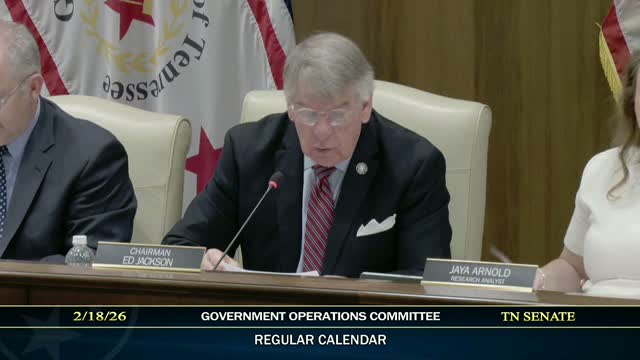
Senate Bill 942, which would create a licensure and oversight system for deaf interpreters in Tennessee, advanced out of the Senate Government Operations subcommittee on a unanimous vote after public testimony and a two‑year sunset amendment.
Sponsor Senator Massey told the committee the bill establishes minimum qualifications, a code of ethics and a complaint process for interpreters working with deaf Tennesseans, arguing licensure is needed because “without licensure anyone can claim to be an interpreter” and that oversight protects safety and civil rights.
The committee heard three brief public statements. Amy Linkheit, introduced herself as a national certified sign‑language interpreter and co‑owner of a Tennessee interpreting agency, said unqualified interpreting can harm clients and lower standards for the field: “I’ve seen how qualified interpreters can save lives and unqualified interpreters can do more damage.” April Haggard, a deaf consumer, said the deaf community needs formal protections for communication and civil rights. Jade Sims, a deaf advocate who previously worked with an interpreter licensing program in Maryland, recounted a medical case she said was misinterpreted and led to delayed care and reduced kidney function; she cited a 1.3‑centimeter kidney stone to illustrate clinical consequences.
After testimony, Sen. Massey moved and the committee adopted a verbal amendment placing the licensure scheme on a two‑year sunset. The subcommittee then voted to recommend SB 942 as amended to the Senate Education Committee; the clerk recorded nine ayes.
The bill’s sponsor and witnesses framed the legislation as narrowly focused on professional standards, ethics and accountability for interpreting in high‑risk settings such as health care, emergency response and courtroom proceedings. The bill’s text (amendment 12,792) also provides for reciprocal recognition of licensure from other states.
The committee’s action is procedural: SB 942 now proceeds to the full Senate Education Committee for further consideration. No fiscal detail was discussed in committee testimony; the legislative record did not include an estimated implementation cost.
The subcommittee indicated willingness to revisit technical or stakeholder changes as the bill continues through the process; the sponsor said he intends to work with stakeholders on any outstanding details.
Sponsor Senator Massey told the committee the bill establishes minimum qualifications, a code of ethics and a complaint process for interpreters working with deaf Tennesseans, arguing licensure is needed because “without licensure anyone can claim to be an interpreter” and that oversight protects safety and civil rights.
The committee heard three brief public statements. Amy Linkheit, introduced herself as a national certified sign‑language interpreter and co‑owner of a Tennessee interpreting agency, said unqualified interpreting can harm clients and lower standards for the field: “I’ve seen how qualified interpreters can save lives and unqualified interpreters can do more damage.” April Haggard, a deaf consumer, said the deaf community needs formal protections for communication and civil rights. Jade Sims, a deaf advocate who previously worked with an interpreter licensing program in Maryland, recounted a medical case she said was misinterpreted and led to delayed care and reduced kidney function; she cited a 1.3‑centimeter kidney stone to illustrate clinical consequences.
After testimony, Sen. Massey moved and the committee adopted a verbal amendment placing the licensure scheme on a two‑year sunset. The subcommittee then voted to recommend SB 942 as amended to the Senate Education Committee; the clerk recorded nine ayes.
The bill’s sponsor and witnesses framed the legislation as narrowly focused on professional standards, ethics and accountability for interpreting in high‑risk settings such as health care, emergency response and courtroom proceedings. The bill’s text (amendment 12,792) also provides for reciprocal recognition of licensure from other states.
The committee’s action is procedural: SB 942 now proceeds to the full Senate Education Committee for further consideration. No fiscal detail was discussed in committee testimony; the legislative record did not include an estimated implementation cost.
The subcommittee indicated willingness to revisit technical or stakeholder changes as the bill continues through the process; the sponsor said he intends to work with stakeholders on any outstanding details.
View the Full Meeting & All Its Details
This article offers just a summary. Unlock complete video, transcripts, and insights as a Founder Member.
✓
Watch full, unedited meeting videos
✓
Search every word spoken in unlimited transcripts
✓
AI summaries & real-time alerts (all government levels)
✓
Permanent access to expanding government content
30-day money-back guarantee
