Nevada districts warn of multi-million-dollar shortfalls as enrollment falls
February 17, 2026 | 2026 Legislature NV, Nevada
This article was created by AI summarizing key points discussed. AI makes mistakes, so for full details and context, please refer to the video of the full meeting. Please report any errors so we can fix them. Report an error »
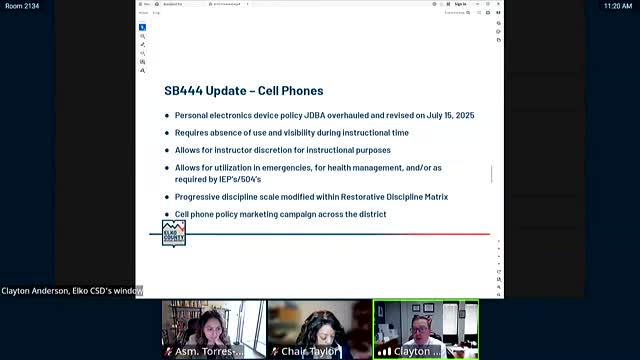
Superintendents from Elko, Douglas, Clark and Washoe told the joint interim committee that enrollment declines and narrowly rising per-pupil allocations are driving persistent budget shortfalls and difficult trade-offs at district level.
Elko County Superintendent Clayton Anderson described a roughly 10–11% enrollment decline over four years and said his district faces an $11 million structural problem driven by per-pupil revenue losses and timing mismatches in the pupil-centered funding plan (PCFP). Douglas County Superintendent Frankie Alvarado reported a $5 million shortfall over three years and said late funding decisions complicate staffing notices and contracts.
Washoe County CFO Mark Mathers told members the district closed projected deficits by reducing central-office positions but warned that continued flat per-pupil funding would force deeper cuts: “If per-pupil amount is not consistent with inflation, we will continue to have projected deficits,” he said. Clark County Superintendent Joan Ebert noted improved achievement and staffing gains but said special-education and fixed operational costs remain underfunded and drive general-fund transfers.
Districts urged several policy responses the committee could consider: revisiting PCFP hold-harmless and declining-enrollment triggers, exploring bridge financing or revolving loans for temporary cash-flow needs, creating targeted capital funds for rural facilities and ensuring funding for special-education and safety/behavioral health services. Multiple superintendents asked for more predictable timing of state appropriations to align staffing contracts with available revenue.
Committee members asked follow-up questions about the drivers of enrollment loss and how funding flows are redistributed when statewide enrollment differs from budget assumptions. The districts said causes vary—declining birth rates, shifts to homeschool or private options, and demographic change—and emphasized the long lag between demographic shifts and budget responses.
No formal vote happened; members requested additional district-level budget detail and will consider policy options ahead of the 2027 session.
Elko County Superintendent Clayton Anderson described a roughly 10–11% enrollment decline over four years and said his district faces an $11 million structural problem driven by per-pupil revenue losses and timing mismatches in the pupil-centered funding plan (PCFP). Douglas County Superintendent Frankie Alvarado reported a $5 million shortfall over three years and said late funding decisions complicate staffing notices and contracts.
Washoe County CFO Mark Mathers told members the district closed projected deficits by reducing central-office positions but warned that continued flat per-pupil funding would force deeper cuts: “If per-pupil amount is not consistent with inflation, we will continue to have projected deficits,” he said. Clark County Superintendent Joan Ebert noted improved achievement and staffing gains but said special-education and fixed operational costs remain underfunded and drive general-fund transfers.
Districts urged several policy responses the committee could consider: revisiting PCFP hold-harmless and declining-enrollment triggers, exploring bridge financing or revolving loans for temporary cash-flow needs, creating targeted capital funds for rural facilities and ensuring funding for special-education and safety/behavioral health services. Multiple superintendents asked for more predictable timing of state appropriations to align staffing contracts with available revenue.
Committee members asked follow-up questions about the drivers of enrollment loss and how funding flows are redistributed when statewide enrollment differs from budget assumptions. The districts said causes vary—declining birth rates, shifts to homeschool or private options, and demographic change—and emphasized the long lag between demographic shifts and budget responses.
No formal vote happened; members requested additional district-level budget detail and will consider policy options ahead of the 2027 session.
View the Full Meeting & All Its Details
This article offers just a summary. Unlock complete video, transcripts, and insights as a Founder Member.
✓
Watch full, unedited meeting videos
✓
Search every word spoken in unlimited transcripts
✓
AI summaries & real-time alerts (all government levels)
✓
Permanent access to expanding government content
30-day money-back guarantee
