Eagle Pass Waterworks presents balanced $16.6M budget and warns of urgent need for second water source
February 18, 2026 | Eagle Pass, Maverick County, Texas
This article was created by AI summarizing key points discussed. AI makes mistakes, so for full details and context, please refer to the video of the full meeting. Please report any errors so we can fix them. Report an error »
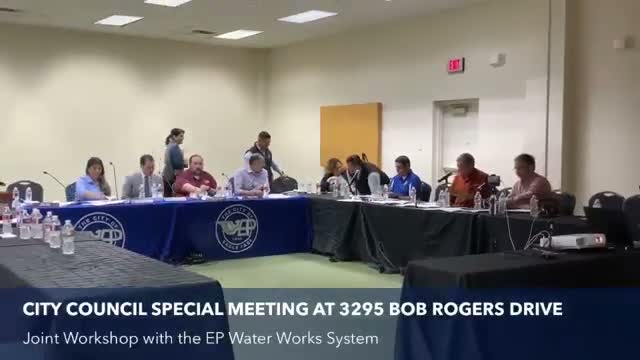
Eagle Pass officials and the Eagle Pass Waterworks System met in a joint workshop on Feb. 17 to review the utility’s proposed 2025–26 budget, capital‑improvement plan and long‑term water‑supply options.
Jorge Barragan, a Waterworks representative, presented the utility’s budget package and infrastructure needs, saying the proposed operating budget balances at roughly $16 million and that total projected revenue for the system is about $16.6 million. He told the council that drought and declining river flows have reduced sales and forced cuts to capital spending this year.
“Without water, we’re not gonna grow,” Barragan said, summing up the urgency that underpins the utility’s planning.
Why it matters: the board and council heard that the system serves a large area and that basic maintenance and expansion needs are substantial. The board described a $55 million capital‑improvement program that includes waterline replacement, storage‑tank rehab, new groundwater storage and continued rollout of AMI metering. The presentation listed recent capital work including replacement of more than 15 miles of cast‑iron pipe (about $17.5 million) and near‑completion of the Roberto Gonzales water plant expansion that will raise capacity from about 15 million to 19 million gallons per day.
Officials also flagged a slate of near‑term needs: a wastewater treatment‑plant expansion (estimated at $40–50 million), sewer collection system rehab (an initial estimate of $10–15 million), asbestos cement pipe replacement (about $15 million), intake‑structure cleaning upgrades ($3–5 million) and a maintenance facility (~$1.2 million). The presenters said these projects, excluding a second water source, represent roughly $80–90 million in needs over the next decade.
The biggest long‑term challenge discussed was securing a second water source. Preliminary cost estimates presented to the council ranged widely, from roughly $250 million to as much as $2 billion depending on the option and scope. The Waterworks noted that some proposals included annual purchase costs that could be tens of millions of dollars per year — a level far higher than the utility’s current $16 million annual budget — and said the size of that burden would require external financing, partnerships or rate changes.
Board member Mr. Loebson urged realism about the tradeoffs, saying, “there’s nothing more expensive than what you don’t have,” as trustees and council members discussed possible private turnkey solutions and other financing structures.
Officials described the system’s scale and current finances: about 91 employees; more than 550 miles of water line and over 500 miles of sewer line; roughly 21,580 total service connections (about 19,056 meters). The presenters said the Waterworks currently provides reclaimed water — roughly 100–120 million gallons a year — to the city golf course without charging; staff estimated that charging for reuse could generate low six‑figure revenues annually but would require permit changes from the Texas environmental regulator (referred to in the meeting as "TCQ").
On reserves and debt: presenters said the utility maintains restricted bond funds that cannot be used outside bond covenants, an emergency fund of about $500,000 and a general fund balance around $2.5 million. Finance staff described the flow‑of‑funds required by bond ordinances and cautioned that some funds are legally dedicated to debt service.
Council members pressed for concrete projections and a clear ‘‘ask’’ from the Waterworks: whether the utility wanted the city to refrain from raising the percentage transfer currently paid by Waterworks to the city, or whether the council should consider rate increases. Board and council members agreed the next step is more detailed joint analysis, including modeled projections of revenues, transfers and potential rate scenarios. Several participants recommended a smaller representative workshop (to avoid creating a quorum) that includes administration, council representatives and Waterworks staff to develop numbers and policy options.
Next step: officials did not adopt new policies at the workshop. Instead, they agreed to convene follow‑up workshops to produce projections and to analyze the fiscal impacts of different transfer percentages and possible rate adjustments. The joint workshop adjourned with no formal action on the capital or second‑source financing plans.
Sources: Presentation and question‑and‑answer exchange at the Eagle Pass City Council and Eagle Pass Waterworks System joint workshop on Feb. 17, 2026.
Jorge Barragan, a Waterworks representative, presented the utility’s budget package and infrastructure needs, saying the proposed operating budget balances at roughly $16 million and that total projected revenue for the system is about $16.6 million. He told the council that drought and declining river flows have reduced sales and forced cuts to capital spending this year.
“Without water, we’re not gonna grow,” Barragan said, summing up the urgency that underpins the utility’s planning.
Why it matters: the board and council heard that the system serves a large area and that basic maintenance and expansion needs are substantial. The board described a $55 million capital‑improvement program that includes waterline replacement, storage‑tank rehab, new groundwater storage and continued rollout of AMI metering. The presentation listed recent capital work including replacement of more than 15 miles of cast‑iron pipe (about $17.5 million) and near‑completion of the Roberto Gonzales water plant expansion that will raise capacity from about 15 million to 19 million gallons per day.
Officials also flagged a slate of near‑term needs: a wastewater treatment‑plant expansion (estimated at $40–50 million), sewer collection system rehab (an initial estimate of $10–15 million), asbestos cement pipe replacement (about $15 million), intake‑structure cleaning upgrades ($3–5 million) and a maintenance facility (~$1.2 million). The presenters said these projects, excluding a second water source, represent roughly $80–90 million in needs over the next decade.
The biggest long‑term challenge discussed was securing a second water source. Preliminary cost estimates presented to the council ranged widely, from roughly $250 million to as much as $2 billion depending on the option and scope. The Waterworks noted that some proposals included annual purchase costs that could be tens of millions of dollars per year — a level far higher than the utility’s current $16 million annual budget — and said the size of that burden would require external financing, partnerships or rate changes.
Board member Mr. Loebson urged realism about the tradeoffs, saying, “there’s nothing more expensive than what you don’t have,” as trustees and council members discussed possible private turnkey solutions and other financing structures.
Officials described the system’s scale and current finances: about 91 employees; more than 550 miles of water line and over 500 miles of sewer line; roughly 21,580 total service connections (about 19,056 meters). The presenters said the Waterworks currently provides reclaimed water — roughly 100–120 million gallons a year — to the city golf course without charging; staff estimated that charging for reuse could generate low six‑figure revenues annually but would require permit changes from the Texas environmental regulator (referred to in the meeting as "TCQ").
On reserves and debt: presenters said the utility maintains restricted bond funds that cannot be used outside bond covenants, an emergency fund of about $500,000 and a general fund balance around $2.5 million. Finance staff described the flow‑of‑funds required by bond ordinances and cautioned that some funds are legally dedicated to debt service.
Council members pressed for concrete projections and a clear ‘‘ask’’ from the Waterworks: whether the utility wanted the city to refrain from raising the percentage transfer currently paid by Waterworks to the city, or whether the council should consider rate increases. Board and council members agreed the next step is more detailed joint analysis, including modeled projections of revenues, transfers and potential rate scenarios. Several participants recommended a smaller representative workshop (to avoid creating a quorum) that includes administration, council representatives and Waterworks staff to develop numbers and policy options.
Next step: officials did not adopt new policies at the workshop. Instead, they agreed to convene follow‑up workshops to produce projections and to analyze the fiscal impacts of different transfer percentages and possible rate adjustments. The joint workshop adjourned with no formal action on the capital or second‑source financing plans.
Sources: Presentation and question‑and‑answer exchange at the Eagle Pass City Council and Eagle Pass Waterworks System joint workshop on Feb. 17, 2026.
View the Full Meeting & All Its Details
This article offers just a summary. Unlock complete video, transcripts, and insights as a Founder Member.
✓
Watch full, unedited meeting videos
✓
Search every word spoken in unlimited transcripts
✓
AI summaries & real-time alerts (all government levels)
✓
Permanent access to expanding government content
30-day money-back guarantee
