Issaquah council orders review of housing barriers, schedules developer roundtable
January 31, 2026 | Issaquah, King County, Washington
This article was created by AI summarizing key points discussed. AI makes mistakes, so for full details and context, please refer to the video of the full meeting. Please report any errors so we can fix them. Report an error »
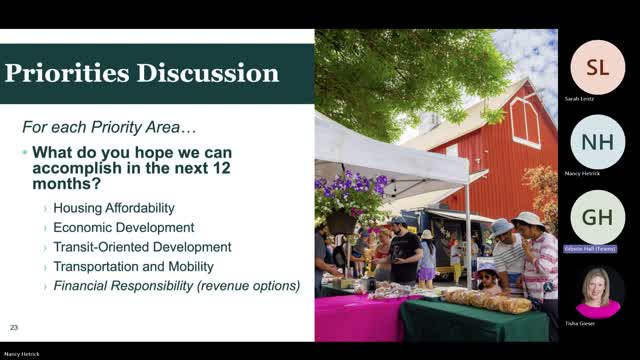
Issaquah — Councilors pressed staff at a retreat to identify specific regulatory and fee barriers that make housing development more costly in the city and to propose time-bound ways to speed construction of smaller, workforce-oriented units.
The discussion focused on two strands: (1) expanding the supply of "naturally affordable" housing (smaller ownership or rental units at market rates affordable to local workers) and (2) preserving and pursuing income-restricted affordable housing where subsidy is available. Several councilors asked for both tracks to proceed in parallel.
What council asked for: Staff were directed to compile a list of potential barriers — including transportation and impact fees, impervious-surface and rip-out requirements on infill parcels, floor-area-ratio/unit-per-acre caps, parking and underground-utility mandates — and return with a prioritized set of options. Speaker 2 suggested beginning with a homebuilder roundtable to hear direct, operational feedback; staff confirmed the roundtable is scheduled for Feb. 26.
Quotes and evidence: "We have swung too far," Speaker 9 said of presentation style, urging clearer materials. Speaker 1 urged the council to consider 'natural affordability' — smaller units and infill — as a separate policy track from highly subsidized affordable housing.
Why it matters: Speakers said small changes to permitting and fees or new incentives could unlock private investment that increases housing supply, reduces pressure on existing stock and helps workforce households. Council members noted that without more homes the local market pressures persist.
Next steps: Staff will return in March with available metrics (permitting turnaround, units permitted/built, unit size distributions and affordability measures) and a proposed work plan that separates short-term, near-term and longer-term actions. The council also discussed whether a dedicated housing specialist should be hired to lead comparative analysis of neighboring cities’ codes and policy tools.
No ordinance or fee change was adopted at the retreat; council action will follow staff recommendations and legal review.
The discussion focused on two strands: (1) expanding the supply of "naturally affordable" housing (smaller ownership or rental units at market rates affordable to local workers) and (2) preserving and pursuing income-restricted affordable housing where subsidy is available. Several councilors asked for both tracks to proceed in parallel.
What council asked for: Staff were directed to compile a list of potential barriers — including transportation and impact fees, impervious-surface and rip-out requirements on infill parcels, floor-area-ratio/unit-per-acre caps, parking and underground-utility mandates — and return with a prioritized set of options. Speaker 2 suggested beginning with a homebuilder roundtable to hear direct, operational feedback; staff confirmed the roundtable is scheduled for Feb. 26.
Quotes and evidence: "We have swung too far," Speaker 9 said of presentation style, urging clearer materials. Speaker 1 urged the council to consider 'natural affordability' — smaller units and infill — as a separate policy track from highly subsidized affordable housing.
Why it matters: Speakers said small changes to permitting and fees or new incentives could unlock private investment that increases housing supply, reduces pressure on existing stock and helps workforce households. Council members noted that without more homes the local market pressures persist.
Next steps: Staff will return in March with available metrics (permitting turnaround, units permitted/built, unit size distributions and affordability measures) and a proposed work plan that separates short-term, near-term and longer-term actions. The council also discussed whether a dedicated housing specialist should be hired to lead comparative analysis of neighboring cities’ codes and policy tools.
No ordinance or fee change was adopted at the retreat; council action will follow staff recommendations and legal review.
Don't Miss a Word: See the Full Meeting!
Go beyond summaries. Unlock every video, transcript, and key insight with a Founder Membership.
✓
Get instant access to full meeting videos
✓
Search and clip any phrase from complete transcripts
✓
Receive AI-powered summaries & custom alerts
✓
Enjoy lifetime, unrestricted access to government data
30-day money-back guarantee
