Issaquah council pushes for visible congestion relief, weighs Metroplex alternatives
January 31, 2026 | Issaquah, King County, Washington
This article was created by AI summarizing key points discussed. AI makes mistakes, so for full details and context, please refer to the video of the full meeting. Please report any errors so we can fix them. Report an error »
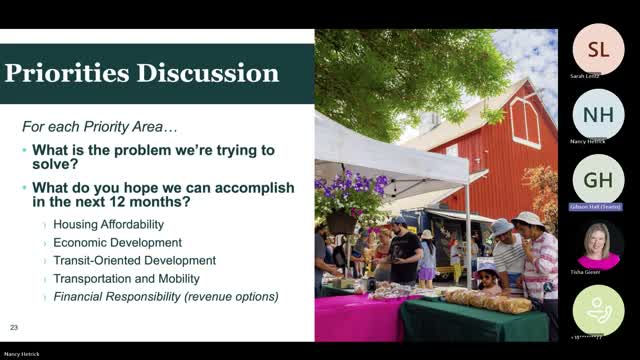
Issaquah — At their retreat, council members prioritized congestion relief and a program of small, visible transportation projects they say will improve resident experience while staff pursues grant-funded larger projects.
Staff outlined three near-term transportation topics for follow-up: pavement-management techniques and pilot treatments, the Metroplex on-demand service alternatives (Circuit, Via or voucher models), and choices about how to use revenue from a transportation benefit district sales tax. The council emphasized both grant-ready projects that can leverage outside funds and smaller projects that deliver immediate neighborhood benefits.
Key points:
- Congestion and small-scope safety projects: Councilors asked staff to identify smaller-scale projects (crosswalks, targeted intersection work, coordination of signal timing) that provide quick, visible relief; one councilor suggested radar-feedback signs as a lower-impact calming tool where permanent physical changes would be contentious.
- Metroplex and ride-on-demand options: Staff described three primary options — continue status quo, pursue Circuit (a microtransit operator) or explore voucher/Uber-type subsidy models — and said more evaluation and proposals will be provided at a February meeting.
- Light-rail advocacy: Several councilors stressed immediate advocacy with Sound Transit and state/federal officials to protect or advance light-rail opportunities tied to regional funding decisions.
Why it matters: Transportation projects affect daily life for commuters and businesses and link to housing and economic development goals. Council members said a mix of grant-funded larger investments and smaller city-funded projects should proceed in parallel.
Next steps: Staff will return with traffic and pavement data, a menu of small-project candidates, and more details on Metroplex alternatives for council consideration.
Staff outlined three near-term transportation topics for follow-up: pavement-management techniques and pilot treatments, the Metroplex on-demand service alternatives (Circuit, Via or voucher models), and choices about how to use revenue from a transportation benefit district sales tax. The council emphasized both grant-ready projects that can leverage outside funds and smaller projects that deliver immediate neighborhood benefits.
Key points:
- Congestion and small-scope safety projects: Councilors asked staff to identify smaller-scale projects (crosswalks, targeted intersection work, coordination of signal timing) that provide quick, visible relief; one councilor suggested radar-feedback signs as a lower-impact calming tool where permanent physical changes would be contentious.
- Metroplex and ride-on-demand options: Staff described three primary options — continue status quo, pursue Circuit (a microtransit operator) or explore voucher/Uber-type subsidy models — and said more evaluation and proposals will be provided at a February meeting.
- Light-rail advocacy: Several councilors stressed immediate advocacy with Sound Transit and state/federal officials to protect or advance light-rail opportunities tied to regional funding decisions.
Why it matters: Transportation projects affect daily life for commuters and businesses and link to housing and economic development goals. Council members said a mix of grant-funded larger investments and smaller city-funded projects should proceed in parallel.
Next steps: Staff will return with traffic and pavement data, a menu of small-project candidates, and more details on Metroplex alternatives for council consideration.
Don't Miss a Word: See the Full Meeting!
Go beyond summaries. Unlock every video, transcript, and key insight with a Founder Membership.
✓
Get instant access to full meeting videos
✓
Search and clip any phrase from complete transcripts
✓
Receive AI-powered summaries & custom alerts
✓
Enjoy lifetime, unrestricted access to government data
30-day money-back guarantee
