Springfield gives staff direction to allow limited housing in Booth Kelly, carves out noisy Q Street triangle
February 17, 2026 | Springfield, Lane County, Oregon
This article was created by AI summarizing key points discussed. AI makes mistakes, so for full details and context, please refer to the video of the full meeting. Please report any errors so we can fix them. Report an error »
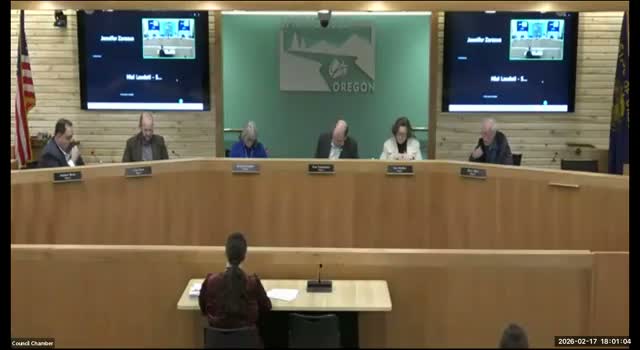
Haley Campbell, project lead for Springfield’s Housing and Design Initiative, told the City Council the work session’s primary request was policy direction on whether to allow housing in industrial‑adjacent areas such as Booth Kelly and the Q Street/Laura corridor. She reminded the council that the project grew from a DLCD grant and that the city must adopt Climate Friendly Areas (CFA) code changes by Dec. 31 to comply with state rulemaking.
The council was asked to weigh competing goals: increase housing production and choice while preserving livability where residential uses adjoin industrial operations. Campbell summarized the proposed approach: move existing Booth Kelly compatibility standards into a proposed Mixed Use Employment district, eliminate a 35% cap on residential in Booth Kelly, and permit residential to occupy up to 40% of the ground floor if a developer chooses. She also emphasized that the CFA overlay would add allowed housing forms in selected areas, noting, “we have to adopt these amendments to comply with the climate friendly areas work” and that the city has “a little less than a year to adopt these amendments.”
Council debate focused on noise, screening and regulatory triggers. Councilors raised possible mitigation tools including hours‑of‑operation limits, measuring noise at source versus property lines, and taller fences where industrial uses butt up to residential. Councilor Stout said he was "comfortable just with the existing standards" but suggested targeted adjustments such as allowing 8‑foot fences at some interfaces; Campbell replied that some taller fence allowances already exist in code. Campbell repeatedly clarified that the proposed compatibility requirements generally apply to new development or projects that trigger review, not to longstanding, unchanged industrial operations.
On area‑by‑area questions, several councilors agreed Booth Kelly can accommodate more housing—particularly on its quieter back side—while the Q Street/Laura triangle (near freeway/arterial traffic and heavy truck movement) is unlikely to produce livable housing without substantial mitigation. The council gave staff direction to proceed with drafting the adoption package that treats Booth Kelly as appropriate for broader residential allowances while carving out the most noise‑exposed portions of Q Street/Laura and allowing more limited residential forms there (for example, live‑work or night‑watch units). One councilor framed the compromise as allowing small forms of housing that support on‑site operators without expecting large residential developments.
Campbell told the council the proposed commercial and community commercial standards will mirror mixed‑use landscaping and screening rules, require screening of dumpsters and ground‑mounted equipment, and include a proposed 20‑foot setback where residential abuts industrial that could be reduced to 10 feet with an 8‑foot fence. Several councilors pressed for options to meet ground‑floor commercial requirements and for flexible ways to regulate noise, including business‑hours restrictions. The council also agreed to include planning commission feedback as staff refines the adoption package.
Next steps: staff will prepare draft ordinances for a CFA adoption package and a housing and design code package for council consideration later in the year and will coordinate required co‑adoption steps with Lane County for the Glenwood CFA area. The council’s direction gives staff authority to prepare the fall adoption materials, with the understanding that more targeted governance committee review could be convened if members want to refine details further.
The council was asked to weigh competing goals: increase housing production and choice while preserving livability where residential uses adjoin industrial operations. Campbell summarized the proposed approach: move existing Booth Kelly compatibility standards into a proposed Mixed Use Employment district, eliminate a 35% cap on residential in Booth Kelly, and permit residential to occupy up to 40% of the ground floor if a developer chooses. She also emphasized that the CFA overlay would add allowed housing forms in selected areas, noting, “we have to adopt these amendments to comply with the climate friendly areas work” and that the city has “a little less than a year to adopt these amendments.”
Council debate focused on noise, screening and regulatory triggers. Councilors raised possible mitigation tools including hours‑of‑operation limits, measuring noise at source versus property lines, and taller fences where industrial uses butt up to residential. Councilor Stout said he was "comfortable just with the existing standards" but suggested targeted adjustments such as allowing 8‑foot fences at some interfaces; Campbell replied that some taller fence allowances already exist in code. Campbell repeatedly clarified that the proposed compatibility requirements generally apply to new development or projects that trigger review, not to longstanding, unchanged industrial operations.
On area‑by‑area questions, several councilors agreed Booth Kelly can accommodate more housing—particularly on its quieter back side—while the Q Street/Laura triangle (near freeway/arterial traffic and heavy truck movement) is unlikely to produce livable housing without substantial mitigation. The council gave staff direction to proceed with drafting the adoption package that treats Booth Kelly as appropriate for broader residential allowances while carving out the most noise‑exposed portions of Q Street/Laura and allowing more limited residential forms there (for example, live‑work or night‑watch units). One councilor framed the compromise as allowing small forms of housing that support on‑site operators without expecting large residential developments.
Campbell told the council the proposed commercial and community commercial standards will mirror mixed‑use landscaping and screening rules, require screening of dumpsters and ground‑mounted equipment, and include a proposed 20‑foot setback where residential abuts industrial that could be reduced to 10 feet with an 8‑foot fence. Several councilors pressed for options to meet ground‑floor commercial requirements and for flexible ways to regulate noise, including business‑hours restrictions. The council also agreed to include planning commission feedback as staff refines the adoption package.
Next steps: staff will prepare draft ordinances for a CFA adoption package and a housing and design code package for council consideration later in the year and will coordinate required co‑adoption steps with Lane County for the Glenwood CFA area. The council’s direction gives staff authority to prepare the fall adoption materials, with the understanding that more targeted governance committee review could be convened if members want to refine details further.
View the Full Meeting & All Its Details
This article offers just a summary. Unlock complete video, transcripts, and insights as a Founder Member.
✓
Watch full, unedited meeting videos
✓
Search every word spoken in unlimited transcripts
✓
AI summaries & real-time alerts (all government levels)
✓
Permanent access to expanding government content
30-day money-back guarantee
