Subcommittee advances 'lemon law' for farm equipment, citing rural harm
February 18, 2026 | 2026 Legislature FL, Florida
This article was created by AI summarizing key points discussed. AI makes mistakes, so for full details and context, please refer to the video of the full meeting. Please report any errors so we can fix them. Report an error »
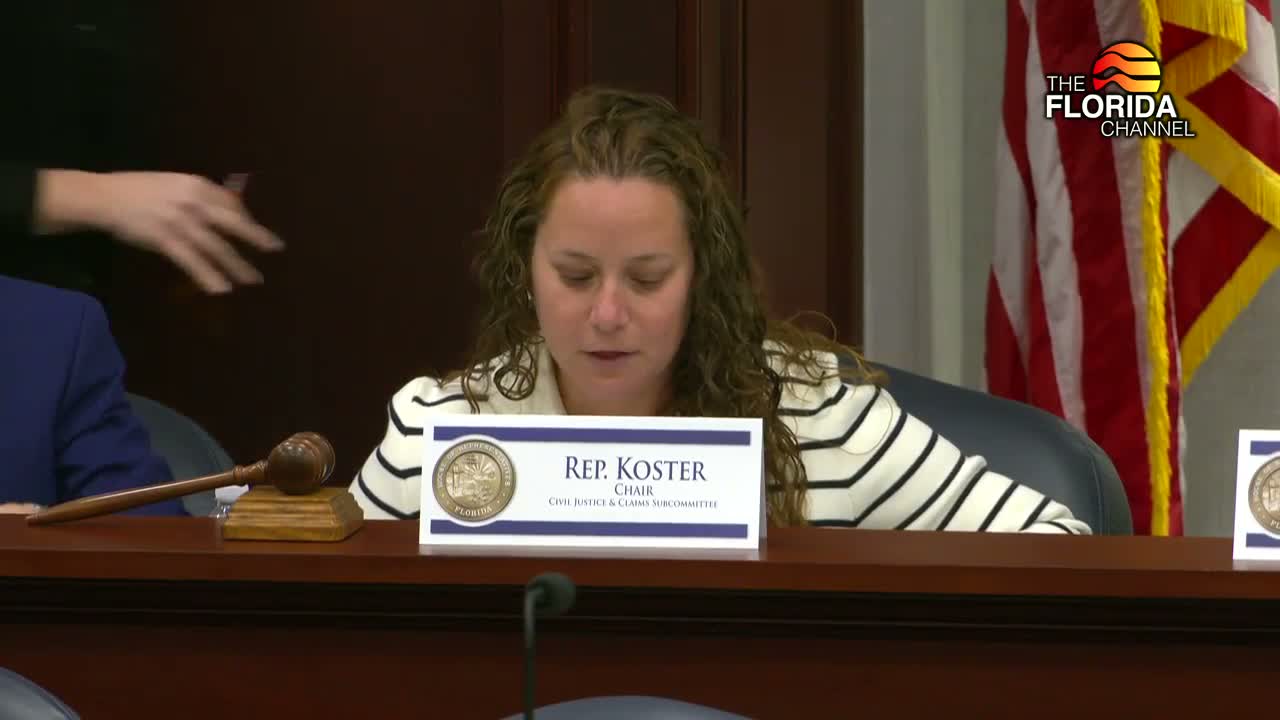
Representative Griffiths introduced CS for HB637 to create consumer protections for major farm equipment, describing the measure as "a lemon law for farm equipment." The bill would define covered farm equipment, establish a consumer right to report nonconforming equipment, and require manufacturers or their agents to repair or replace defective equipment at no cost.
The bill's sponsor and committee members framed the measure as a response to problems raised by rural communities. Representative Griffiths said the proposal mirrors the state automobile lemon law and relies on existing guidance in the Motor Vehicle Warranty Enforcement Act for the number and documentation of repair attempts. "This is a lemon law for farm equipment," Griffiths said.
During questioning, Ranking Member Rayner asked for plain-language clarification of "nonconform" and what evidence proves an attempt was reasonable; Griffiths told members that the bill adopts the automobile statute's approach and that documentation from dealerships or manufacturers would show attempts and timing. The sponsor explained that, under the bill's approach, a consumer who returns a piece of equipment under the manufacturer's warranty and faces multiple unsuccessful repair attempts would have a remedy.
Ex officio Representative Escamani and other members noted timing and right-to-repair concerns during debate; Escamani asked about an "18 months" timeline and said, "18 months is a long time to have equipment that's not working, especially when you are in the ag industry," while congratulating the sponsor for addressing rural needs. Representatives Nicks and Black supported the bill on the record, emphasizing the economic loss when equipment is down during critical farm operations.
Tripp Hunter of the Florida Farm Bureau and Jim Spratt of the Florida Forestry Association waived in support. After debate, Representative Griffiths closed and the clerk recorded a roll-call vote: 14 yeas, 0 nays. CS for HB637 was reported favorably and will proceed in the legislative process.
The bill text references documentation standards tied to the Motor Vehicle Warranty Enforcement Act and applies a reasonable-attempts framework similar to existing automobile protections; the measure's practical effect is intended to reduce lost opportunity costs for farmers whose operations are disrupted by defective equipment.
The bill's sponsor and committee members framed the measure as a response to problems raised by rural communities. Representative Griffiths said the proposal mirrors the state automobile lemon law and relies on existing guidance in the Motor Vehicle Warranty Enforcement Act for the number and documentation of repair attempts. "This is a lemon law for farm equipment," Griffiths said.
During questioning, Ranking Member Rayner asked for plain-language clarification of "nonconform" and what evidence proves an attempt was reasonable; Griffiths told members that the bill adopts the automobile statute's approach and that documentation from dealerships or manufacturers would show attempts and timing. The sponsor explained that, under the bill's approach, a consumer who returns a piece of equipment under the manufacturer's warranty and faces multiple unsuccessful repair attempts would have a remedy.
Ex officio Representative Escamani and other members noted timing and right-to-repair concerns during debate; Escamani asked about an "18 months" timeline and said, "18 months is a long time to have equipment that's not working, especially when you are in the ag industry," while congratulating the sponsor for addressing rural needs. Representatives Nicks and Black supported the bill on the record, emphasizing the economic loss when equipment is down during critical farm operations.
Tripp Hunter of the Florida Farm Bureau and Jim Spratt of the Florida Forestry Association waived in support. After debate, Representative Griffiths closed and the clerk recorded a roll-call vote: 14 yeas, 0 nays. CS for HB637 was reported favorably and will proceed in the legislative process.
The bill text references documentation standards tied to the Motor Vehicle Warranty Enforcement Act and applies a reasonable-attempts framework similar to existing automobile protections; the measure's practical effect is intended to reduce lost opportunity costs for farmers whose operations are disrupted by defective equipment.
Don't Miss a Word: See the Full Meeting!
Go beyond summaries. Unlock every video, transcript, and key insight with a Founder Membership.
✓
Get instant access to full meeting videos
✓
Search and clip any phrase from complete transcripts
✓
Receive AI-powered summaries & custom alerts
✓
Enjoy lifetime, unrestricted access to government data
30-day money-back guarantee
