Matrix staffing study recommends 136 phased positions across city departments; police draft shows up to 89 sworn needs
February 16, 2026 | Raleigh, Wake County, North Carolina
This article was created by AI summarizing key points discussed. AI makes mistakes, so for full details and context, please refer to the video of the full meeting. Please report any errors so we can fix them. Report an error »
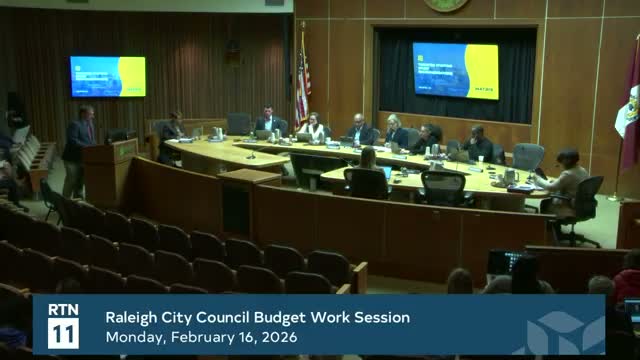
Consultants from Matrix Consulting presented a targeted staffing study examining eight functional areas and recommended phased hires to align workforce with projected workloads as Raleigh grows.
"We did a deep dive, staffing and workload analysis for current and projected needs," said Aaron Baggerly, project manager for Matrix Consulting, who told councilors the firm used historic workload, adopted service levels and a multi‑variable growth model to project needs over five and 10 years.
Matrix recommended about 136 additional positions for non‑police functions phased over three years (52.5 FTEs proposed in year one, 48 in year two and 35.5 in year three). Major near‑term needs include emergency communications (a net need of about 22 positions, including telecommunicators and a records analyst), roughly 29.5 building safety positions phased to reduce inspection backlog, 21 positions for solid waste to absorb leaf/yard collection transfers and frequency increases, and 14 roles for the fire marshal’s office to handle plan review and inspection workload.
A preliminary police analysis, still undergoing data validation, suggested a maximum addition of 89 sworn positions (covering patrol, detectives and traffic enforcement) and 12 civilian roles for administrative and analytic support. Chief Rico Boyce said the police department has internal metrics and ongoing academy scheduling constraints that will determine how new sworn hires could be phased into training; the chief emphasized the department’s high clearance rates for serious crimes.
City staff and consultants stressed that the recommendations are planning tools to inform budget tradeoffs, not immediate hire authorizations. "If you had $2,000,000,000 in the bank and you could do it, you'd like to get those today," Baggerly said, adding that practical constraints — academy capacity, field training officers, specialized recruitment pipelines — require a phased approach.
Councilors asked about recruitment strategies for technical roles (building plan reviewers, inspectors, engineers), whether technology or redistricting could reduce needs, and how the city will preserve service levels while phasing hires. Planning and development staff pointed to existing partnerships with Wake Tech and other regional institutions and said the manager’s office will return a multi‑year implementation plan and a dynamic model the city can use for ongoing evaluation.
No formal adoption or budgetary commitment was made at the meeting; staff said a draft report and validated police model would be available for further review in March to support FY27 deliberations.
"We did a deep dive, staffing and workload analysis for current and projected needs," said Aaron Baggerly, project manager for Matrix Consulting, who told councilors the firm used historic workload, adopted service levels and a multi‑variable growth model to project needs over five and 10 years.
Matrix recommended about 136 additional positions for non‑police functions phased over three years (52.5 FTEs proposed in year one, 48 in year two and 35.5 in year three). Major near‑term needs include emergency communications (a net need of about 22 positions, including telecommunicators and a records analyst), roughly 29.5 building safety positions phased to reduce inspection backlog, 21 positions for solid waste to absorb leaf/yard collection transfers and frequency increases, and 14 roles for the fire marshal’s office to handle plan review and inspection workload.
A preliminary police analysis, still undergoing data validation, suggested a maximum addition of 89 sworn positions (covering patrol, detectives and traffic enforcement) and 12 civilian roles for administrative and analytic support. Chief Rico Boyce said the police department has internal metrics and ongoing academy scheduling constraints that will determine how new sworn hires could be phased into training; the chief emphasized the department’s high clearance rates for serious crimes.
City staff and consultants stressed that the recommendations are planning tools to inform budget tradeoffs, not immediate hire authorizations. "If you had $2,000,000,000 in the bank and you could do it, you'd like to get those today," Baggerly said, adding that practical constraints — academy capacity, field training officers, specialized recruitment pipelines — require a phased approach.
Councilors asked about recruitment strategies for technical roles (building plan reviewers, inspectors, engineers), whether technology or redistricting could reduce needs, and how the city will preserve service levels while phasing hires. Planning and development staff pointed to existing partnerships with Wake Tech and other regional institutions and said the manager’s office will return a multi‑year implementation plan and a dynamic model the city can use for ongoing evaluation.
No formal adoption or budgetary commitment was made at the meeting; staff said a draft report and validated police model would be available for further review in March to support FY27 deliberations.
Don't Miss a Word: See the Full Meeting!
Go beyond summaries. Unlock every video, transcript, and key insight with a Founder Membership.
✓
Get instant access to full meeting videos
✓
Search and clip any phrase from complete transcripts
✓
Receive AI-powered summaries & custom alerts
✓
Enjoy lifetime, unrestricted access to government data
30-day money-back guarantee
