Senate committee hears January revenue report; official warns of cooling jobs and reliance on data‑center growth
February 18, 2026 | 2026 Legislature VA, Virginia
This article was created by AI summarizing key points discussed. AI makes mistakes, so for full details and context, please refer to the video of the full meeting. Please report any errors so we can fix them. Report an error »
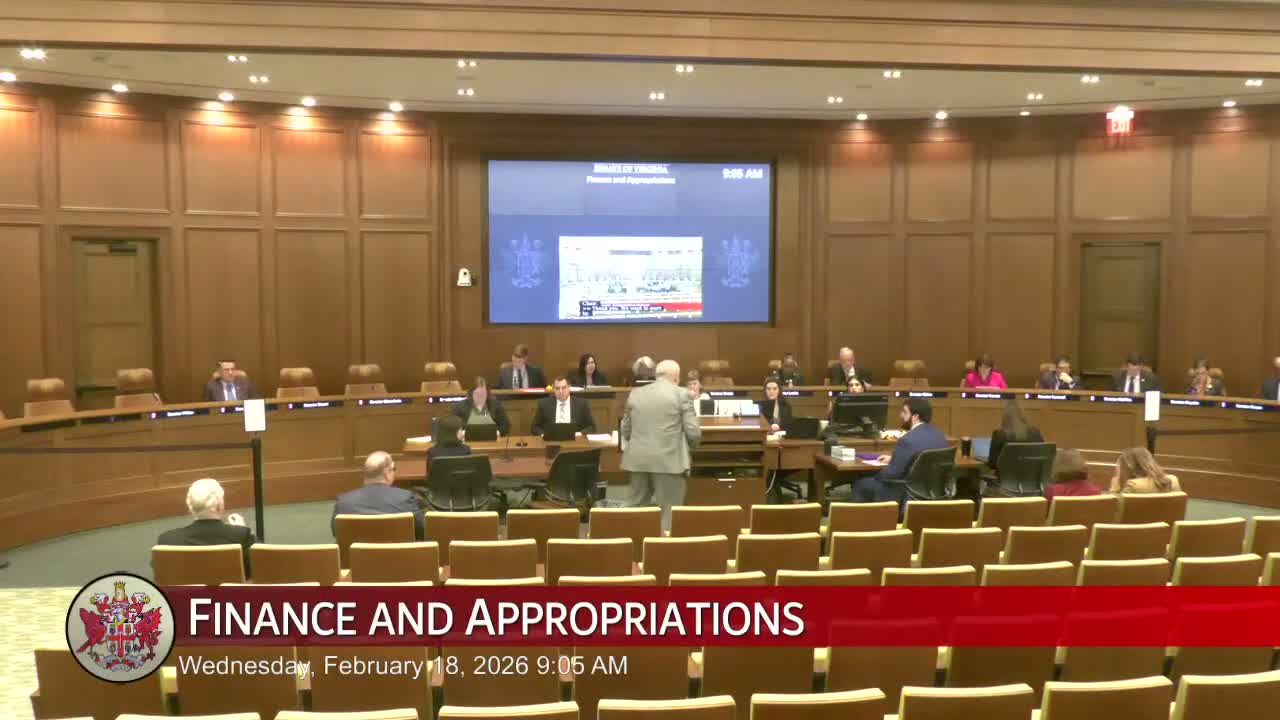
Secretary Sickles presented the Senate committee with the administration's January revenue outlook, saying Virginia's most recent quarterly GDP estimate was about 1.3% and that year‑to‑date general fund collections were roughly $521 million ahead of the forecast.
"We only grew by 1.3%," Secretary Sickles said while reviewing state and national growth charts, and he noted that the U.S. job growth figures and Virginia's labor market are showing signs of cooling. He told members that the state had collected about $18 billion so far this fiscal year against a projected $32 billion in general fund collections and that, "from here in the next 5 months of this fiscal year, we need to raise $13.9 billion to meet the target." He referenced HB 30's 3% growth assumption for the budget.
Committee members pressed on the underlying employment data. A senator asked whether recent Bureau of Labor Statistics (BLS) downward revisions to national job counts had already been reflected in Virginia's numbers. Charles Kennington of the Department of Exposition explained that the BLS performs a periodic "rebenchmarking" of employment estimates and that the state's revised figures would be reflected in the March state employment report, so the current Virginia numbers were not yet adjusted.
"The BLS does, what they call re benchmarking estimates of employment for both the U.S. and the states," Kennington said, adding that preliminary and final estimates are released on a schedule tied to monthly reports.
Lawmakers also asked about the type of jobs the state is losing and the administration's strategy to attract similar, high‑paying positions. Senator Fevola asked whether there is a plan to replace mid‑level and senior federal jobs with comparable private‑sector positions. Secretary Sickles pointed to recent private investments and a focus on retaining professional and business services while recruiting advanced manufacturing.
"I think 80% of our growth in the last year has come from data center related, manufacturing, employment, construction," Sickles said, describing data centers as a primary driver of recent private‑sector growth and cautioning that reliance on a concentrated sector carries risk if that activity slows.
Senators raised concerns that measures of unemployment do not capture underemployment or part‑time work among formerly full‑time consultants and professionals. Sickles acknowledged the phenomenon and suggested that additional research—potentially from university partners—could help the state better measure underemployment.
No formal votes or motions were taken during the session. With no further questions, the chair closed the hearing and the committee rose.
"We only grew by 1.3%," Secretary Sickles said while reviewing state and national growth charts, and he noted that the U.S. job growth figures and Virginia's labor market are showing signs of cooling. He told members that the state had collected about $18 billion so far this fiscal year against a projected $32 billion in general fund collections and that, "from here in the next 5 months of this fiscal year, we need to raise $13.9 billion to meet the target." He referenced HB 30's 3% growth assumption for the budget.
Committee members pressed on the underlying employment data. A senator asked whether recent Bureau of Labor Statistics (BLS) downward revisions to national job counts had already been reflected in Virginia's numbers. Charles Kennington of the Department of Exposition explained that the BLS performs a periodic "rebenchmarking" of employment estimates and that the state's revised figures would be reflected in the March state employment report, so the current Virginia numbers were not yet adjusted.
"The BLS does, what they call re benchmarking estimates of employment for both the U.S. and the states," Kennington said, adding that preliminary and final estimates are released on a schedule tied to monthly reports.
Lawmakers also asked about the type of jobs the state is losing and the administration's strategy to attract similar, high‑paying positions. Senator Fevola asked whether there is a plan to replace mid‑level and senior federal jobs with comparable private‑sector positions. Secretary Sickles pointed to recent private investments and a focus on retaining professional and business services while recruiting advanced manufacturing.
"I think 80% of our growth in the last year has come from data center related, manufacturing, employment, construction," Sickles said, describing data centers as a primary driver of recent private‑sector growth and cautioning that reliance on a concentrated sector carries risk if that activity slows.
Senators raised concerns that measures of unemployment do not capture underemployment or part‑time work among formerly full‑time consultants and professionals. Sickles acknowledged the phenomenon and suggested that additional research—potentially from university partners—could help the state better measure underemployment.
No formal votes or motions were taken during the session. With no further questions, the chair closed the hearing and the committee rose.
Don't Miss a Word: See the Full Meeting!
Go beyond summaries. Unlock every video, transcript, and key insight with a Founder Membership.
✓
Get instant access to full meeting videos
✓
Search and clip any phrase from complete transcripts
✓
Receive AI-powered summaries & custom alerts
✓
Enjoy lifetime, unrestricted access to government data
30-day money-back guarantee
