Port Richey council workshop reviews draft CRA incentive policy, asks staff to scale plan and seek legal review
February 17, 2026 | Port Richey City, Pasco County, Florida
This article was created by AI summarizing key points discussed. AI makes mistakes, so for full details and context, please refer to the video of the full meeting. Please report any errors so we can fix them. Report an error »
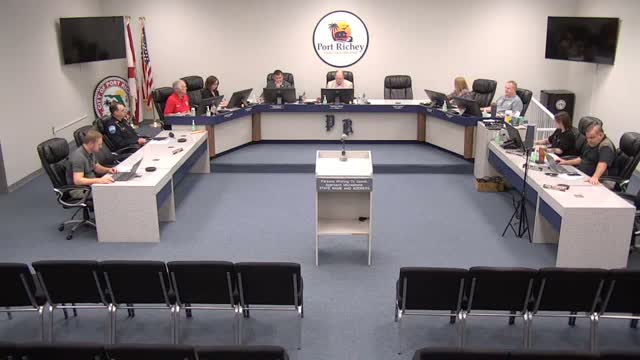
Port Richey council members spent the workshop examining a draft Community Redevelopment Agency (CRA) incentive policy that would target the city’s waterfront and the U.S. 19 corridor and would expire if the CRA sunset is not extended.
Derek, the staff presenter, summarized the draft and said, "So there wasn't great changes since the first time you've seen this," adding the proposal includes definitions, an affordable‑housing element and a targeted district approach rather than a city‑wide program.
The draft sets a maximum eligible incentive of 12% of a project's increase in assessed value and starts reimbursement at 50% of the tax‑increment amount, paid from the CRA trust fund. Council members and staff debated how the county and city tax portions affect calculations and the effective share the city retains when the county portion is included.
"Unpaid incentives may terminate if CRA is dissolved," a council member noted during discussion of section 7.2 on the CRA sunset; the item prompted repeated questions about the legal durability of commitments after the CRA expires in January 2032. Multiple members urged a formal legal review of the draft before council adopts any long‑term obligation.
Members also used a concrete example to test the policy's scale: a $50 million project that increased taxable value by $42 million would generate a 12% eligible incentive — about $5,040,000 under the draft — a sum several councillors said could overexpose a small CRA if multiple large projects qualified.
Several councillors compared Port Richey to larger jurisdictions such as Bradenton and New Port Richey, saying those cities have longer incentive windows and greater staff and financial capacity. "I can't see that we could commit to anything of this size," one councillor said, arguing the policy must be pared back to fit Port Richey's smaller tax base and staff resources.
Council members asked staff to develop scaled options and clearer definitions for categories such as low‑impact development, shared parking and infrastructure contributions. Derek told the council a consultant engagement to vet and tailor the policy would likely cost in the neighborhood of $60,000; councillors suggested using staff work to limit consultant scope and reduce costs.
The council directed staff to return with tiered options (examples discussed included a higher cap during the CRA period that phases down post‑sunset), concrete budget numbers and a legal review of the implications of any commitments that would continue after the CRA ends. Staff said they would present options and legal notes at an upcoming meeting and include budgetary estimates tied to the regular budget process.
The workshop concluded after the council voted to adjourn. Staff were given direction to refine the draft, provide definitions and cost estimates, and seek outside legal and financial review before any adoption vote.
Derek, the staff presenter, summarized the draft and said, "So there wasn't great changes since the first time you've seen this," adding the proposal includes definitions, an affordable‑housing element and a targeted district approach rather than a city‑wide program.
The draft sets a maximum eligible incentive of 12% of a project's increase in assessed value and starts reimbursement at 50% of the tax‑increment amount, paid from the CRA trust fund. Council members and staff debated how the county and city tax portions affect calculations and the effective share the city retains when the county portion is included.
"Unpaid incentives may terminate if CRA is dissolved," a council member noted during discussion of section 7.2 on the CRA sunset; the item prompted repeated questions about the legal durability of commitments after the CRA expires in January 2032. Multiple members urged a formal legal review of the draft before council adopts any long‑term obligation.
Members also used a concrete example to test the policy's scale: a $50 million project that increased taxable value by $42 million would generate a 12% eligible incentive — about $5,040,000 under the draft — a sum several councillors said could overexpose a small CRA if multiple large projects qualified.
Several councillors compared Port Richey to larger jurisdictions such as Bradenton and New Port Richey, saying those cities have longer incentive windows and greater staff and financial capacity. "I can't see that we could commit to anything of this size," one councillor said, arguing the policy must be pared back to fit Port Richey's smaller tax base and staff resources.
Council members asked staff to develop scaled options and clearer definitions for categories such as low‑impact development, shared parking and infrastructure contributions. Derek told the council a consultant engagement to vet and tailor the policy would likely cost in the neighborhood of $60,000; councillors suggested using staff work to limit consultant scope and reduce costs.
The council directed staff to return with tiered options (examples discussed included a higher cap during the CRA period that phases down post‑sunset), concrete budget numbers and a legal review of the implications of any commitments that would continue after the CRA ends. Staff said they would present options and legal notes at an upcoming meeting and include budgetary estimates tied to the regular budget process.
The workshop concluded after the council voted to adjourn. Staff were given direction to refine the draft, provide definitions and cost estimates, and seek outside legal and financial review before any adoption vote.
View the Full Meeting & All Its Details
This article offers just a summary. Unlock complete video, transcripts, and insights as a Founder Member.
✓
Watch full, unedited meeting videos
✓
Search every word spoken in unlimited transcripts
✓
AI summaries & real-time alerts (all government levels)
✓
Permanent access to expanding government content
30-day money-back guarantee
