Guam hearing draws widespread opposition to bill that would open decolonization vote to all registered voters
February 18, 2026 | General Government Operations and Appropriations , Legislative, Guam, International
This article was created by AI summarizing key points discussed. AI makes mistakes, so for full details and context, please refer to the video of the full meeting. Please report any errors so we can fix them. Report an error »
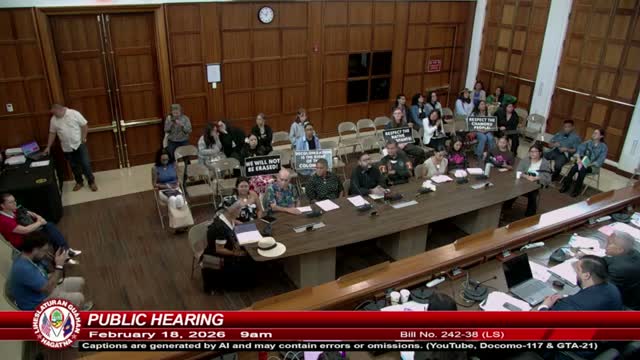
A public hearing before the General Government Operations and Appropriations committee on Bill 242-38 drew sustained, often emotional opposition from a wide range of community members, elders, cultural institutions and advocacy groups on Wednesday.
Bill 242-38 would replace the current “native inhabitant” eligibility for a political‑status plebiscite with a definition of eligible voter under Guam law — effectively allowing any registered voter, with as little as 30 days residency, to participate. Testimony at the hearing, which the committee recessed and said it will continue at a later date, centered on whether a vote to determine Guam’s political status should be limited to the indigenous people who were colonized.
Why it matters: Opponents said decolonization is a remedy for historic injustice and a right that belongs to the colonized, not merely an ordinary election. Wampat Melvin Wampat Borja, executive director of the Commission on Decolonization, told the committee the bill “would compromise the exercise of the Somoto people’s sacred right of self determination,” and described the measure as a legalistic shortcut that risks “recolonization.”
Hundreds of residents gave testimony. Gabrielle Solis Blas Jr., who asked to be called Jarena, spoke as a private citizen and described the change as an attack on Chamorro sovereignty and history. Edward Ekfaji Jr., a museum assistant at the Guam Museum, recounted a century-long record of Chamorro self-determination work and urged rejection of the bill. Environmental and social‑service speakers warned the bill could weaken indigenous stewardship over land and water and exacerbate health and housing inequities.
The sponsor’s case: Sen. William Parkinson, who introduced the bill to respond to the federal Davis v. Guam litigation and Ninth Circuit rulings, told senators and the public that the existing law will not survive constitutional challenge and that preserving the current language will indefinitely delay any plebiscite. Parkinson said he sought compromise dates and residency standards but found none acceptable to all stakeholders, and argued the bill is intended as a pragmatic route to a vote. “If this bill fails, status quo wins,” he said, adding that he will continue to press the measure.
Questions of law and precedent dominated parts of the hearing. Committee members asked witnesses whether the United Nations or other international bodies had approved native-only plebiscites. Witnesses pointed to cases such as New Caledonia, Western Sahara and South Sudan as partial analogs showing that restricted electorates have been used in context-specific, negotiated processes; they also emphasized the unique legal and political situation facing Guam.
Procedure and next steps: The committee did not vote on the bill. The chair noted the panel had heard 42 live testimonies and recorded that about 69 people remained signed up; the hearing recessed at 4:26 p.m. and will be continued and properly noticed. Senators and community members urged further public engagement and legal study as the legislature considers the proposals.
Voices from the hearing: “When you return sovereignty, you also have to say, okay, so the people of Guam are not at this particular time economically or able to be self-sustaining,” Jarena said in testimony opposing the bill. Wampat Borja told the committee, “The proposed bill would compromise the exercise of the Somoto people’s sacred right of self determination.” Sen. William Parkinson said he introduced the bill because he believes it is the only realistic way to secure a plebiscite after federal court rulings.
The hearing will resume at a date to be publicly posted. No formal vote on Bill 242-38 occurred during the session.
Bill 242-38 would replace the current “native inhabitant” eligibility for a political‑status plebiscite with a definition of eligible voter under Guam law — effectively allowing any registered voter, with as little as 30 days residency, to participate. Testimony at the hearing, which the committee recessed and said it will continue at a later date, centered on whether a vote to determine Guam’s political status should be limited to the indigenous people who were colonized.
Why it matters: Opponents said decolonization is a remedy for historic injustice and a right that belongs to the colonized, not merely an ordinary election. Wampat Melvin Wampat Borja, executive director of the Commission on Decolonization, told the committee the bill “would compromise the exercise of the Somoto people’s sacred right of self determination,” and described the measure as a legalistic shortcut that risks “recolonization.”
Hundreds of residents gave testimony. Gabrielle Solis Blas Jr., who asked to be called Jarena, spoke as a private citizen and described the change as an attack on Chamorro sovereignty and history. Edward Ekfaji Jr., a museum assistant at the Guam Museum, recounted a century-long record of Chamorro self-determination work and urged rejection of the bill. Environmental and social‑service speakers warned the bill could weaken indigenous stewardship over land and water and exacerbate health and housing inequities.
The sponsor’s case: Sen. William Parkinson, who introduced the bill to respond to the federal Davis v. Guam litigation and Ninth Circuit rulings, told senators and the public that the existing law will not survive constitutional challenge and that preserving the current language will indefinitely delay any plebiscite. Parkinson said he sought compromise dates and residency standards but found none acceptable to all stakeholders, and argued the bill is intended as a pragmatic route to a vote. “If this bill fails, status quo wins,” he said, adding that he will continue to press the measure.
Questions of law and precedent dominated parts of the hearing. Committee members asked witnesses whether the United Nations or other international bodies had approved native-only plebiscites. Witnesses pointed to cases such as New Caledonia, Western Sahara and South Sudan as partial analogs showing that restricted electorates have been used in context-specific, negotiated processes; they also emphasized the unique legal and political situation facing Guam.
Procedure and next steps: The committee did not vote on the bill. The chair noted the panel had heard 42 live testimonies and recorded that about 69 people remained signed up; the hearing recessed at 4:26 p.m. and will be continued and properly noticed. Senators and community members urged further public engagement and legal study as the legislature considers the proposals.
Voices from the hearing: “When you return sovereignty, you also have to say, okay, so the people of Guam are not at this particular time economically or able to be self-sustaining,” Jarena said in testimony opposing the bill. Wampat Borja told the committee, “The proposed bill would compromise the exercise of the Somoto people’s sacred right of self determination.” Sen. William Parkinson said he introduced the bill because he believes it is the only realistic way to secure a plebiscite after federal court rulings.
The hearing will resume at a date to be publicly posted. No formal vote on Bill 242-38 occurred during the session.
Don't Miss a Word: See the Full Meeting!
Go beyond summaries. Unlock every video, transcript, and key insight with a Founder Membership.
✓
Get instant access to full meeting videos
✓
Search and clip any phrase from complete transcripts
✓
Receive AI-powered summaries & custom alerts
✓
Enjoy lifetime, unrestricted access to government data
30-day money-back guarantee
