Sen. William Parkinson says his bill is necessary to secure a plebiscite after court rulings
February 18, 2026 | General Government Operations and Appropriations , Legislative, Guam, International
This article was created by AI summarizing key points discussed. AI makes mistakes, so for full details and context, please refer to the video of the full meeting. Please report any errors so we can fix them. Report an error »
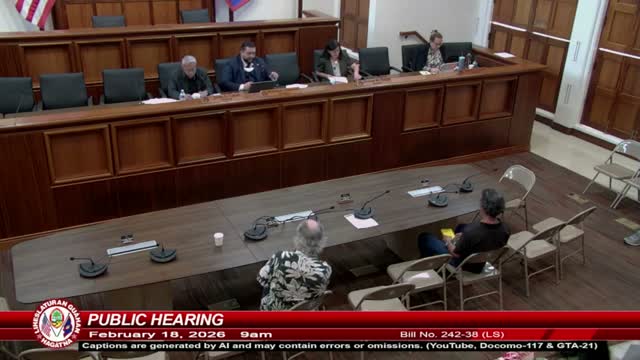
Sen. William Parkinson, sponsor of Bill 242-38, told the General Government Operations and Appropriations committee that he introduced the measure reluctantly but out of a belief that it is the only feasible route to a political-status plebiscite after federal court decisions.
Parkinson said he tried to find compromises — including different cutoff dates and residency thresholds — but that those alternatives failed to obtain community consensus. “Keeping that language doesn’t change the constitutionality of the law,” he said, arguing that maintaining the current native‑inhabitant definition would indefinitely delay any vote and leave Guam without a path to decolonization.
The bill would replace the existing ancestry-based plebiscite eligibility with the Guam law definition of an eligible voter (which in practice can include a resident after a minimum residency period such as 30 days). Parkinson said he is aware his proposal is controversial and that it risks political costs to himself and his family, but he framed the choice as between trying a route that can survive legal scrutiny or accepting that “status quo wins” and no plebiscite occurs.
Opponents at the hearing asked whether there is an internationally recognized precedent for a native-only plebiscite and cited examples such as New Caledonia, Western Sahara and South Sudan as processes that used restricted electorates in negotiated arrangements. Witnesses told the committee that decolonization must center the colonized and cautioned that expanding eligibility would undermine restorative justice.
Parkinson concluded by saying he will press the bill forward and asked the legislature and the public to propose a workable alternative route to a vote if they oppose his approach. The committee recessed the hearing for a later continuation; no vote on the bill occurred during this session.
Parkinson said he tried to find compromises — including different cutoff dates and residency thresholds — but that those alternatives failed to obtain community consensus. “Keeping that language doesn’t change the constitutionality of the law,” he said, arguing that maintaining the current native‑inhabitant definition would indefinitely delay any vote and leave Guam without a path to decolonization.
The bill would replace the existing ancestry-based plebiscite eligibility with the Guam law definition of an eligible voter (which in practice can include a resident after a minimum residency period such as 30 days). Parkinson said he is aware his proposal is controversial and that it risks political costs to himself and his family, but he framed the choice as between trying a route that can survive legal scrutiny or accepting that “status quo wins” and no plebiscite occurs.
Opponents at the hearing asked whether there is an internationally recognized precedent for a native-only plebiscite and cited examples such as New Caledonia, Western Sahara and South Sudan as processes that used restricted electorates in negotiated arrangements. Witnesses told the committee that decolonization must center the colonized and cautioned that expanding eligibility would undermine restorative justice.
Parkinson concluded by saying he will press the bill forward and asked the legislature and the public to propose a workable alternative route to a vote if they oppose his approach. The committee recessed the hearing for a later continuation; no vote on the bill occurred during this session.
View the Full Meeting & All Its Details
This article offers just a summary. Unlock complete video, transcripts, and insights as a Founder Member.
✓
Watch full, unedited meeting videos
✓
Search every word spoken in unlimited transcripts
✓
AI summaries & real-time alerts (all government levels)
✓
Permanent access to expanding government content
30-day money-back guarantee
