Senate committee defers enterprise-zone changes after questions on who benefits
February 18, 2026 | Senate, Legislative , Hawaii
This article was created by AI summarizing key points discussed. AI makes mistakes, so for full details and context, please refer to the video of the full meeting. Please report any errors so we can fix them. Report an error »
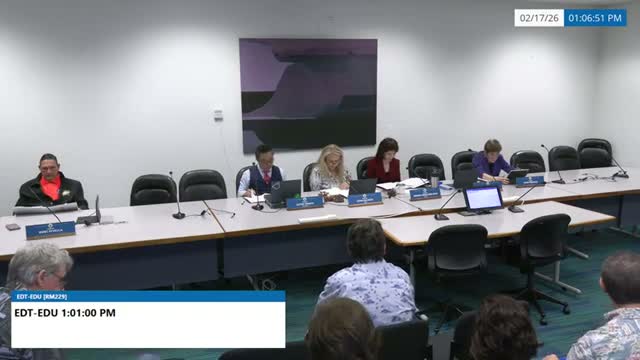
Chair opened a joint hearing on SB 2816, a proposal to revise Hawaii’s state enterprise-zone program and to create targeted incentives for sectors such as health‑care technology. Testimony came from state agencies, universities and business groups; several witnesses stood on written testimony.
DBEDT program manager Jason Ushijima told the committee the department produces annual reports and cited 2022 figures showing foregone state revenue from enterprise-zone credits of about $460,000 and aggregate revenues for participating companies of roughly $221,000,000. University of Hawaii representatives and local economic-development advocates supported designating areas near the UH Cancer Center as enterprise zones to spur research and facility investment.
Several senators pressed DBEDT on safeguards to prevent firms from restructuring existing activities to claim benefits or on the risk that the program would favor already-advantaged waterfront or commercial areas rather than depressed neighborhoods the zones were originally intended to help. DBEDT staff said whether to allow firms outside the designated district to qualify is a policy decision for the Legislature; the department described plans to layer incentives and to use rulemaking and board review to set criteria.
DBEDT also described administrative constraints: the department said establishing a new cooperative development or enterprise program requires staffing and rulemaking, and that program setup can take 12–24 months. Committee members asked for cost‑benefit data and clearer metrics for return on investment, and several senators requested a comprehensive evaluation of the program so the Legislature can weigh whether this targeted expansion aligns with original statutory goals.
Because the committee identified outstanding policy and evaluation questions, members voted to defer SB 2816 to the Feb. 19, 2026 meeting to allow staff to provide more analysis and revised bill language.
The committee did not take final action on the substance of the incentives; next steps are additional DBEDT materials and a follow-up hearing.
DBEDT program manager Jason Ushijima told the committee the department produces annual reports and cited 2022 figures showing foregone state revenue from enterprise-zone credits of about $460,000 and aggregate revenues for participating companies of roughly $221,000,000. University of Hawaii representatives and local economic-development advocates supported designating areas near the UH Cancer Center as enterprise zones to spur research and facility investment.
Several senators pressed DBEDT on safeguards to prevent firms from restructuring existing activities to claim benefits or on the risk that the program would favor already-advantaged waterfront or commercial areas rather than depressed neighborhoods the zones were originally intended to help. DBEDT staff said whether to allow firms outside the designated district to qualify is a policy decision for the Legislature; the department described plans to layer incentives and to use rulemaking and board review to set criteria.
DBEDT also described administrative constraints: the department said establishing a new cooperative development or enterprise program requires staffing and rulemaking, and that program setup can take 12–24 months. Committee members asked for cost‑benefit data and clearer metrics for return on investment, and several senators requested a comprehensive evaluation of the program so the Legislature can weigh whether this targeted expansion aligns with original statutory goals.
Because the committee identified outstanding policy and evaluation questions, members voted to defer SB 2816 to the Feb. 19, 2026 meeting to allow staff to provide more analysis and revised bill language.
The committee did not take final action on the substance of the incentives; next steps are additional DBEDT materials and a follow-up hearing.
View the Full Meeting & All Its Details
This article offers just a summary. Unlock complete video, transcripts, and insights as a Founder Member.
✓
Watch full, unedited meeting videos
✓
Search every word spoken in unlimited transcripts
✓
AI summaries & real-time alerts (all government levels)
✓
Permanent access to expanding government content
30-day money-back guarantee
