Committee debates elevating assault on sports officials to felony-level; defers while drafting narrower civil relief language
February 18, 2026 | Senate, Legislative , Hawaii
This article was created by AI summarizing key points discussed. AI makes mistakes, so for full details and context, please refer to the video of the full meeting. Please report any errors so we can fix them. Report an error »
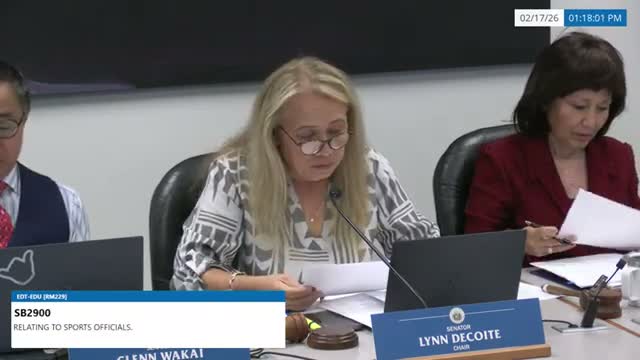
SB 2900, a measure to provide legal protections for sports officials, prompted a split between advocates seeking stronger protections and defenders of criminal-justice proportionality. The Department of Education told the committee it supports elevating intentional bodily injury against sports officials to enhance safety for officials who face threats and assaults at school events.
Haley Chang, first deputy of the Office of the Public Defender, opposed the criminal-elevation portion, arguing the bill would convert conduct now treated as misdemeanor-level bodily injury into a class B felony and would extend elevated status to new protected classes without adequate justification. Chang and other defense-oriented witnesses warned that ordinary shove or nonvisible pain could be criminalized at a higher level.
Deputy Attorney General counsel suggested narrower drafting to match existing special classes of protected people: specifically, they recommended inserting the word 'substantial' before 'bodily injury' in the criminal sections to preserve charging discretion and avoid elevating minor conduct automatically to a higher felony class. On the civil side, the deputy AG and other witnesses said the provision that would make the Attorney General’s office act as plaintiffs’ counsel raised separation‑of‑function concerns; they recommended removing the civil‑action language and instead developing a policy that would allow departments to hire private counsel or create a legal‑advocate position to help employees seek temporary restraining orders (TROs).
Senators asked for a narrowly tailored solution so the AG’s office could assist in immediate protective relief without converting the AG into a universal plaintiffs’ attorney. Committee members discussed that volunteer officials, athletic-association referees and athletic directors may fall under the bill’s broad definition and asked staff to clarify scope.
Because members wanted to tighten language on the civil TRO assistance and criminal thresholds, they agreed to use SB 3179 (a related vehicle on safety of education workers) for amendments and deferred SB 2900 indefinitely while that work proceeds.
No final criminal or civil substantive change was adopted in the hearing; the committee’s next action will be drafting targeted amendments to preserve protective relief without unintended expansion of felony exposure.
Haley Chang, first deputy of the Office of the Public Defender, opposed the criminal-elevation portion, arguing the bill would convert conduct now treated as misdemeanor-level bodily injury into a class B felony and would extend elevated status to new protected classes without adequate justification. Chang and other defense-oriented witnesses warned that ordinary shove or nonvisible pain could be criminalized at a higher level.
Deputy Attorney General counsel suggested narrower drafting to match existing special classes of protected people: specifically, they recommended inserting the word 'substantial' before 'bodily injury' in the criminal sections to preserve charging discretion and avoid elevating minor conduct automatically to a higher felony class. On the civil side, the deputy AG and other witnesses said the provision that would make the Attorney General’s office act as plaintiffs’ counsel raised separation‑of‑function concerns; they recommended removing the civil‑action language and instead developing a policy that would allow departments to hire private counsel or create a legal‑advocate position to help employees seek temporary restraining orders (TROs).
Senators asked for a narrowly tailored solution so the AG’s office could assist in immediate protective relief without converting the AG into a universal plaintiffs’ attorney. Committee members discussed that volunteer officials, athletic-association referees and athletic directors may fall under the bill’s broad definition and asked staff to clarify scope.
Because members wanted to tighten language on the civil TRO assistance and criminal thresholds, they agreed to use SB 3179 (a related vehicle on safety of education workers) for amendments and deferred SB 2900 indefinitely while that work proceeds.
No final criminal or civil substantive change was adopted in the hearing; the committee’s next action will be drafting targeted amendments to preserve protective relief without unintended expansion of felony exposure.
Don't Miss a Word: See the Full Meeting!
Go beyond summaries. Unlock every video, transcript, and key insight with a Founder Membership.
✓
Get instant access to full meeting videos
✓
Search and clip any phrase from complete transcripts
✓
Receive AI-powered summaries & custom alerts
✓
Enjoy lifetime, unrestricted access to government data
30-day money-back guarantee
