Lawmakers press University of Hawaii leaders on large tuition-fee balances, RIM use and transparency
February 14, 2026 | Senate, Legislative , Hawaii
This article was created by AI summarizing key points discussed. AI makes mistakes, so for full details and context, please refer to the video of the full meeting. Please report any errors so we can fix them. Report an error »
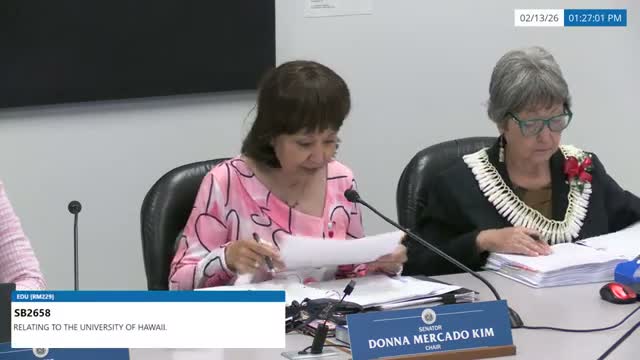
Senators spent significant time on Feb. 13 questioning University of Hawaii leaders about bills that would change how tuition and special-fee fund balances are treated and how lump-sum RIM (Repair, Improvement and Maintenance) funding is used.
Tom Yamachika (Tax Foundation) described the proposed amendment to SB 2602 as a technical fix, but University President Wendell Hensel and other university witnesses urged caution. Hensel told senators that sweeping campus-held balances back to a central fund would be a "major shift" in how the university is funded and could handcuff the university’s ability to plan long-range investments, debt service and strategic initiatives.
Luis Salaveria, UH vice president and chief financial officer, provided campus-level figures: he said Manoa holds the largest tuition-and-fees special-fund balance (approximately $93,000,000) and that community colleges collectively hold roughly $142,000,000. Salaveria said the aggregate difference between policy reserves (16%) and current balances is about $101,116,170 (as described in testimony) and offered to provide the committee with more detailed, campus-by-campus reporting.
Debate over SB 2658 (RIM/CIP) focused on whether RIM lump sums should be restricted from covering cost overruns on previously appropriated CIP projects. University witnesses warned the bill could render RIM unusable for legitimate deferred-maintenance work; senators stressed transparency, regular reporting, and rules to prevent shifting funds without legislative knowledge.
The committee approved technical amendments and recommended passage on several related measures (SB 2602, SB 2658 amendments, SB 3229 donor evaluations, SB 3232 universal school meals reporting provisions, and related procurement and meal-cost measures), often asking the university to provide clearer reporting and policy changes to reassure lawmakers.
Next steps: University leadership committed to supply more granular reporting on balances and to work with the legislature on policy and oversight to address concerns about transparency and equitable use of funds.
Tom Yamachika (Tax Foundation) described the proposed amendment to SB 2602 as a technical fix, but University President Wendell Hensel and other university witnesses urged caution. Hensel told senators that sweeping campus-held balances back to a central fund would be a "major shift" in how the university is funded and could handcuff the university’s ability to plan long-range investments, debt service and strategic initiatives.
Luis Salaveria, UH vice president and chief financial officer, provided campus-level figures: he said Manoa holds the largest tuition-and-fees special-fund balance (approximately $93,000,000) and that community colleges collectively hold roughly $142,000,000. Salaveria said the aggregate difference between policy reserves (16%) and current balances is about $101,116,170 (as described in testimony) and offered to provide the committee with more detailed, campus-by-campus reporting.
Debate over SB 2658 (RIM/CIP) focused on whether RIM lump sums should be restricted from covering cost overruns on previously appropriated CIP projects. University witnesses warned the bill could render RIM unusable for legitimate deferred-maintenance work; senators stressed transparency, regular reporting, and rules to prevent shifting funds without legislative knowledge.
The committee approved technical amendments and recommended passage on several related measures (SB 2602, SB 2658 amendments, SB 3229 donor evaluations, SB 3232 universal school meals reporting provisions, and related procurement and meal-cost measures), often asking the university to provide clearer reporting and policy changes to reassure lawmakers.
Next steps: University leadership committed to supply more granular reporting on balances and to work with the legislature on policy and oversight to address concerns about transparency and equitable use of funds.
View the Full Meeting & All Its Details
This article offers just a summary. Unlock complete video, transcripts, and insights as a Founder Member.
✓
Watch full, unedited meeting videos
✓
Search every word spoken in unlimited transcripts
✓
AI summaries & real-time alerts (all government levels)
✓
Permanent access to expanding government content
30-day money-back guarantee
