Senate commerce committee advances multiple condominium bills, defers several for revision
February 14, 2026 | Senate, Legislative , Hawaii
This article was created by AI summarizing key points discussed. AI makes mistakes, so for full details and context, please refer to the video of the full meeting. Please report any errors so we can fix them. Report an error »
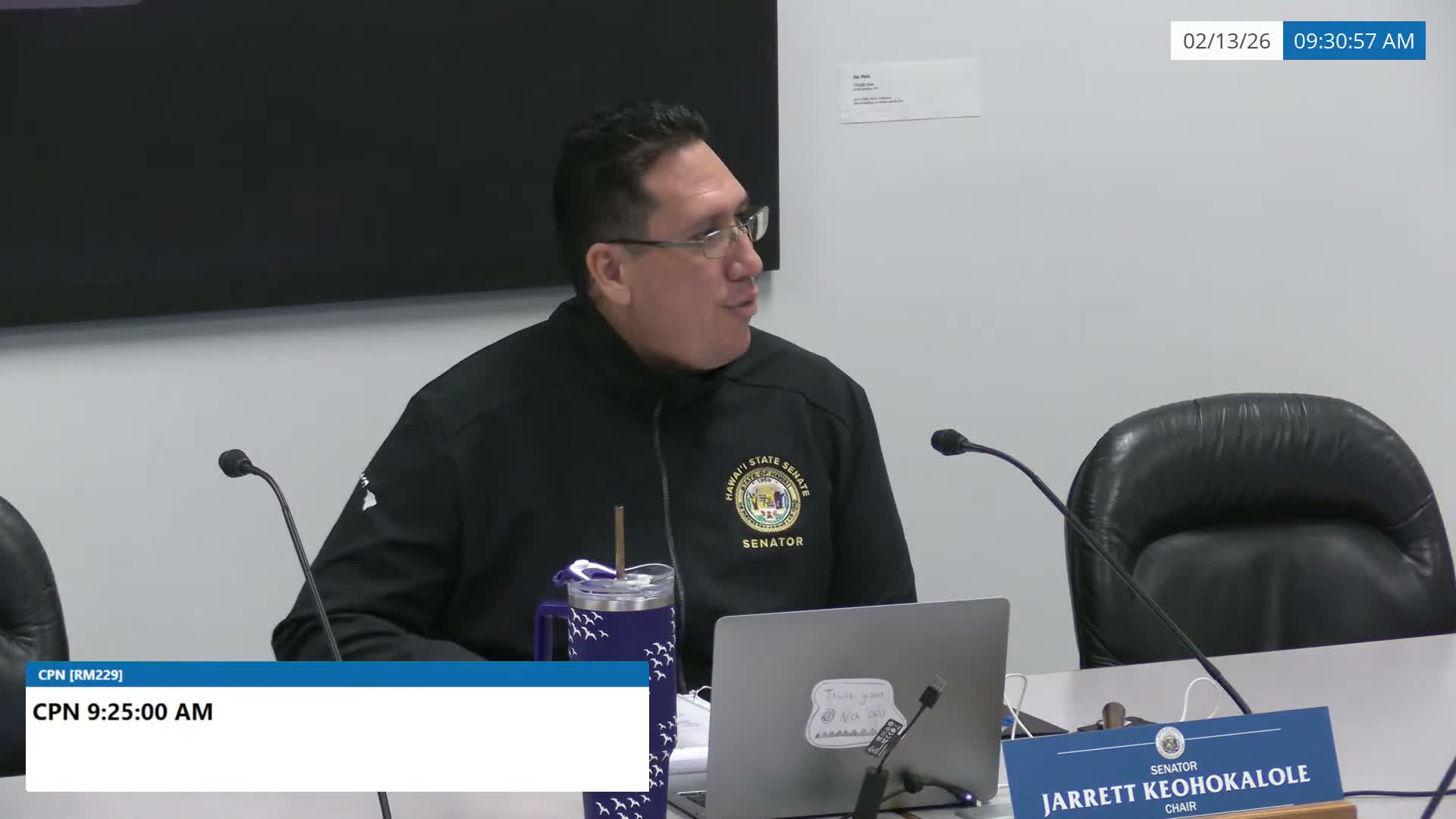
The Hawaii State Senate Committee on Commerce and Consumer Protection took up a slate of condominium and common-interest community bills on Feb. 13, hearing hours of testimony before passing several measures with amendments and deferring others for further work.
The committee passed SB 2294—intended to clarify that actions by association boards and managing agents under chapter 514B must comply with applicable laws and regulations—with amendments and a defective effective date of July 1, 2050, to allow additional drafting. Phil Nerney of the Community Associations Institute opposed the original bill as redundant, saying existing law already requires compliance. Homeowners and resident board members, including Susan Trombley and Greg Masecki, urged clearer external enforcement and stronger owner protections, describing incidents where city inspectors deferred enforcement to condo boards.
On proxy forms, SB 2298 drew mixed reactions. Proponents such as Susan Trombley told the committee that proxy options should be clearly explained so owners understand how their proxy votes are used. Opponents, including members of CAI and long‑time owners like Sandy Wong and Greg Mesakian, said adding explanatory text beside ballot boxes could make proxy materials longer and more confusing; the committee moved to replace the proposed amendments with language more consistent with existing sections and to continue work.
The committee deferred SB 2300, which would change required reserve study projection horizons from 30 years to 25 years, after CAI representatives warned the change could increase short‑term homeowner costs and reduce transparency. Testimony from board members stressed that the effect of projection-horizon changes varies widely by property and urged careful study.
SB 2037, addressing recovery of attorney fees and related appeal rules, prompted extensive debate. The committee agreed to remove a proposed 25% cap on attorneys’ fees and to clarify appeal and collection procedures; the changes were adopted as committee amendments to strike a balance between owner protections and enforceability, according to the chair. Opponents including Phil Nerney and the Collection Law Section (Paul Ireland) said a fee cap would undermine associations’ ability to collect assessments and enforce rules; proponents and affected owners urged clearer billing transparency and procedural protections for owners.
The committee also considered SB 2764 (clarifying application of owner payments to money judgments) and SB 2765 (rental income retained by associations after foreclosure). SB 2765 was amended and passed to clarify timing of rental‑income calculations after foreclosure to reflect legislative intent; SB 2764 was deferred for additional drafting after members raised concerns about foreclosure consequences and possible artificial delinquencies.
Two measures relating to public access and owner participation—SB 2433 (recognizing unit owners as stakeholders for the Condominium Education Trust Fund) and SB 2838 (establishing an online DCCA portal for association documents)—drew competing views on transparency versus privacy and business confidentiality; both were deferred to February 18 for further work. Supporters including members of the Real Estate Commission and several owners urged more robust disclosure mechanisms and quicker access to documents; CAI warned that broad public disclosure of private contracts and minutes could create privacy issues and risks such as price‑fixing.
Finally, SB 2949 to establish a homeowners insurance ombudsman within the DCCA received agency comments and passed with technical, non‑substantive amendments and a defective effective date to allow coordination with other regulatory functions. DCCA’s insurance division emphasized the need for an ombudsman framework that complements existing regulatory authority and avoids duplication.
What’s next: several bills were left with defective effective dates to permit drafting changes and technical amendments. SB 2300, SB 2764, SB 2433 and SB 2838 were deferred for further work; the committee scheduled follow‑up consideration for some items. Committee members repeatedly invited stakeholder collaboration—CAI, homeowner advocates, the Real Estate Commission, and the collection law section—to refine language before the measures return.
Quotes heard in committee included Phil Nerney of CAI: “It is redundant and injects doubt into the statute if this were to pass,” and Susan Trombley: “Voting for our association’s board members shouldn’t be confusing.” The chair stressed the intent to keep discussions going and to avoid sending parties back to litigation while the committee refines statutory language.
The committee passed SB 2294—intended to clarify that actions by association boards and managing agents under chapter 514B must comply with applicable laws and regulations—with amendments and a defective effective date of July 1, 2050, to allow additional drafting. Phil Nerney of the Community Associations Institute opposed the original bill as redundant, saying existing law already requires compliance. Homeowners and resident board members, including Susan Trombley and Greg Masecki, urged clearer external enforcement and stronger owner protections, describing incidents where city inspectors deferred enforcement to condo boards.
On proxy forms, SB 2298 drew mixed reactions. Proponents such as Susan Trombley told the committee that proxy options should be clearly explained so owners understand how their proxy votes are used. Opponents, including members of CAI and long‑time owners like Sandy Wong and Greg Mesakian, said adding explanatory text beside ballot boxes could make proxy materials longer and more confusing; the committee moved to replace the proposed amendments with language more consistent with existing sections and to continue work.
The committee deferred SB 2300, which would change required reserve study projection horizons from 30 years to 25 years, after CAI representatives warned the change could increase short‑term homeowner costs and reduce transparency. Testimony from board members stressed that the effect of projection-horizon changes varies widely by property and urged careful study.
SB 2037, addressing recovery of attorney fees and related appeal rules, prompted extensive debate. The committee agreed to remove a proposed 25% cap on attorneys’ fees and to clarify appeal and collection procedures; the changes were adopted as committee amendments to strike a balance between owner protections and enforceability, according to the chair. Opponents including Phil Nerney and the Collection Law Section (Paul Ireland) said a fee cap would undermine associations’ ability to collect assessments and enforce rules; proponents and affected owners urged clearer billing transparency and procedural protections for owners.
The committee also considered SB 2764 (clarifying application of owner payments to money judgments) and SB 2765 (rental income retained by associations after foreclosure). SB 2765 was amended and passed to clarify timing of rental‑income calculations after foreclosure to reflect legislative intent; SB 2764 was deferred for additional drafting after members raised concerns about foreclosure consequences and possible artificial delinquencies.
Two measures relating to public access and owner participation—SB 2433 (recognizing unit owners as stakeholders for the Condominium Education Trust Fund) and SB 2838 (establishing an online DCCA portal for association documents)—drew competing views on transparency versus privacy and business confidentiality; both were deferred to February 18 for further work. Supporters including members of the Real Estate Commission and several owners urged more robust disclosure mechanisms and quicker access to documents; CAI warned that broad public disclosure of private contracts and minutes could create privacy issues and risks such as price‑fixing.
Finally, SB 2949 to establish a homeowners insurance ombudsman within the DCCA received agency comments and passed with technical, non‑substantive amendments and a defective effective date to allow coordination with other regulatory functions. DCCA’s insurance division emphasized the need for an ombudsman framework that complements existing regulatory authority and avoids duplication.
What’s next: several bills were left with defective effective dates to permit drafting changes and technical amendments. SB 2300, SB 2764, SB 2433 and SB 2838 were deferred for further work; the committee scheduled follow‑up consideration for some items. Committee members repeatedly invited stakeholder collaboration—CAI, homeowner advocates, the Real Estate Commission, and the collection law section—to refine language before the measures return.
Quotes heard in committee included Phil Nerney of CAI: “It is redundant and injects doubt into the statute if this were to pass,” and Susan Trombley: “Voting for our association’s board members shouldn’t be confusing.” The chair stressed the intent to keep discussions going and to avoid sending parties back to litigation while the committee refines statutory language.
Don't Miss a Word: See the Full Meeting!
Go beyond summaries. Unlock every video, transcript, and key insight with a Founder Membership.
✓
Get instant access to full meeting videos
✓
Search and clip any phrase from complete transcripts
✓
Receive AI-powered summaries & custom alerts
✓
Enjoy lifetime, unrestricted access to government data
30-day money-back guarantee
