Senate committee removes 25% attorney‑fee cap from condominium bill after heated testimony
February 14, 2026 | Senate, Legislative , Hawaii
This article was created by AI summarizing key points discussed. AI makes mistakes, so for full details and context, please refer to the video of the full meeting. Please report any errors so we can fix them. Report an error »
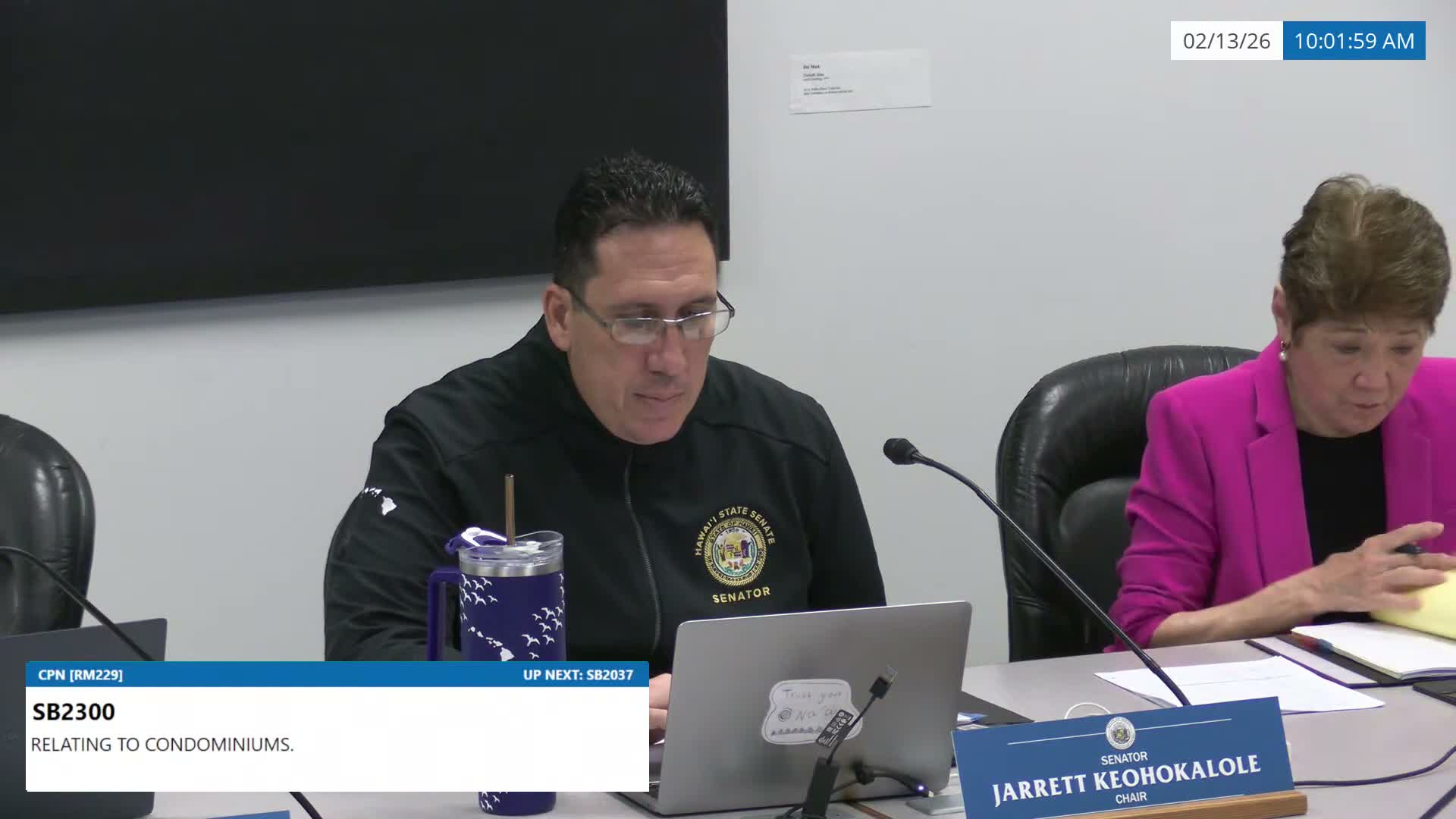
The Hawaii Senate Commerce and Consumer Protection Committee on Feb. 13 amended SB 2037—legislation concerning condominium enforcement and recovery of attorneys’ fees—to remove a proposed 25% cap on attorneys’ fees and to clarify appeal timing and the definition of when fines are 'deemed collectible.' The committee then passed the bill with those amendments.
Phil Nerney, testifying for the Community Associations Institute, told the committee a 25% cap would undermine associations’ ability to collect maintenance fees and enforce rules: "Condominium associations cease to exist" if they cannot recover enforcement costs, he said. Paul Ireland of the Collection Law Section of the Hawaii State Bar Association similarly opposed the cap as arbitrary and likely to shift costs to compliant owners, especially in non‑monetary cases where a percentage cap may be inapplicable.
Owners and advocates urged stronger owner protections and billing transparency. Jeff Sodino, supporting the measure, recommended requiring attorney invoices be provided to unit owners (with redactions where appropriate) to prevent accounting errors and improper charge shifting. Testifiers also raised concerns about weaponized use of fines in targeted disputes and urged clearer statutory remedies for retaliation.
In response to testimony, the committee amended SB 2037 to:
- Clarify that the time to initiate an appeal may be determined by an association’s governing documents;
- Provide clearer standards for when a fine is 'deemed collectible' and allow certain challenges in small claims court;
- Remove the proposed 25% cap on recovered attorneys’ fees and costs;
- Align trial de novo language with existing arbitration rules on prevailing‑party determinations.
The chair said the amendments aim to protect owners from abusive practices while preserving associations’ ability to enforce rules and collect assessments. The recommendation to pass with amendments was adopted by committee voice vote.
Next steps: The bill moves forward with committee amendments; sponsors and stakeholders were encouraged to continue working on procedural clarifications and owner protections ahead of further legislative action.
Representative testimony included: Phil Nerney (CAI): "It can't be the case that to chase $1,000 you have to spend more than $1,000." Paul Ireland (Collection Law Section): "This cap is entirely arbitrary and bears no relationship to the complexity of the disputes." Jeff Sodino (owner/supporter): recommended requiring attorney invoices be provided to owners.
Phil Nerney, testifying for the Community Associations Institute, told the committee a 25% cap would undermine associations’ ability to collect maintenance fees and enforce rules: "Condominium associations cease to exist" if they cannot recover enforcement costs, he said. Paul Ireland of the Collection Law Section of the Hawaii State Bar Association similarly opposed the cap as arbitrary and likely to shift costs to compliant owners, especially in non‑monetary cases where a percentage cap may be inapplicable.
Owners and advocates urged stronger owner protections and billing transparency. Jeff Sodino, supporting the measure, recommended requiring attorney invoices be provided to unit owners (with redactions where appropriate) to prevent accounting errors and improper charge shifting. Testifiers also raised concerns about weaponized use of fines in targeted disputes and urged clearer statutory remedies for retaliation.
In response to testimony, the committee amended SB 2037 to:
- Clarify that the time to initiate an appeal may be determined by an association’s governing documents;
- Provide clearer standards for when a fine is 'deemed collectible' and allow certain challenges in small claims court;
- Remove the proposed 25% cap on recovered attorneys’ fees and costs;
- Align trial de novo language with existing arbitration rules on prevailing‑party determinations.
The chair said the amendments aim to protect owners from abusive practices while preserving associations’ ability to enforce rules and collect assessments. The recommendation to pass with amendments was adopted by committee voice vote.
Next steps: The bill moves forward with committee amendments; sponsors and stakeholders were encouraged to continue working on procedural clarifications and owner protections ahead of further legislative action.
Representative testimony included: Phil Nerney (CAI): "It can't be the case that to chase $1,000 you have to spend more than $1,000." Paul Ireland (Collection Law Section): "This cap is entirely arbitrary and bears no relationship to the complexity of the disputes." Jeff Sodino (owner/supporter): recommended requiring attorney invoices be provided to owners.
Don't Miss a Word: See the Full Meeting!
Go beyond summaries. Unlock every video, transcript, and key insight with a Founder Membership.
✓
Get instant access to full meeting videos
✓
Search and clip any phrase from complete transcripts
✓
Receive AI-powered summaries & custom alerts
✓
Enjoy lifetime, unrestricted access to government data
30-day money-back guarantee
