Guam hearing on Bill 242-38 exposes deep split over who should vote in a decolonization plebiscite
February 18, 2026 | General Government Operations and Appropriations , Legislative, Guam, International
This article was created by AI summarizing key points discussed. AI makes mistakes, so for full details and context, please refer to the video of the full meeting. Please report any errors so we can fix them. Report an error »
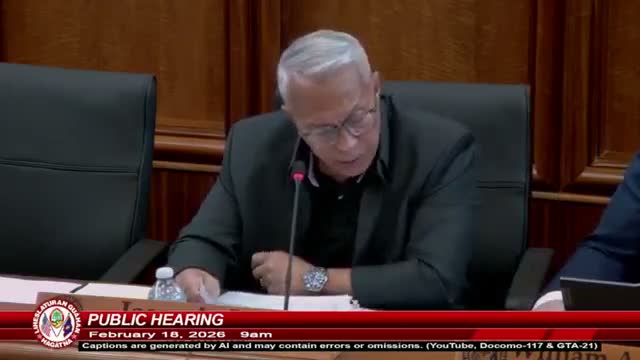
A Guam legislative committee on Feb. 18 held a heated public hearing on Bill 242-38, a measure that would remove ancestry-based voter restrictions from the territory's political-status plebiscite and require that plebiscite eligibility follow Guam's ordinary voter rules. The bill's author, Senator Will Parkinson, told the Committee on Transportation, Tourism, Customs, Utilities, and Federal and Foreign Affairs that federal court decisions and international practice make the current law untenable.
Parkinson said the Ninth Circuit's decision in Davis v. Guam and related developments mean the decolonization registry 'as written cannot be implemented.' He argued Guam should adopt a plebiscite electorate based on ordinary voter eligibility, while remaining open to a 'reasonable residency requirement' as an amendment. "Never in the history of UN supported decolonization has any territory successfully pursued decolonization by restricting the vote to native inhabitants only," Parkinson said, urging lawmakers to change the statute so any plebiscite can be recognized by the United States and international bodies.
Opponents, including the Commission on Decolonization and multiple community groups, framed the issue as one of restorative justice for the Chamorro people. Victoria Lola Leon Guerrero, reading the commission's formal statement, told the committee that 'the right of self determination belongs to those who were colonized' and argued that Bill 242-38 would erase that internationally recognized right. The commission urged local leaders to pursue alternatives such as federal petitioning or international legal avenues rather than broadening the electorate.
Legal testimony and community voices split the room. Dr. Robert Underwood, testifying remotely, warned against rushing a change and recommended more deliberation, saying the situation is 'unique to Guam' and requires careful political and legal work. He told senators, "Withdraw the bill, and let's have a panel of conversations with us," urging more consultation before altering the plebiscite rules.
Public testimony included veterans, elders, students and advocacy organizations. Annie Fe Camacho submitted a petition she said had about 1,820 signatures (which she later said had grown to roughly 1,870) opposing the bill. Youth for Decolonization students said expanding eligibility to voters who meet a 30-day residency requirement would undercut the remedial purpose of a decolonization plebiscite. Several speakers supporting the bill argued it responds to the Davis ruling and would avoid further costly litigation.
The committee did not take a vote. Members acknowledged the depth of feeling and the volume of submitted testimony and indicated additional hearings would be scheduled so the committee can consider the record and potential amendments. The chair also noted the Guam Election Commission's Feb. 17, 2026 letter confirming the registry has not been used since the injunction and that the commission ceased registry activities.
The next procedural step is continuation of committee work: senators said they will review written testimony and may schedule further public hearings to allow more witnesses and additional deliberation before any committee action.
Parkinson said the Ninth Circuit's decision in Davis v. Guam and related developments mean the decolonization registry 'as written cannot be implemented.' He argued Guam should adopt a plebiscite electorate based on ordinary voter eligibility, while remaining open to a 'reasonable residency requirement' as an amendment. "Never in the history of UN supported decolonization has any territory successfully pursued decolonization by restricting the vote to native inhabitants only," Parkinson said, urging lawmakers to change the statute so any plebiscite can be recognized by the United States and international bodies.
Opponents, including the Commission on Decolonization and multiple community groups, framed the issue as one of restorative justice for the Chamorro people. Victoria Lola Leon Guerrero, reading the commission's formal statement, told the committee that 'the right of self determination belongs to those who were colonized' and argued that Bill 242-38 would erase that internationally recognized right. The commission urged local leaders to pursue alternatives such as federal petitioning or international legal avenues rather than broadening the electorate.
Legal testimony and community voices split the room. Dr. Robert Underwood, testifying remotely, warned against rushing a change and recommended more deliberation, saying the situation is 'unique to Guam' and requires careful political and legal work. He told senators, "Withdraw the bill, and let's have a panel of conversations with us," urging more consultation before altering the plebiscite rules.
Public testimony included veterans, elders, students and advocacy organizations. Annie Fe Camacho submitted a petition she said had about 1,820 signatures (which she later said had grown to roughly 1,870) opposing the bill. Youth for Decolonization students said expanding eligibility to voters who meet a 30-day residency requirement would undercut the remedial purpose of a decolonization plebiscite. Several speakers supporting the bill argued it responds to the Davis ruling and would avoid further costly litigation.
The committee did not take a vote. Members acknowledged the depth of feeling and the volume of submitted testimony and indicated additional hearings would be scheduled so the committee can consider the record and potential amendments. The chair also noted the Guam Election Commission's Feb. 17, 2026 letter confirming the registry has not been used since the injunction and that the commission ceased registry activities.
The next procedural step is continuation of committee work: senators said they will review written testimony and may schedule further public hearings to allow more witnesses and additional deliberation before any committee action.
View the Full Meeting & All Its Details
This article offers just a summary. Unlock complete video, transcripts, and insights as a Founder Member.
✓
Watch full, unedited meeting videos
✓
Search every word spoken in unlimited transcripts
✓
AI summaries & real-time alerts (all government levels)
✓
Permanent access to expanding government content
30-day money-back guarantee
