House Energy committee reviews ADS FY27 request, flags $9M recurring appropriation and billing shifts
February 17, 2026 | Environment & Energy, HOUSE OF REPRESENTATIVES, Committees, Legislative , Vermont
This article was created by AI summarizing key points discussed. AI makes mistakes, so for full details and context, please refer to the video of the full meeting. Please report any errors so we can fix them. Report an error »
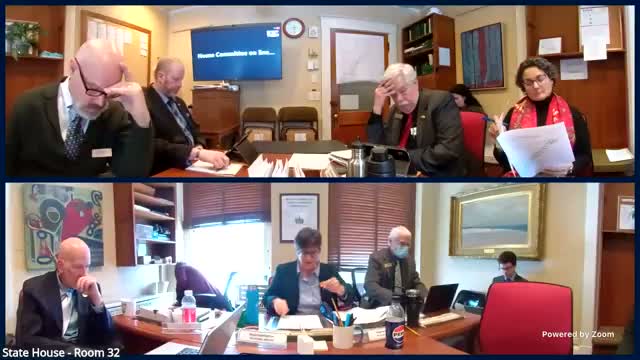
At a House Energy and Digital Infrastructure committee meeting on Feb. 17, members reviewed the Agency of Digital Services’ FY27 budget request, discussing a $9 million recurring general‑fund appropriation and internal billing changes that together produce a roughly $5 million net increase in ADS billback authority across state agencies.
Committee members said the draft letter to Appropriations must cover four budget areas: ADS, the Department of Public Service, the Vermont Community Broadband Board and the Public Utility Commission, plus two language items (E233 and E233.1). Speaker 1 summarized the ADS topline as “a $9,000,000 increase in the general fund appropriation,” plus “a $10,800,000 increase in ADS allocation charges” and “a $5,800,000 decrease in ADS service level agreement charges,” which net to about $5,000,000 in additional billback authority.
Representative Speaker 3 pressed for clarity on how those numbers interact: “So their ask is $9,000,000 increase in funding. Correct?” Committee members clarified the $9 million is new base general‑fund money in the governor’s recommendation, while the allocation and service‑level adjustments reallocate or expand ADS’ ability to charge other agencies for services. Several members emphasized that, although the $9 million formalizes spending the state appears to be covering now, it nonetheless creates an ongoing pressure on the general fund.
Members also flagged accounting and structural concerns. The committee discussed splitting ADS’s large internal service fund into four service funds (labeled in the draft as Request 1) to allow more granular billing and better identify services that currently go unrecovered. Speaker 1 described the split as a first step toward addressing a growing internal‑service deficit and said JFO had reviewed parts of the ADS draft but should return to explain the mechanics of billbacks and how multi‑year project spending is recorded.
On project accounting, the committee used the enterprise resource planning project as an example to probe how total project costs and year‑by‑year appropriations are shown in budgets. Speaker 1 asked for JFO to explain “what we’re spending this year” on multiyear projects so the committee can accurately capture current‑year budget impacts in its letter.
The committee agreed to take straw polls by section (rather than a formal committee vote) and to include straw‑poll results in the letter to Appropriations. Next steps include bringing JFO back to clarify accounting and scheduling a near‑term follow‑up meeting so the committee can finalize the FY27 letter before the Appropriations deadline.
Committee members said the draft letter to Appropriations must cover four budget areas: ADS, the Department of Public Service, the Vermont Community Broadband Board and the Public Utility Commission, plus two language items (E233 and E233.1). Speaker 1 summarized the ADS topline as “a $9,000,000 increase in the general fund appropriation,” plus “a $10,800,000 increase in ADS allocation charges” and “a $5,800,000 decrease in ADS service level agreement charges,” which net to about $5,000,000 in additional billback authority.
Representative Speaker 3 pressed for clarity on how those numbers interact: “So their ask is $9,000,000 increase in funding. Correct?” Committee members clarified the $9 million is new base general‑fund money in the governor’s recommendation, while the allocation and service‑level adjustments reallocate or expand ADS’ ability to charge other agencies for services. Several members emphasized that, although the $9 million formalizes spending the state appears to be covering now, it nonetheless creates an ongoing pressure on the general fund.
Members also flagged accounting and structural concerns. The committee discussed splitting ADS’s large internal service fund into four service funds (labeled in the draft as Request 1) to allow more granular billing and better identify services that currently go unrecovered. Speaker 1 described the split as a first step toward addressing a growing internal‑service deficit and said JFO had reviewed parts of the ADS draft but should return to explain the mechanics of billbacks and how multi‑year project spending is recorded.
On project accounting, the committee used the enterprise resource planning project as an example to probe how total project costs and year‑by‑year appropriations are shown in budgets. Speaker 1 asked for JFO to explain “what we’re spending this year” on multiyear projects so the committee can accurately capture current‑year budget impacts in its letter.
The committee agreed to take straw polls by section (rather than a formal committee vote) and to include straw‑poll results in the letter to Appropriations. Next steps include bringing JFO back to clarify accounting and scheduling a near‑term follow‑up meeting so the committee can finalize the FY27 letter before the Appropriations deadline.
View the Full Meeting & All Its Details
This article offers just a summary. Unlock complete video, transcripts, and insights as a Founder Member.
✓
Watch full, unedited meeting videos
✓
Search every word spoken in unlimited transcripts
✓
AI summaries & real-time alerts (all government levels)
✓
Permanent access to expanding government content
30-day money-back guarantee
