Lease with Power Transitions draws scrutiny as Vermont weighs reuse options for Vermont Yankee site
February 17, 2026 | Environment & Energy, HOUSE OF REPRESENTATIVES, Committees, Legislative , Vermont
This article was created by AI summarizing key points discussed. AI makes mistakes, so for full details and context, please refer to the video of the full meeting. Please report any errors so we can fix them. Report an error »
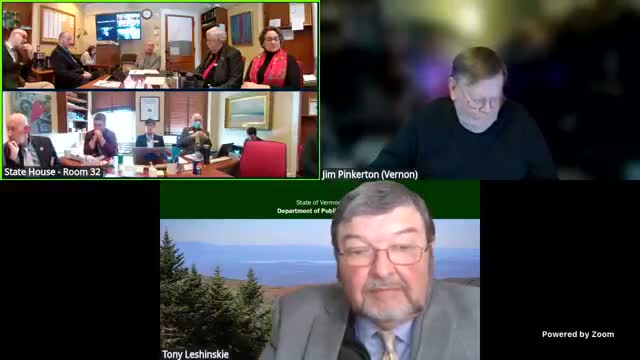
The committee also focused on what comes after decommissioning: who controls the site, what uses are possible, and how communities will participate in future planning.
Commissioner Carrick Johnson told the committee the Vermont Yankee site is roughly 141 acres and that a lease option held by a company called Power Transitions was executed before his current tenure. He said the department holds a right of first refusal if the property is sold and that the department has started discussions with the lessee. "Power transitions...they're kind of MO there...they've had a different plan there regardless," Johnson said, describing the firm’s practice of redeveloping former energy sites. He added the department is seeking a collaborative approach and offered to introduce committee members to Power Transitions.
Jim Pinkerton, who serves on the Vernon Select Board and chairs the Wyndham Regional Commission project review committee, told lawmakers the town was surprised by the lease and has been actively preparing through studies and town‑plan updates; he emphasized municipal involvement and regional review. "We have basically a 140 acres of riverfront property...that would make a fine business absent the spent fuel storage area," Pinkerton said, acknowledging limits created by the presence of on‑site spent fuel.
Committee members asked whether redevelopment proposals would trigger Vermont’s Act 250 or the Public Utility Commission’s Section 248 certificate of public good (CPG) process. Witnesses said proposed generation projects would require a PUC CPG and some large loads or data centers could trigger Act 250 regional review; both PUC and Act 250 processes can allow municipal and regional interveners. Johnson said some outcomes could also require legislative sign‑off before a final CPG in particular statutory circumstances.
Lawmakers pressed on whether spent fuel could be reused for small modular reactors and who owns the fuel. Lushinski said some SMR designs could hypothetically use previously burned fuel but ownership and disposition are subject to federal jurisdiction; he confirmed NorthStar currently owns the on‑site fuel.
Committee members asked for clarity on permitting, local interventions and any impacts to the local tax base. The department committed to providing additional documentation and to facilitate direct discussions between committee members, municipal leaders and the lessee as part of follow‑up work.
The hearing record shows active local engagement and that redevelopment will move forward only after standard state and municipal reviews, including opportunities for the town, regional commission and the PUC to intervene where law allows.
Commissioner Carrick Johnson told the committee the Vermont Yankee site is roughly 141 acres and that a lease option held by a company called Power Transitions was executed before his current tenure. He said the department holds a right of first refusal if the property is sold and that the department has started discussions with the lessee. "Power transitions...they're kind of MO there...they've had a different plan there regardless," Johnson said, describing the firm’s practice of redeveloping former energy sites. He added the department is seeking a collaborative approach and offered to introduce committee members to Power Transitions.
Jim Pinkerton, who serves on the Vernon Select Board and chairs the Wyndham Regional Commission project review committee, told lawmakers the town was surprised by the lease and has been actively preparing through studies and town‑plan updates; he emphasized municipal involvement and regional review. "We have basically a 140 acres of riverfront property...that would make a fine business absent the spent fuel storage area," Pinkerton said, acknowledging limits created by the presence of on‑site spent fuel.
Committee members asked whether redevelopment proposals would trigger Vermont’s Act 250 or the Public Utility Commission’s Section 248 certificate of public good (CPG) process. Witnesses said proposed generation projects would require a PUC CPG and some large loads or data centers could trigger Act 250 regional review; both PUC and Act 250 processes can allow municipal and regional interveners. Johnson said some outcomes could also require legislative sign‑off before a final CPG in particular statutory circumstances.
Lawmakers pressed on whether spent fuel could be reused for small modular reactors and who owns the fuel. Lushinski said some SMR designs could hypothetically use previously burned fuel but ownership and disposition are subject to federal jurisdiction; he confirmed NorthStar currently owns the on‑site fuel.
Committee members asked for clarity on permitting, local interventions and any impacts to the local tax base. The department committed to providing additional documentation and to facilitate direct discussions between committee members, municipal leaders and the lessee as part of follow‑up work.
The hearing record shows active local engagement and that redevelopment will move forward only after standard state and municipal reviews, including opportunities for the town, regional commission and the PUC to intervene where law allows.
Don't Miss a Word: See the Full Meeting!
Go beyond summaries. Unlock every video, transcript, and key insight with a Founder Membership.
✓
Get instant access to full meeting videos
✓
Search and clip any phrase from complete transcripts
✓
Receive AI-powered summaries & custom alerts
✓
Enjoy lifetime, unrestricted access to government data
30-day money-back guarantee
