Enhanced 9‑1‑1 board cites new per‑line fee and steady call volume while seeking $5.56M for FY27
February 17, 2026 | Appropriations, HOUSE OF REPRESENTATIVES, Committees, Legislative , Vermont
This article was created by AI summarizing key points discussed. AI makes mistakes, so for full details and context, please refer to the video of the full meeting. Please report any errors so we can fix them. Report an error »
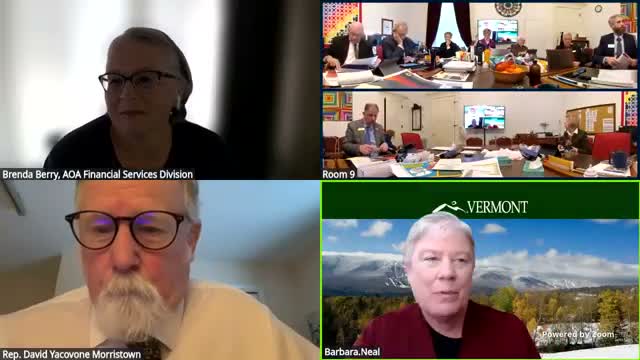
Barbara Neal, executive director of the Enhanced 9‑1‑1 Board, told the House Appropriations Committee on Feb. 17 that the board’s FY27 request is approximately $5,560,000 and that a revenue change effective July 1, 2025 — moving from a 2.4% retail telecommunications charge to a per‑line fee of 72¢ per eligible line per month — appears to have steadied the Vermont Universal Service Fund.
Neal said a 2024 joint fiscal office estimate indicated a 70¢ per-access-line fee would generate about $7.3 million; the board expects the 72¢ fee to yield slightly more. She described a statutory hierarchy for fund distribution that directs 17% of VUSF revenue to the Vermont Community Broadband Board, then covers the fiscal agent cost, funds the telecommunications relay service, the equipment distribution program and the lifeline program before allocating the remainder to Enhanced 9‑1‑1 board operations. Neal said the board accounts for about 78% of the universal service fund’s remaining revenue after earlier priorities are paid.
On operations, Neal said the 9‑1‑1 system handled over 233,000 calls in 2025, about 181,000 of them cellular (roughly 77%), with about 15,000 abandoned calls (7% of incoming). Neal said average answer time last year was six seconds (up one second from 2024) and that the typical call length was about 2 minutes, 16 seconds. Statewide text-to-911 volume was 1,391 messages in 2025; Neal cautioned that text-to-911 is a best-effort service dependent on carriers.
The board’s FY27 request of roughly $5.56 million represents about a 3% increase from the current year’s appropriation; Neal cited personnel cost increases and a roughly $60,000 line for two part-time training positions to boost quality-assurance review of calls. Those positions were hired as part-time temporary roles to improve call review coverage and to identify remediations and training needs.
Neal explained the PSAP reimbursement fund that pays answering centers a stipend based on performance metrics; that line grows about 3% annually even if call volume is steady. Committee members asked for more granular cost information; Representative Dave Iacoboni asked whether the agency keeps per-PSAP cost-per-call data after dividing the budget by calls (his quick calculation yielded about $24 per call). Neal agreed to check and provide per-PSAP cost data to the committee.
On ADS billing, the financial manager said the ADS allocated fee for E9‑1‑1 is $45,572 and the service-level agreement line is $8,002.16, yielding a net increase of roughly $7,000 year over year due to ADS’s changed billing methodology. Neal said the public service department has not yet collected a full year of data under the new fee structure and expects final revenue numbers by mid‑summer; staff identified a potential $80,000 shortfall for the current fiscal year that they expect to cover with carryforward funds.
The committee thanked the 9‑1‑1 board for the presentation and requested follow-up on PSAP cost-per-call variability and ADS billing details; no formal votes were taken during the hearing.
Neal said a 2024 joint fiscal office estimate indicated a 70¢ per-access-line fee would generate about $7.3 million; the board expects the 72¢ fee to yield slightly more. She described a statutory hierarchy for fund distribution that directs 17% of VUSF revenue to the Vermont Community Broadband Board, then covers the fiscal agent cost, funds the telecommunications relay service, the equipment distribution program and the lifeline program before allocating the remainder to Enhanced 9‑1‑1 board operations. Neal said the board accounts for about 78% of the universal service fund’s remaining revenue after earlier priorities are paid.
On operations, Neal said the 9‑1‑1 system handled over 233,000 calls in 2025, about 181,000 of them cellular (roughly 77%), with about 15,000 abandoned calls (7% of incoming). Neal said average answer time last year was six seconds (up one second from 2024) and that the typical call length was about 2 minutes, 16 seconds. Statewide text-to-911 volume was 1,391 messages in 2025; Neal cautioned that text-to-911 is a best-effort service dependent on carriers.
The board’s FY27 request of roughly $5.56 million represents about a 3% increase from the current year’s appropriation; Neal cited personnel cost increases and a roughly $60,000 line for two part-time training positions to boost quality-assurance review of calls. Those positions were hired as part-time temporary roles to improve call review coverage and to identify remediations and training needs.
Neal explained the PSAP reimbursement fund that pays answering centers a stipend based on performance metrics; that line grows about 3% annually even if call volume is steady. Committee members asked for more granular cost information; Representative Dave Iacoboni asked whether the agency keeps per-PSAP cost-per-call data after dividing the budget by calls (his quick calculation yielded about $24 per call). Neal agreed to check and provide per-PSAP cost data to the committee.
On ADS billing, the financial manager said the ADS allocated fee for E9‑1‑1 is $45,572 and the service-level agreement line is $8,002.16, yielding a net increase of roughly $7,000 year over year due to ADS’s changed billing methodology. Neal said the public service department has not yet collected a full year of data under the new fee structure and expects final revenue numbers by mid‑summer; staff identified a potential $80,000 shortfall for the current fiscal year that they expect to cover with carryforward funds.
The committee thanked the 9‑1‑1 board for the presentation and requested follow-up on PSAP cost-per-call variability and ADS billing details; no formal votes were taken during the hearing.
Don't Miss a Word: See the Full Meeting!
Go beyond summaries. Unlock every video, transcript, and key insight with a Founder Membership.
✓
Get instant access to full meeting videos
✓
Search and clip any phrase from complete transcripts
✓
Receive AI-powered summaries & custom alerts
✓
Enjoy lifetime, unrestricted access to government data
30-day money-back guarantee
