Owen County reviewers narrow proposed subdivision rules, debate 40% open-space benchmark
February 17, 2026 | Owen County, Indiana
This article was created by AI summarizing key points discussed. AI makes mistakes, so for full details and context, please refer to the video of the full meeting. Please report any errors so we can fix them. Report an error »
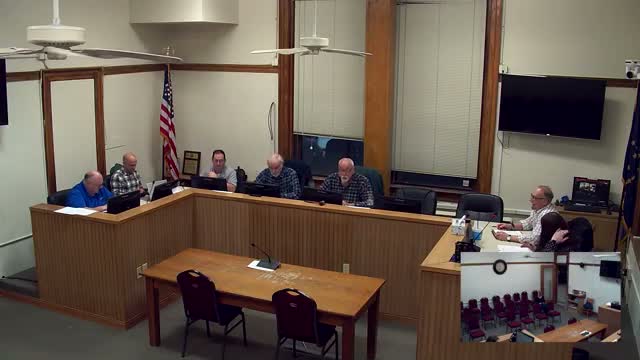
Unidentified Speaker 2 (transcript label; speaker names not provided in the record) presented a redlined draft of a subdivision ordinance intended for Owen County and said, "All I did was try to go through and simplify as much as I could as well as put in verbiage that would make sense for Owen County," asking the group to indicate edits they wanted preserved or reversed.
The review focused on three primary issues: how prescriptive the ordinance should be for conservation subdivisions, which county office should handle technical reviews (Plan Commission vs. highway/road department), and whether certain bonus-density and commercial provisions were appropriate for a largely rural county. The editor removed commercial and industrial references, added references to county and higher-level (state and federal) requirements, and proposed leaving some measurements to case-by-case decisions during approval rather than fixed numeric targets in the ordinance text.
A central point of contention was an open-space benchmark for conservation subdivisions. One participant argued for discretion, saying that minimum open-space requirements should be determined "during the approval process" because needs vary by site and utility availability. Another participant urged retaining a stated target to guard against favoritism, saying it "might make sense to stick with the 40% because this is, you know, this this document is very developer friendly." To illustrate scale, that speaker added, "A 1 acre lot conserve 40% of it would be, 17,000 square feet. So 1 acre lot is around 44,000 square feet," arguing the number is not necessarily onerous when measured in real units.
Members discussed tying base density to municipal water and sewer availability, with the editor noting denser development should be contemplated where utilities allow. Several participants supported simplifying permitted-district labels (fewer residential/agricultural subcategories) and removing bonus-density language that judges said would be difficult to interpret and police in practice. The draft also added a requirement that developers fund improvements (roads, drainage and other required site work) before lot sales and home construction, a point the group generally favored to avoid partial construction and enforcement problems later.
The meeting included practical, procedural points: speakers had trouble editing the shared Word file live because of licensing/access issues, and they agreed to mark changes and take notes manually when necessary. The editor asked members to cross-check the draft against the county's current definitions and the Comprehensive Plan (which the editor added to the draft) so references align between documents. Several items were flagged for follow-up, including a water-protection draft submitted by Jeffrey McMillan (identified in the transcript as a pastor in Cloverdale who provided proposed text for water protections).
Unidentified Speaker 5 recommended participants complete 'homework'—review the circulated draft and flag specific sections or concerns before the next meeting to speed future discussion. The motion to assign that homework was made, seconded, and approved by voice vote.
No formal ordinance adoption or numeric policy changes were recorded at this meeting; the transcript documents line-by-line review, substantive debate about policy approach (standards versus discretion), and agreed next steps for continued review.
The review focused on three primary issues: how prescriptive the ordinance should be for conservation subdivisions, which county office should handle technical reviews (Plan Commission vs. highway/road department), and whether certain bonus-density and commercial provisions were appropriate for a largely rural county. The editor removed commercial and industrial references, added references to county and higher-level (state and federal) requirements, and proposed leaving some measurements to case-by-case decisions during approval rather than fixed numeric targets in the ordinance text.
A central point of contention was an open-space benchmark for conservation subdivisions. One participant argued for discretion, saying that minimum open-space requirements should be determined "during the approval process" because needs vary by site and utility availability. Another participant urged retaining a stated target to guard against favoritism, saying it "might make sense to stick with the 40% because this is, you know, this this document is very developer friendly." To illustrate scale, that speaker added, "A 1 acre lot conserve 40% of it would be, 17,000 square feet. So 1 acre lot is around 44,000 square feet," arguing the number is not necessarily onerous when measured in real units.
Members discussed tying base density to municipal water and sewer availability, with the editor noting denser development should be contemplated where utilities allow. Several participants supported simplifying permitted-district labels (fewer residential/agricultural subcategories) and removing bonus-density language that judges said would be difficult to interpret and police in practice. The draft also added a requirement that developers fund improvements (roads, drainage and other required site work) before lot sales and home construction, a point the group generally favored to avoid partial construction and enforcement problems later.
The meeting included practical, procedural points: speakers had trouble editing the shared Word file live because of licensing/access issues, and they agreed to mark changes and take notes manually when necessary. The editor asked members to cross-check the draft against the county's current definitions and the Comprehensive Plan (which the editor added to the draft) so references align between documents. Several items were flagged for follow-up, including a water-protection draft submitted by Jeffrey McMillan (identified in the transcript as a pastor in Cloverdale who provided proposed text for water protections).
Unidentified Speaker 5 recommended participants complete 'homework'—review the circulated draft and flag specific sections or concerns before the next meeting to speed future discussion. The motion to assign that homework was made, seconded, and approved by voice vote.
No formal ordinance adoption or numeric policy changes were recorded at this meeting; the transcript documents line-by-line review, substantive debate about policy approach (standards versus discretion), and agreed next steps for continued review.
Don't Miss a Word: See the Full Meeting!
Go beyond summaries. Unlock every video, transcript, and key insight with a Founder Membership.
✓
Get instant access to full meeting videos
✓
Search and clip any phrase from complete transcripts
✓
Receive AI-powered summaries & custom alerts
✓
Enjoy lifetime, unrestricted access to government data
30-day money-back guarantee
