Wyoming Judiciary Committee advances False Claims Act with whistleblower protections and penalties
February 16, 2026 | Judiciary Committee, Senate, Committees, Legislative, Wyoming
This article was created by AI summarizing key points discussed. AI makes mistakes, so for full details and context, please refer to the video of the full meeting. Please report any errors so we can fix them. Report an error »
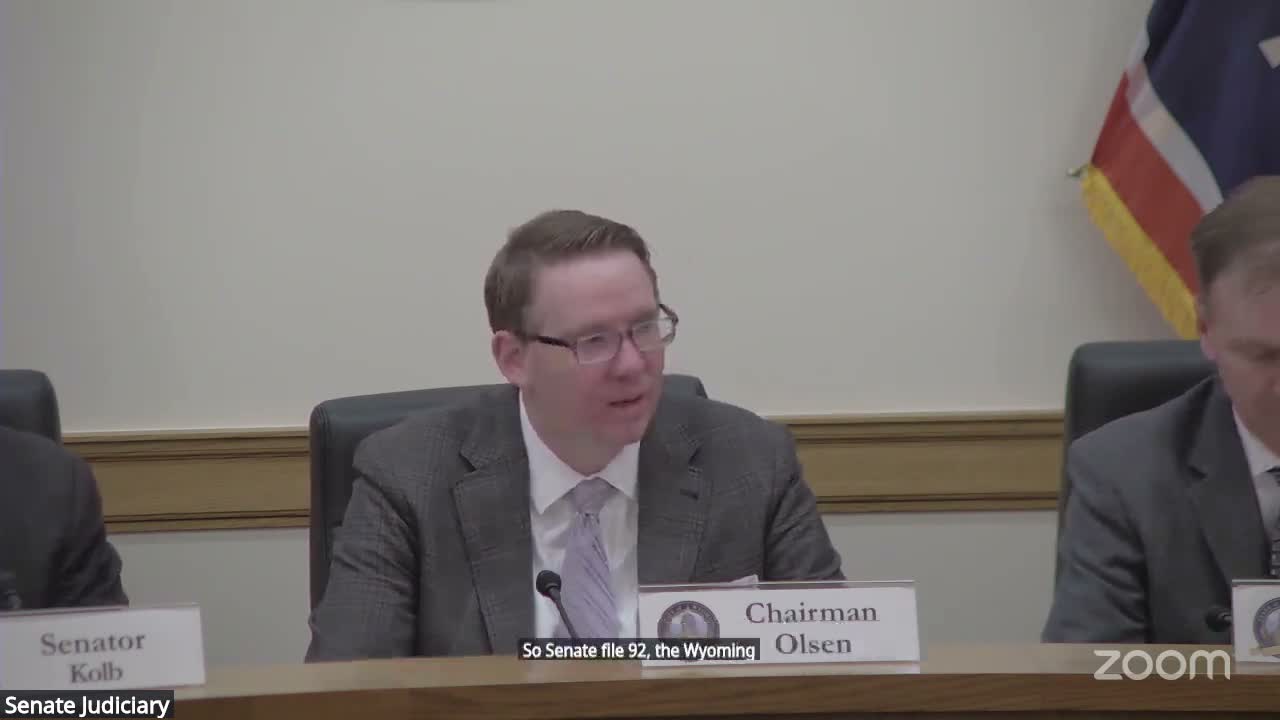
Senator Nedickott introduced Senate File 92, a proposed Wyoming False Claims Act intended to provide a civil remedy for fraud against state and political-subdivision funds. Citing high-profile fraud reports from other states, the sponsor described the measure as modeled in part on the federal False Claims Act and similar state statutes to allow the state — and private parties in some models — to recover funds obtained by fraud.
The bill defines "claim" broadly as any request or demand for money or property presented to a state officer, employee, agent, contractor, grantee, or other recipient, and it attaches a scienter requirement: liability requires that a person have actual knowledge, deliberate ignorance, or reckless disregard of the falsity of the information. "It has to be there has to be an intent, a fraud element," the sponsor said, emphasizing the bill does not target honest mistakes.
Under the draft, a person who commits a violation is liable for treble damages, the costs of the civil action, and a civil penalty of not less than $5,500 and not more than $11,000 per violation. The sponsor said those penalties are intended as a deterrent and noted the draft borrows penalty figures from District of Columbia practice.
The bill includes several procedural and scope provisions: original-source rules for qui tam reporting, limited jurisdiction where matters are publicly disclosed, an exhaustion requirement for present or former state employees (who must first use internal reporting channels unless the state fails to act within a reasonable time), and specific exclusions (for example, certain workers' compensation claims and federal benefit programs where federal remedies apply).
The sponsor also proposed a false claims account into which 33% of proceeds from an action or settlement would be deposited, with remaining proceeds directed to the public school fund by draft language; committee members discussed clarifying where recovered funds should flow and whether counties should receive reimbursement for prosecution costs.
Dylan Waits, testifying for the Council on State Taxation, requested the committee exclude all state and local taxes and fees from the act to avoid private suits challenging tax administration. In response to member questions, the sponsor agreed to clarify definitions and to work with LSO and stakeholders.
Senator Crago successfully moved an amendment adding language to reimburse prosecuting authorities for costs to support investigations and prosecutions under the act; the committee adopted the amendment and then advanced the bill on a roll-call vote, 5-0. The sponsor signaled interest in adding a private cause of action in the future and asked for committee support to consider a drafted amendment on the floor.
The bill defines "claim" broadly as any request or demand for money or property presented to a state officer, employee, agent, contractor, grantee, or other recipient, and it attaches a scienter requirement: liability requires that a person have actual knowledge, deliberate ignorance, or reckless disregard of the falsity of the information. "It has to be there has to be an intent, a fraud element," the sponsor said, emphasizing the bill does not target honest mistakes.
Under the draft, a person who commits a violation is liable for treble damages, the costs of the civil action, and a civil penalty of not less than $5,500 and not more than $11,000 per violation. The sponsor said those penalties are intended as a deterrent and noted the draft borrows penalty figures from District of Columbia practice.
The bill includes several procedural and scope provisions: original-source rules for qui tam reporting, limited jurisdiction where matters are publicly disclosed, an exhaustion requirement for present or former state employees (who must first use internal reporting channels unless the state fails to act within a reasonable time), and specific exclusions (for example, certain workers' compensation claims and federal benefit programs where federal remedies apply).
The sponsor also proposed a false claims account into which 33% of proceeds from an action or settlement would be deposited, with remaining proceeds directed to the public school fund by draft language; committee members discussed clarifying where recovered funds should flow and whether counties should receive reimbursement for prosecution costs.
Dylan Waits, testifying for the Council on State Taxation, requested the committee exclude all state and local taxes and fees from the act to avoid private suits challenging tax administration. In response to member questions, the sponsor agreed to clarify definitions and to work with LSO and stakeholders.
Senator Crago successfully moved an amendment adding language to reimburse prosecuting authorities for costs to support investigations and prosecutions under the act; the committee adopted the amendment and then advanced the bill on a roll-call vote, 5-0. The sponsor signaled interest in adding a private cause of action in the future and asked for committee support to consider a drafted amendment on the floor.
Don't Miss a Word: See the Full Meeting!
Go beyond summaries. Unlock every video, transcript, and key insight with a Founder Membership.
✓
Get instant access to full meeting videos
✓
Search and clip any phrase from complete transcripts
✓
Receive AI-powered summaries & custom alerts
✓
Enjoy lifetime, unrestricted access to government data
30-day money-back guarantee
