Committee advances bill letting conservation-district supervisors finish terms, sets residency rules
February 17, 2026 | Agriculture, State & Public Lands & Water Resources Committee, House of Representative, Committees, Legislative, Wyoming
This article was created by AI summarizing key points discussed. AI makes mistakes, so for full details and context, please refer to the video of the full meeting. Please report any errors so we can fix them. Report an error »
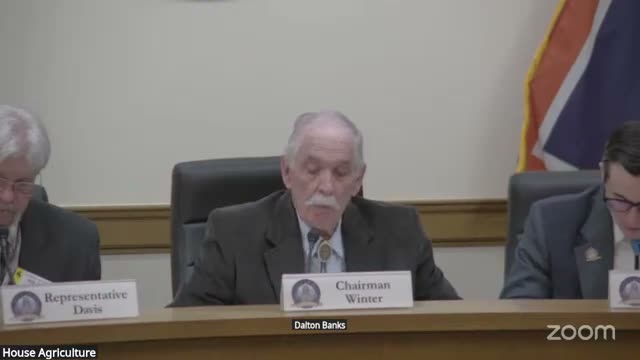
Representative John Davis brought House Bill 133 to the Agriculture, State & Public Lands & Water Resources Committee, saying the measure responds to conservation districts’ requests to modernize how supervisors are selected and to ease board continuity.
The bill requires five supervisors who reside within the conservation district and directs nonpartisan, at-large elections; it also sets minimum rural-representation criteria to preserve agricultural intent, Davis said. "It's a good little bill... it's a good fix," Davis said, describing the change as intended to help voluntary boards fill seats and maintain agricultural representation.
Holly Kennedy of the Wyoming Association of Conservation Districts testified in favor, describing the bill as the product of local resolutions debated at area and statewide meetings. "What conservation districts are really looking for ... is allowing those supervisors once they've been elected, as long as they continue to reside within that district, to finish out the term that they were elected for," Kennedy said.
Committee members pressed the sponsor on several details: whether a supervisor who moves within or out of a district must resign, how to define "rural" for the purposes of guaranteed seats, and whether election law already imposes residency prerequisites. Davis said the intent is that supervisors must live within district boundaries and that the bill can be fine-tuned to address gray areas about changing classification while in office.
Representative Davis offered and the committee considered an amendment adding the requirement that supervisors have lived in Wyoming for one year. After discussion about potential redundancy with existing election law, the amendment was adopted.
The committee voted 9–0 in favor of a due-pass recommendation with the amendment.
What happens next: House Bill 133 will go to the House floor with a committee recommendation to pass with the adopted amendment.
The bill requires five supervisors who reside within the conservation district and directs nonpartisan, at-large elections; it also sets minimum rural-representation criteria to preserve agricultural intent, Davis said. "It's a good little bill... it's a good fix," Davis said, describing the change as intended to help voluntary boards fill seats and maintain agricultural representation.
Holly Kennedy of the Wyoming Association of Conservation Districts testified in favor, describing the bill as the product of local resolutions debated at area and statewide meetings. "What conservation districts are really looking for ... is allowing those supervisors once they've been elected, as long as they continue to reside within that district, to finish out the term that they were elected for," Kennedy said.
Committee members pressed the sponsor on several details: whether a supervisor who moves within or out of a district must resign, how to define "rural" for the purposes of guaranteed seats, and whether election law already imposes residency prerequisites. Davis said the intent is that supervisors must live within district boundaries and that the bill can be fine-tuned to address gray areas about changing classification while in office.
Representative Davis offered and the committee considered an amendment adding the requirement that supervisors have lived in Wyoming for one year. After discussion about potential redundancy with existing election law, the amendment was adopted.
The committee voted 9–0 in favor of a due-pass recommendation with the amendment.
What happens next: House Bill 133 will go to the House floor with a committee recommendation to pass with the adopted amendment.
Don't Miss a Word: See the Full Meeting!
Go beyond summaries. Unlock every video, transcript, and key insight with a Founder Membership.
✓
Get instant access to full meeting videos
✓
Search and clip any phrase from complete transcripts
✓
Receive AI-powered summaries & custom alerts
✓
Enjoy lifetime, unrestricted access to government data
30-day money-back guarantee
