Committee advances water-protection bill restricting hydrogen production that 'destroys' water, seeks clarifications on wastewater use
February 17, 2026 | Agriculture, State & Public Lands & Water Resources Committee, House of Representative, Committees, Legislative, Wyoming
This article was created by AI summarizing key points discussed. AI makes mistakes, so for full details and context, please refer to the video of the full meeting. Please report any errors so we can fix them. Report an error »
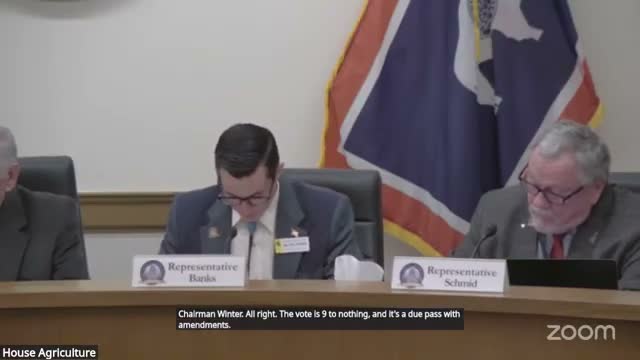
Representative Strzok introduced House Bill 116 as a measure to protect Wyoming's scarce water resources by declaring that destroying water molecules to produce hydrogen is not a beneficial use under state water law.
Brandon Gebhardt, State Engineer, told the committee that if the bill retains language declaring the practice "not a beneficial use," the State Engineer's Office would lack authority to permit that specific method of hydrogen production. "If that portion stays in, then we're not allowed to permit it under any circumstance as it's defined," Gebhardt said, and urged members to consider regional or water‑type exceptions if the committee does not intend to ban all hydrogen production methods.
Members and witnesses raised practical questions: whether currently planned hydrogen projects exist (Gebhardt said one project was in planning but not operational), how much water would be required for a viable facility (no precise figure in record), and whether produced or wastewater could still be used. Industry and farm interests supported protections for fresh water but urged clarification to preserve potential beneficial use of byproduct or brackish waters.
Petroleum and industry witnesses said many operators recycle produced water and suggested that allowing use of produced or recycled water could be valuable; Farm Bureau and other agricultural witnesses supported restrictions on using freshwater while noting potential opportunities with wastewater.
The committee agreed to ask the State Engineer's office to work with staff on amendments to clarify the bill's scope and treatment of produced/wastewater before House-floor consideration. The committee then voted 8–1 to report the bill (due pass); Representative Provenza said he voted no because the bill needs more study in Select Water Committee.
What happens next: Staff and the State Engineer will draft potential amendments clarifying regional exceptions and whether produced or brackish waters are treated differently; the bill proceeds to the House floor with committee direction to refine language.
Brandon Gebhardt, State Engineer, told the committee that if the bill retains language declaring the practice "not a beneficial use," the State Engineer's Office would lack authority to permit that specific method of hydrogen production. "If that portion stays in, then we're not allowed to permit it under any circumstance as it's defined," Gebhardt said, and urged members to consider regional or water‑type exceptions if the committee does not intend to ban all hydrogen production methods.
Members and witnesses raised practical questions: whether currently planned hydrogen projects exist (Gebhardt said one project was in planning but not operational), how much water would be required for a viable facility (no precise figure in record), and whether produced or wastewater could still be used. Industry and farm interests supported protections for fresh water but urged clarification to preserve potential beneficial use of byproduct or brackish waters.
Petroleum and industry witnesses said many operators recycle produced water and suggested that allowing use of produced or recycled water could be valuable; Farm Bureau and other agricultural witnesses supported restrictions on using freshwater while noting potential opportunities with wastewater.
The committee agreed to ask the State Engineer's office to work with staff on amendments to clarify the bill's scope and treatment of produced/wastewater before House-floor consideration. The committee then voted 8–1 to report the bill (due pass); Representative Provenza said he voted no because the bill needs more study in Select Water Committee.
What happens next: Staff and the State Engineer will draft potential amendments clarifying regional exceptions and whether produced or brackish waters are treated differently; the bill proceeds to the House floor with committee direction to refine language.
View the Full Meeting & All Its Details
This article offers just a summary. Unlock complete video, transcripts, and insights as a Founder Member.
✓
Watch full, unedited meeting videos
✓
Search every word spoken in unlimited transcripts
✓
AI summaries & real-time alerts (all government levels)
✓
Permanent access to expanding government content
30-day money-back guarantee
